PUBLISHER: Mordor Intelligence | PRODUCT CODE: 2072528

PUBLISHER: Mordor Intelligence | PRODUCT CODE: 2072528
India Travel Insurance - Market Share Analysis, Industry Trends & Statistics, Growth Forecasts (2026 - 2031)
According to Mordor Intelligence, the india travel insurance market size in terms of premium value is expected to increase from USD 1.17 billion in 2025 to USD 1.29 billion in 2026 and reach USD 2.12 billion by 2031, growing at a CAGR of 10.43% over 2026-2031.
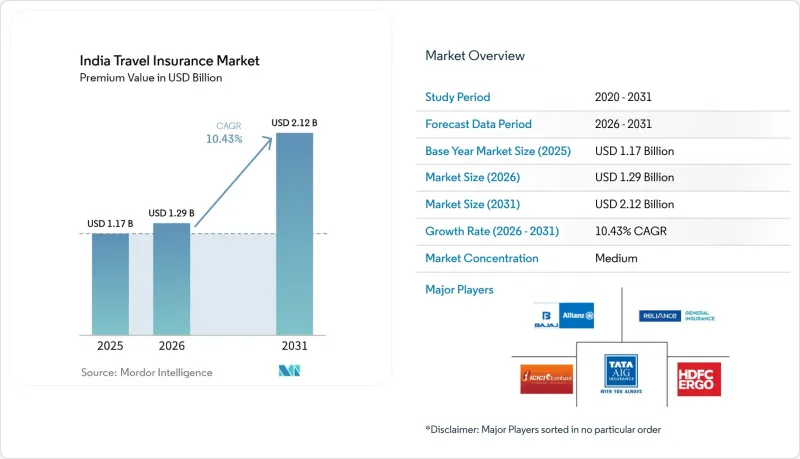
This report is Segmented by Coverage Type (Single-Trip Travel Insurance, Annual Multi-Trip Travel Insurance), End User (Senior Citizens, Education Travelers, Business Travelers, and More), and Distribution Channel (Insurance Intermediaries, Insurance Companies, Banks, and More). The Market Forecasts are Provided in Terms of Value (USD).
India Travel Insurance Market Trends and Insights
Post-COVID Rebound in Outbound Leisure & VFR Travel
Indian passport holders logged 15 million international departures in H1 2024, surpassing pre-pandemic baselines and reinforcing the upward trajectory of the India travel insurance market. Travelers now view insurance as indispensable infrastructure for medical contingencies, flight disruptions, and geopolitical risks that previously went uninsured. Corporate travel is forecast to hit USD 35 billion in 2025, intensifying demand for real-time claims support, emergency evacuation benefits, and pandemic-related covers. As risk awareness grows, insurers differentiate through value-added services like multilingual telemedicine and airport concierge assistance that resonate with seasoned travelers. The market's pivot from price competition to benefits-driven propositions positions comprehensive coverage as the new norm rather than a premium add-on.
Mandatory Visa Insurance Requirements Reshape Product Design
The Schengen area's USD 31,246.8 (EUR 30,000) minimum coverage rule has entrenched protection buying among Europe-bound Indians, effectively hard-coding travel insurance into the visa checklist. April 2024 brought multi-year Schengen visas that require renewal-aligned coverage, creating a predictable recurring revenue stream for insurers. Parallel mandates in Canada, Australia, and Gulf nations are widening this compliance-led customer funnel, encouraging insurers to craft modular, multi-destination policies that meet diverse embassy standards. Digital issuance and API-based validation now allow instant embassy-ready documents, trimming customer effort and boosting satisfaction. Aggregators benefit by funneling this captive demand through one-click purchase paths that elevate attach rates and lifetime value.
Low Awareness Among First-Time International Travellers Constrains Market Penetration
International travel is spreading into Tier-2/3 cities, yet insurance literacy lags among debut travelers who weigh policy premiums against perceived destination safety. Traditional mass-media campaigns rarely translate coverage features into relatable stories, leaving misconceptions unaddressed and leakage high. Local agents often push visa-compliant products without explaining post-departure benefits, limiting upsell to comprehensive covers. Aggregators have begun deploying vernacular explainer videos and influencer testimonials, but early results show modest conversion owing to digital trust gaps. Sustained growth, therefore, hinges on hyper-local education that links real-world anecdotes, such as medical emergencies abroad, to tangible financial outcomes.
Other drivers and restraints analyzed in the detailed report include:
- Growth of Digital Aggregators & OTA-Embedded Sales
- Rapid Rise in Senior-Citizen Cruise Tourism
- Complex & Time-Consuming Claims Settlement Undermines Confidence
For complete list of drivers and restraints, kindly check the Table Of Contents.
Segment Analysis
Single-trip policies held an 84.62% stake in the India travel insurance market in 2025, reflecting the nation's episodic travel culture anchored in leisure, VFR, and purpose-defined business journeys. Visa-aligned offerings and duration-flexible add-ons further cemented single-trip popularity among travelers who book well in advance and prefer tailor-made protection. Annual multi-trip products, however, are accelerating at a 10.74% CAGR, benefiting from corporate mobility, student exchanges, and the rise of "workations." The India travel insurance market size for the multi-trip segment is forecast to widen materially as insurers introduce auto-renewing plans and app-based trip activations that eliminate administrative friction.
Multi-trip holders exhibit higher insurance literacy and cross-buy propensity; students frequently add gadget covers, while business executives upgrade to higher medical limits. Digital dashboards enable customers to manage upcoming journeys, download embassy letters, and file claims, enhancing engagement loops that anchor loyalty. Insurers are using usage analytics to adjust pricing, rewarding low-risk frequent flyers with premium discounts that further tilt the value equation. As air connectivity densifies and visa-free corridors expand, the India travel insurance market will likely see a narrowing gap between single- and multi-trip penetration rates, especially within the urban affluent cohort.
Complete Report Scope:
- By Coverage Type
- Single-trip Travel Insurance
- Annual Multi-Trip Travel Insurance
- By End User
- Senior Citizens
- Education Travelers
- Business Travelers
- Family Travelers
- Other End-Users
- By Distribution Channel
- Insurance Intermediaries
- Insurance Companies
- Banks
- Insurance Brokers
- Insurance Aggregators
List of Companies Covered in this Report:
- ICICI Lombard General Insurance
- Tata AIG General Insurance
- HDFC ERGO General Insurance
- Bajaj Allianz General Insurance
- Reliance General Insurance
- SBI General Insurance
- Care Health Insurance
- Niva Bupa Health Insurance
- Bharti AXA General Insurance
- Cholamandalam MS General Insurance
- Future Generali India Insurance
- Royal Sundaram General Insurance
- Go Digit General Insurance
- ManipalCigna Health Insurance
- National Insurance Company
- New India Assurance
- Oriental Insurance
- United India Insurance
- Aditya Birla Health Insurance
- Edelweiss General Insurance
Additional Benefits:
- The market estimate (ME) sheet in Excel format
- 3 months of analyst support
TABLE OF CONTENTS
1 Introduction
- 1.1 Study Assumptions and Market Definition
- 1.2 Scope of the Study
2 Research Methodology
3 Executive Summary
4 Market Landscape
- 4.1 Market Overview
- 4.2 Market Drivers
- 4.2.1 Post-COVID rebound in outbound leisure and VFR travel
- 4.2.2 Mandatory insurance for Schengen and other visas
- 4.2.3 Growth of digital aggregators and OTA-embedded sales
- 4.2.4 Airline ticketing portals launching embedded cover
- 4.2.5 Rapid rise in senior-citizen cruise tourism
- 4.2.6 UPI-enabled pay-as-you-go micro-duration policies
- 4.3 Market Restraints
- 4.3.1 Low awareness among first-time international travellers
- 4.3.2 Complex and time-consuming claims settlement
- 4.3.3 Gaps in adventure-sports coverage hurt brand trust
- 4.3.4 RBI forex-card rules limiting bundled insurance add-ons
- 4.4 Value / Supply-Chain Analysis
- 4.5 Regulatory Landscape
- 4.6 Technological Outlook
- 4.7 Porter's Five Forces
- 4.7.1 Bargaining Power of Suppliers
- 4.7.2 Bargaining Power of Buyers
- 4.7.3 Threat of New Entrants
- 4.7.4 Threat of Substitutes
- 4.7.5 Competitive Rivalry
5 Market Size & Growth Forecasts (Value)
- 5.1 By Coverage Type
- 5.1.1 Single-trip Travel Insurance
- 5.1.2 Annual Multi-Trip Travel Insurance
- 5.2 By End User
- 5.2.1 Senior Citizens
- 5.2.2 Education Travelers
- 5.2.3 Business Travelers
- 5.2.4 Family Travelers
- 5.2.5 Other End-Users
- 5.3 By Distribution Channel
- 5.3.1 Insurance Intermediaries
- 5.3.2 Insurance Companies
- 5.3.3 Banks
- 5.3.4 Insurance Brokers
- 5.3.5 Insurance Aggregators
6 Competitive Landscape
- 6.1 Market Concentration
- 6.2 Strategic Moves
- 6.3 Market Share Analysis
- 6.4 Company Profiles (includes Global level Overview, Market level overview, Core Segments, Financials as available, Strategic Information, Market Rank/Share for key companies, Products & Services, and Recent Developments)
- 6.4.1 ICICI Lombard General Insurance
- 6.4.2 Tata AIG General Insurance
- 6.4.3 HDFC ERGO General Insurance
- 6.4.4 Bajaj Allianz General Insurance
- 6.4.5 Reliance General Insurance
- 6.4.6 SBI General Insurance
- 6.4.7 Care Health Insurance
- 6.4.8 Niva Bupa Health Insurance
- 6.4.9 Bharti AXA General Insurance
- 6.4.10 Cholamandalam MS General Insurance
- 6.4.11 Future Generali India Insurance
- 6.4.12 Royal Sundaram General Insurance
- 6.4.13 Go Digit General Insurance
- 6.4.14 ManipalCigna Health Insurance
- 6.4.15 National Insurance Company
- 6.4.16 New India Assurance
- 6.4.17 Oriental Insurance
- 6.4.18 United India Insurance
- 6.4.19 Aditya Birla Health Insurance
- 6.4.20 Edelweiss General Insurance
7 Market Opportunities and Future Outlook
- 7.1 White-space and Unmet-Need Assessment

