
PUBLISHER: Mordor Intelligence | PRODUCT CODE: 2061794

PUBLISHER: Mordor Intelligence | PRODUCT CODE: 2061794
Germany Heat Pump - Market Share Analysis, Industry Trends & Statistics, Growth Forecasts (2026 - 2031)
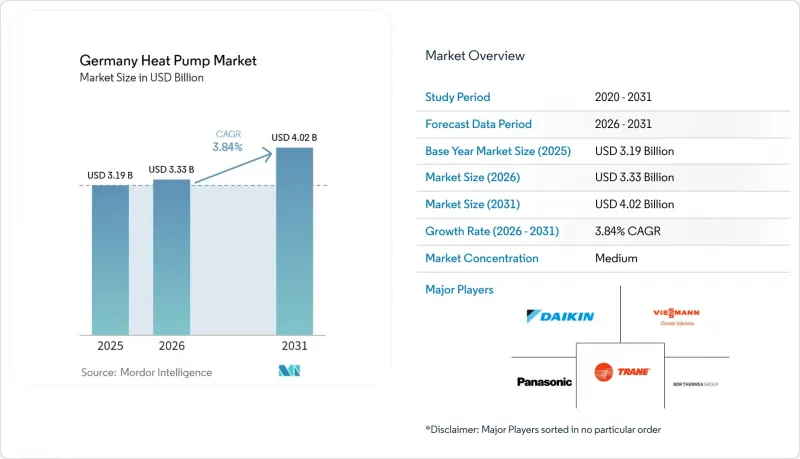
According to Mordor Intelligence, the germany heat pump market size is expected to increase from USD 3.19 billion in 2025 to USD 3.33 billion in 2026 and reach USD 4.02 billion by 2031, growing at a CAGR of 3.84% over 2026-2031.
This report is Segmented by Source Type (Air Source, Water Source, and More), Technology (Air-To-Air, Air-To-Water, and More), Capacity (Below 10 KW, 10-50 KW, and More), Application (Space Heating, Industrial and Process Heating, and More), End User (Residential, Commercial, and More), Installation (New Installation, and Retrofit), and Geography. The Market Forecasts are Provided in Terms of Value (USD).
Germany Heat Pump Market Trends and Insights
Robust Federal and State Subsidies, Tax-Credit Schemes
Germany's BEG program disbursed EUR 3.8 billion (USD 4.3 billion) in heat-pump grants during 2025, underwriting up to 70% of eligible costs for qualifying households. Payback periods compressed to four-to-six years, tipping the cost equation decisively away from gas boilers. State top-ups in Baden-Wurttemberg and Bavaria further sweeten the economics for ground-source and district-connected systems. Bundling incentives with building-envelope upgrades and rooftop photovoltaics can push combined subsidies past EUR 50,000 (USD 56,500) per project, a level that has spawned a consultancy niche to navigate the complex approval pipeline Although administrative friction remains, the magnitude and duration of the grant architecture underpin demand through the decade.
Rising Demand for High-Efficiency Heating and Cooling
Climate adaptation is now a mainstream buying trigger: dual-use units capable of cooling captured 38% of residential installs in 2026, up from 22% two years earlier. Southern states enduring heatwaves above 35 °C favor air-to-air models with seasonal performance factors over 4.5. Commercial buyers specify variable-speed compressors that slice peak load by nearly 30% while sharpening zone control. Propane-charged systems add another 8-12% efficiency lift versus R410A predecessors, satisfying ESG scorecards. Impending 2027 Ecodesign thresholds will lock these performance gains into regulatory minimums.
Stringent F-Gas and Safety Compliance Requirements
The 2027 ban on refrigerants with GWP above 150 forces a pivot to propane, classified as highly flammable, adding EUR 300-500 (USD 339-565) per unit in compliance outlays for safety features and installer certifications. Smaller OEMs lack the engineering depth to redesign quickly and are instead merging or exiting, narrowing consumer choice. Germany's occupational-safety authority mandates extra training and leak-detection gear, stretching installer capacity still further. Legacy R410A and R32 systems risk becoming orphaned as production quotas ratchet down, a prospect that dampens near-term retrofit demand. Until supply chains normalize around R290, compliance drag will shave momentum from the Germany heat pump market.
Other drivers and restraints analyzed in the detailed report include:
- EU Fit-for-55 Decarbonization Targets and Electrification Push
- Surge in Low-Noise Air-to-Air Heat Pumps for Multi-Family Retrofits
- Shortage of Certified Installers and HVAC Technicians
For complete list of drivers and restraints, kindly check the Table Of Contents.
Segment Analysis
Air-source units produced 67.78% of 2025 revenue in the Germany heat pump market, retaining pole position through a mix of moderate upfront cost and straightforward installation that suits most retrofit projects . Hybrids pairing an air-source module with a condensing gas boiler are forecast to deliver the fastest 5.61% annual growth, because they meet the 65% renewable-heat rule while insulating owners from potential electricity-price spikes. Water-source and ground-source solutions remain niche, yet the federal subsidy bonus for geothermal systems narrows the cost gap and is drawing interest from municipalities that need baseload heat for dense districts.
Hybrid momentum also reflects technological refinements: Vaillant's aroTHERM plus calibrates fuel switching in real time, while Daikin's flow-temperature boost to 70 °C removes the need for radiator changes in older homes. Policymakers amplify the trend by allowing dual-fuel systems to qualify for full BEG grants once the heat pump supplies two-thirds of annual load, effectively pushing legacy boilers into backup status. As a result, hybrids are expected to lift their Germany heat pump market share each year through 2031, even while pure air-source units keep dominating overall shipments.
Air-to-water systems controlled 59.31% of 2025 sales, underpinned by mature supply chains and installer familiarity. Yet ground-to-water units are projected to grow 5.02% per year, faster than the 3.84% aggregate, because drilling costs fall sharply when district-heating operators connect hundreds of buildings to a shared bore-field. Water-to-water designs occupy an industrial niche tied to process heat and swimming pools, whereas air-to-air splits are winning multi-family retrofits that need low-noise facade units.
Federal subsidies add five extra percentage points for geothermal systems that achieve seasonal performance factors above 4.0, bringing total support to as high as 70% of project cost. Hamburg's 4 MW air-source plant and Cologne's 150 MW geothermal contract exemplify how city utilities are scaling diverse technologies to decarbonize legacy steam networks. Incremental upgrades, such as Viessmann's R290 revision of its Vitocal line, help air-to-water incumbents defend share, but the longer-term upswing in district networks tilts incremental Germany heat pump market size toward ground-centric architectures.
List of Companies Covered in this Report:
- Daikin Industries Ltd.
- Viessmann Climate Solutions SE
- Panasonic Holdings Corporation
- Trane Technologies plc
- BDR Thermea Group B.V.
- Heliotherm GmbH
- Robert Bosch GmbH
- Systemair AB
- Ariston Holding N.V.
- Alpha Innotec GmbH
- Stiebel Eltron GmbH and Co. KG
- Glen Dimplex GmbH
- Johnson Controls International plc
- Vaillant Group
- Max Weishaupt GmbH
- Wolf GmbH
- Waterkotte GmbH
- Elco GmbH
- Mitsubishi Electric Corporation
- Qvantum Energi AB
Additional Benefits:
- The market estimate (ME) sheet in Excel format
- 3 months of analyst support
TABLE OF CONTENTS
1 INTRODUCTION
- 1.1 Study Assumptions and Market Definition
- 1.2 Scope of the Study
2 RESEARCH METHODOLOGY
3 EXECUTIVE SUMMARY
4 MARKET LANDSCAPE
- 4.1 Market Overview
- 4.2 Market Drivers
- 4.2.1 Robust Federal and State Subsidies, Tax-Credit Schemes
- 4.2.2 Rising Demand for High-Efficiency Heating and Cooling
- 4.2.3 EU Fit-for-55 Decarbonization Targets and Electrification Push
- 4.2.4 Surge in Low-Noise Air-to-Air Heat Pumps for Multi-Family Retrofits
- 4.2.5 Smart-Grid Demand-Response Incentives from German TSOs
- 4.2.6 EU Component Near-Shoring Driven by Supply-Chain Resilience Policies
- 4.3 Market Restraints
- 4.3.1 Stringent F-Gas and Safety Compliance Requirements
- 4.3.2 Shortage of Certified Installers and HVAC Technicians
- 4.3.3 Rural Distribution-Grid Congestion
- 4.3.4 Propane (R290) Refrigerant Supply Bottlenecks
- 4.4 Industry Value Chain Analysis
- 4.5 Regulatory Landscape
- 4.6 Technological Outlook
- 4.7 Porter's Five Forces Analysis
- 4.7.1 Bargaining Power of Suppliers
- 4.7.2 Bargaining Power of Buyers
- 4.7.3 Threat of New Entrants
- 4.7.4 Threat of Substitutes
- 4.7.5 Intensity of Competitive Rivalry
- 4.8 Impact of Macroeconomic Factors on the Market
5 MARKET SIZE AND GROWTH FORECASTS (VALUE)
- 5.1 By Source Type
- 5.1.1 Air Source
- 5.1.2 Water Source
- 5.1.3 Ground Source
- 5.1.4 Hybrid
- 5.2 By Technology
- 5.2.1 Air-to-Air
- 5.2.2 Air-to-Water
- 5.2.3 Water-to-Water
- 5.2.4 Ground-to-Water
- 5.3 By Capacity
- 5.3.1 Below 10 kW
- 5.3.2 10-50 kW
- 5.3.3 50-200 kW
- 5.3.4 Above 200 kW
- 5.4 By Application
- 5.4.1 Space Heating
- 5.4.2 Space Cooling
- 5.4.3 Domestic and Sanitary Hot Water
- 5.4.4 Industrial and Process Heating
- 5.4.5 Other Applications
- 5.5 By End User
- 5.5.1 Residential
- 5.5.2 Commercial
- 5.5.3 Industrial
- 5.6 By Installation
- 5.6.1 New Installation
- 5.6.2 Retrofit
6 COMPETITIVE LANDSCAPE
- 6.1 Market Concentration
- 6.2 Strategic Moves
- 6.3 Vendor Positioning Analysis
- 6.4 Company Profiles (includes Global Level Overview, Market Level Overview, Core Segments, Financials as available, Strategic Information, Market Rank/Share, Products and Services, Recent Developments)
- 6.4.1 Daikin Industries Ltd.
- 6.4.2 Viessmann Climate Solutions SE
- 6.4.3 Panasonic Holdings Corporation
- 6.4.4 Trane Technologies plc
- 6.4.5 BDR Thermea Group B.V.
- 6.4.6 Heliotherm GmbH
- 6.4.7 Robert Bosch GmbH
- 6.4.8 Systemair AB
- 6.4.9 Ariston Holding N.V.
- 6.4.10 Alpha Innotec GmbH
- 6.4.11 Stiebel Eltron GmbH and Co. KG
- 6.4.12 Glen Dimplex GmbH
- 6.4.13 Johnson Controls International plc
- 6.4.14 Vaillant Group
- 6.4.15 Max Weishaupt GmbH
- 6.4.16 Wolf GmbH
- 6.4.17 Waterkotte GmbH
- 6.4.18 Elco GmbH
- 6.4.19 Mitsubishi Electric Corporation
- 6.4.20 Qvantum Energi AB
7 MARKET OPPORTUNITIES AND FUTURE OUTLOOK
- 7.1 White-Space and Unmet-Need Assessment

