PUBLISHER: Mordor Intelligence | PRODUCT CODE: 2063309

PUBLISHER: Mordor Intelligence | PRODUCT CODE: 2063309
Spain Freight Brokerage Services - Market Share Analysis, Industry Trends & Statistics, Growth Forecasts (2026 - 2031)
According to Mordor Intelligence, the spain freight brokerage services market size was valued at USD 1.23 billion in 2025 and estimated to grow from USD 1.32 billion in 2026 to reach USD 1.85 billion by 2031, at a CAGR of 6.97% during the forecast period (2026-2031).
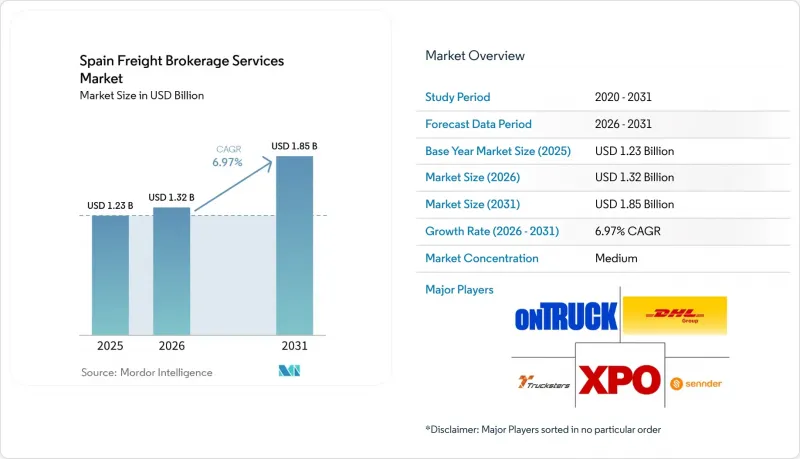
Digital-document mandates, automated warehouses, and expanding short-sea loops are reshaping competition, rewarding brokers that embed API-ready workflows and real-time capacity matching. This report is Segmented by Service (Full-Truckload, Less-Than-Truckload, Others), by Equipment/Trailer Type (Dry Van, Refrigerated Van, and More), by Haul Length (Long-Haul, Regional, Local), by Business Model (Traditional, and More), by End-User Industry (Manufacturing and More), and by Customer Size (Large Enterprise, and More). The Market Forecasts are Provided in Terms of Value (USD).
Spain Freight Brokerage Services Market Trends and Insights
Warehouse-Automation Race Amplifying Intra-Spain Same-Day Freight Needs
Automated storage and retrieval systems now shrink dwell time from days to hours, forcing shippers to secure outbound trucks inside 30-minute windows. Digital brokers that ingest warehouse-management signals via API and dispatch carriers in real time monetize this velocity premium. Zaragoza's PLAZA hub and Barcelona's Zona Franca concentrate robotics deployments, enabling profitable same-day moves for loads above 300 kg. Traditional call-center brokers lose share as shippers pivot toward platforms offering electronic proof-of-delivery and auto-billing. Same-day expectations ripple across retail, pharma, and high-tech verticals, driving double-digit order growth for time-definite lanes.
Mandatory E-Freight Documents Accelerating Platform Uptake
Spain's "Ley Crea y Crece" enforces e-invoices in B2B trade, and the EU eCMR framework digitizes consignment notes for cross-border trips. Platform brokers hard-wire both requirements, letting shippers auto-generate compliant paperwork inside their TMS. Adoption already tops 40% of carrier trips on France and Portugal corridors, versus 15% on purely domestic lanes. Compliance convenience is tipping mid-market exporters toward digital vendors, boosting onboarding rates by triple digits year over year. Paper-based operators face integration costs that erode margins and delay invoice cycles, widening the performance gap.
NIS-2 Cybersecurity Compliance Raising Operating Costs for Digital Brokers
By October 2024, digital freight platforms classified as essential will file 24-hour breach reports and undergo yearly audits or risk fines of up to EUR 10 million (USD 11.7 million). Mid-size brokers must allocate EUR 200,000-500,000 (USD 23,508-58,770) annually for SOC tools, penetration testing, and staff training. These outlays accelerate consolidation as smaller entrants sell portfolios to capital-rich rivals. Traditional phone-based firms stay outside the directive's scope yet lose customers seeking full digital visibility. The compliance burden, therefore, reshapes market structure even while slowing overall growth.
Other drivers and restraints analyzed in the detailed report include:
- EU Green-Logistics and Digital-Corridor Funding
- Growth of Spain-Maghreb Short-Sea Loops Creating First/Last-Mile Brokerage Opportunities
- Pending 2026-2027 National Road-User Charge Debate Creating Tariff Uncertainty
For complete list of drivers and restraints, kindly check the Table Of Contents.
Segment Analysis
Full-truckload shipments dominated with 63.29% of the Spain freight brokerage services market share in 2025, as large exporters still prefer direct point-to-point moves that simplify border transit. At the same time, less-than-truckload volumes are growing at an 8.76% CAGR because warehouse automation and omnichannel retail break orders into sub-pallet consignments. Digital route-building engines lower per-stop costs, making multi-drop tours viable on dense Madrid-Barcelona-Valencia lanes.
Rapid LTL uptake is diversifying the Spain freight brokerage services market. Brokers able to merge partial loads into full trailers capture higher revenue per mile while offering shippers carbon-efficient options. FTL brokers respond by launching hybrid services that guarantee a base trailer but monetize unused floor space through spot inserts, blurring traditional segment boundaries.
Refrigerated vans held 48.39% of the Spain freight brokerage services market size in 2025, and will expand at a 9.60% CAGR as Spain's fruit, veg, and vaccine exports require tight temperature control. Electric self-charging reefers introduced in 2025 cut diesel genset use and unlock urban low-emission zones, attracting premium payloads from pharma and grocery chains. Dry-van boxes remain essential for consumer staples but grow more slowly, while tankers and flatbeds cycle with chemicals and construction output.
Within the Spain freight brokerage services market size, cold-chain lanes exhibit the lowest price elasticity, letting brokers pass on fuel surcharges without losing share. Those managing validated GDP lanes add analytics on temperature excursions, creating stickiness with life-science customers. As produce seasonality shifts, brokers redeploy reefers into frozen seafood and confectionery, smoothing asset utilization year-round.
List of Companies Covered in this Report:
- Ontruck
- Trucksters
- Sennder
- DHL Group
- XPO Inc.
- Kuehne+Nagel
- DSV A/S
- Clicktrans
- Emo Trans
- Carmovia
- Logista Freight
- Arola Logistics
- Noatum Logistics
- GEODIS
- Rhenus Logistics
- Cargobot
- NYK Line (Including Yusen Logistics)
- Scan Global Logistics
- Grupo Moldtrans
- Tennders
Additional Benefits:
- The market estimate (ME) sheet in Excel format
- 3 months of analyst support
TABLE OF CONTENTS
1 Introduction
- 1.1 Study Assumptions and Market Definition
- 1.2 Scope of the Study
2 Research Methodology
3 Executive Summary
4 Market Landscape
- 4.1 Market Overview
- 4.2 Market Drivers
- 4.2.1 Warehouse-Automation Race Amplifying Intra-Spain Same-Day Freight Needs
- 4.2.2 Mandatory E-Freight Documents (Ecmr and "Ley Crea Y Crece" E-Invoice) Accelerating Platform Uptake
- 4.2.3 ETS-2 Carbon Pricing on Road Transport Boosting Demand for Load-Consolidation Algorithms
- 4.2.4 Growth of Spain-Maghreb Short-Sea Loops Creating First/Last-Mile Brokerage Opportunities
- 4.2.5 Hydrogen Corridor (H2Med and Spanish H2-Valleys) Spurring Early Green-Lane Brokerage Products
- 4.2.6 AI-Driven Public-Private Logistics Data Space Enabling Real-Time Multimodal Booking APIs
- 4.3 Market Restraints
- 4.3.1 NIS-2 Cyber-Security Compliance Raising Operating Costs for Digital Brokers
- 4.3.2 Pending 2026-2027 National Road-User Charge Debate Creating Tariff Uncertainty
- 4.3.3 OEM-Captive Logistics and Retailer Insourcing Shrinking Accessible Spot Volumes
- 4.3.4 Persistent Equipment Imbalance at Iberian Ports Disrupting Back-Haul Availability
- 4.4 Value / Supply-Chain Analysis
- 4.5 Regulatory Landscape
- 4.6 Technological Outlook
- 4.7 Porter's Five Forces Analysis
- 4.7.1 Bargaining Power of Buyers
- 4.7.2 Bargaining Power of Suppliers
- 4.7.3 Threat of New Entrants
- 4.7.4 Threat of Substitutes
- 4.7.5 Competitive Rivalry
5 Market Size and Growth Forecasts
- 5.1 By Service
- 5.1.1 Full-Truckload (FTL)
- 5.1.2 Less-than-Truckload (LTL)
- 5.1.3 Others
- 5.2 By Equipment / Trailer Type
- 5.2.1 Dry Van
- 5.2.2 Refrigerated Van
- 5.2.3 Flatbed / Step-Deck
- 5.2.4 Tanker (Bulk Liquid and Chemical)
- 5.2.5 Others
- 5.3 By Haul Length
- 5.3.1 Long-Haul (More than 500 miles)
- 5.3.2 Regional (100-500 miles)
- 5.3.3 Local (Less than 100 miles)
- 5.4 By Business Model
- 5.4.1 Traditional Freight Brokerage
- 5.4.2 Asset-Based Freight Brokerage
- 5.4.3 Agent Model Freight Brokerage
- 5.4.4 Digital Freight Brokerage
- 5.5 By End-User Industry
- 5.5.1 Manufacturing and Automotive
- 5.5.2 Construction and Infrastructure Projects
- 5.5.3 Oil, Gas, Mining and Chemicals
- 5.5.4 Agriculture and Food / Beverage
- 5.5.5 Retail, FMCG and Wholesale Distribution
- 5.5.6 Healthcare and Pharmaceuticals
- 5.5.7 E-commerce and 3PL Fulfilment
- 5.5.8 Others
- 5.6 By Customer Size
- 5.6.1 Large Enterprise Shippers (More than USD 100 M)
- 5.6.2 Mid-Market Shippers (USD 10-100 M)
- 5.6.3 Small Businesses (Less than USD 10 M)
6 Competitive Landscape
- 6.1 Market Concentration
- 6.2 Strategic Moves
- 6.3 Market Share Analysis
- 6.4 Company Profiles (Includes Global Level Overview, Market Level Overview, Core Segments, Financials as Available, Strategic Information, Market Rank/Share for Key Companies, Products and Services, and Recent Developments)
- 6.4.1 Ontruck
- 6.4.2 Trucksters
- 6.4.3 Sennder
- 6.4.4 DHL Group
- 6.4.5 XPO Inc.
- 6.4.6 Kuehne+Nagel
- 6.4.7 DSV A/S
- 6.4.8 Clicktrans
- 6.4.9 Emo Trans
- 6.4.10 Carmovia
- 6.4.11 Logista Freight
- 6.4.12 Arola Logistics
- 6.4.13 Noatum Logistics
- 6.4.14 GEODIS
- 6.4.15 Rhenus Logistics
- 6.4.16 Cargobot
- 6.4.17 NYK Line (Including Yusen Logistics)
- 6.4.18 Scan Global Logistics
- 6.4.19 Grupo Moldtrans
- 6.4.20 Tennders
7 Market Opportunities and Future Outlook
- 7.1 White-space and Unmet-need Assessment

