PUBLISHER: Mordor Intelligence | PRODUCT CODE: 2063418

PUBLISHER: Mordor Intelligence | PRODUCT CODE: 2063418
South America Travel Retail - Market Share Analysis, Industry Trends & Statistics, Growth Forecasts (2026 - 2031)
According to Mordor Intelligence, the south america travel retail market size is expected to grow from USD 1.23 billion in 2025 to USD 1.34 billion in 2026 and is forecast to reach USD 2.01 billion by 2031 at 8.50% CAGR over 2026-2031, signalling a recovery path supported by returning passenger volumes and structural upgrades in airport commercial zones.
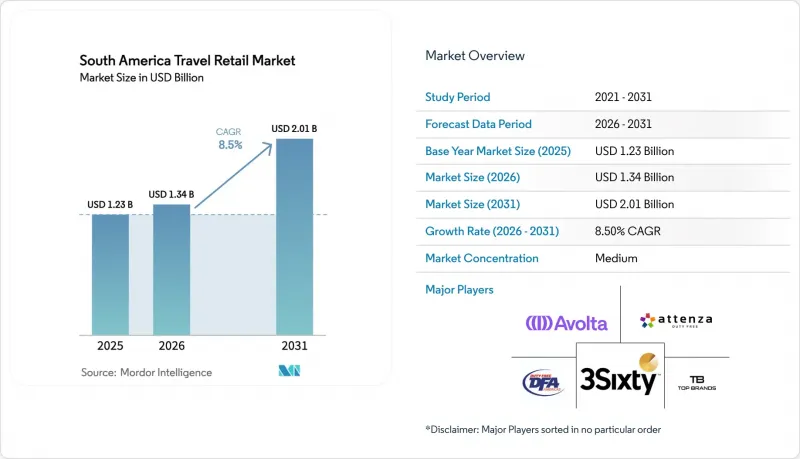
This report is Segmented by Product Type (Perfumes & Cosmetics, Wines & Spirits, Tobacco, Fashion & Accessories, Confectionery & Fine Foods, Watches & Jewelry, Electronics & Gadgets, Local Artisanal & Destination Goods), Distribution Channel (Airports, Airlines Inflight Retail, and More), and Geography (Mexico, Brazil, and More). The Market Forecasts are Provided in Terms of Value (USD).
South America Travel Retail Market Trends and Insights
Air Passenger Recovery and Connectivity Expansion
Regional passenger volumes reached 477.3 million in 2025, a 3.8% year-on-year increase that restored critical footfall for airside retailers and set a favorable base for the South America travel retail market. . Colombia's aviation system continued to scale on a multiyear investment track, which supports sustained traffic gains that translate to higher retail capture in major hubs and secondary cities. The recovery in intra-regional connectivity is improving assortment relevance because route mix and traveler profiles are stabilizing, which allows operators to sharpen curation across beauty, spirits, and destination goods in the South America travel retail market. Airport and airline standardization initiatives elevate the importance of data sharing and slot management, which in turn helps smooth passenger flows through commercial areas and raises the effective window for conversion. The combination of improved traffic, better schedule reliability, and targeted merchandising forms a self-reinforcing cycle that sustains growth in the South America travel retail market as operators align staffing and inventory to peak periods.
Airport Infrastructure Expansion (New Terminals, Concessions)
Airports in Chile, Colombia, Mexico, and Peru are executing large capital programs that expand gates and commercial zones, which directly raises the ceiling for revenue capture per passenger in the South America travel retail market. Santiago's Terminal 2 overhaul has already doubled capacity with modernized passenger flows, and a newly awarded 12-year duty-free concession will activate a larger retail footprint from 2026 . Bogota's expansion is designed to lift terminal capacity and add significant commercial space, which encourages multi-format store strategies tailored to international and domestic flows within the South America travel retail market . Lima's flagship redevelopment includes extensive retail and dining zones that are being deployed in phases, which aligns space activation with traffic milestones and operator ramp-up in the South America travel retail market. Across these projects, concession frameworks are increasingly guided by global best practices that link investment commitment, risk-sharing mechanisms, and service-level obligations to passenger delivery and commercial performance.
FX Volatility Eroding Price Advantage and Basket Size
Foreign-exchange swings reduce perceived discounts when travelers convert USD-denominated prices into local currencies, which can delay or downsize purchases in the South America travel retail market. Currency instability in Argentina and policy transitions heightened sensitivity to imported goods pricing, which affects core categories such as premium beauty and spirits. Card-spend data show mixed discretionary trends across large markets during 2025, which underscores the need for targeted offers rather than broad markdowns to defend average ticket sizes in the South America travel retail market. Operators use loyalty currencies and payment flexibility to cushion exchange-rate shocks and to sustain engagement during adverse FX cycles, which spread risk across journeys and channels. Regional currency performance in 2025 benefited partly from global USD dynamics rather than fundamental local improvements, which suggests the South America travel retail market remains exposed to renewed volatility.
Other drivers and restraints analyzed in the detailed report include:
- Omnichannel Adoption (Reserve & Collect, AR Try-On, Airline Pre-Order)
- Cruise Deployment Growth Benefiting South America Ports & Onboard Retail
- Tobacco Regulation Tightening Risk to Category Sales
For complete list of drivers and restraints, kindly check the Table Of Contents.
Segment Analysis
Perfumes & Cosmetics accounted for 46% of the South America travel retail market share in 2025, which confirms beauty's anchor role in walkthrough designs and assortment planning across leading airports. Operators are pairing flagship counters and personalized services with travel-exclusive sets to lift engagement, which strengthens category resilience during currency volatility in the South America travel retail market. Beauty activations in major hubs are complemented by loyalty-linked offers that boost conversion among frequent flyers, which extends the category's lead over other segments. Prestige fragrance and skincare continue to attract a wide traveler base that spans genders and age cohorts, which keeps unit economics favorable relative to space allocation in the South America travel retail market. The South America travel retail industry is also expanding into adjacent beauty accessories and devices to diversify baskets while protecting price positioning against domestic retail.
Fashion & Accessories is gaining momentum and is projected to post a 9.05% CAGR in 2026-2031 through curated boutiques and designer-led activations that target millennial and Gen Z travelers, which makes it a priority for incremental space allocation in upcoming terminal programs. Category diversification includes watches, jewelry, and travel essentials that complement beauty and spirits gifting, which creates more balanced baskets in the South America travel retail market. Wines & Spirits continue to benefit from premiumization, and cruise-led learning on assortment and brand storytelling is migrating into airport formats that target high-value shoppers. Tobacco's role has moderated due to regulatory tightening, which nudges operators to emphasize beauty, confectionery, and destination goods that face fewer policy constraints in the South America travel retail market. The South America travel retail industry relies on beauty as a stabilizer while scaling fashion and accessories as the next major growth layer, supported by loyalty and experiential retail.
List of Companies Covered in this Report:
- Avolta AG (Dufry)
- Duty Free Americas
- Motta Internacional (Attenza Duty Free)
- Top Brands International (Luryx
- Neutral by Luryx)
- Lagardere Travel Retail
- 3Sixty Duty Free
- London Supply Group (Duty Free Shop Puerto Iguazu)
- Sineriz Free Shop
- Cellshop Duty Free
- Shopping China Importados
- BCN Duty Free (Colon Free Zone)
- Heinemann Americas
- Starboard Cruise Services
- Harding+
- Retail Services (Peru/Brazil)
- HKG Duty Free (Mexico)
- Attenza (brand of Motta)
- Aelia Duty Free (Lagardere)
- Duty Free LATAM
- Barao Free Shop (Brazil)
Additional Benefits:
- The market estimate (ME) sheet in Excel format
- 3 months of analyst support
TABLE OF CONTENTS
1 Introduction
- 1.1 Study Assumptions & Market Definition
- 1.2 Scope of the Study
2 Research Methodology
3 Executive Summary
4 Market Landscape
- 4.1 Market Overview
- 4.2 Market Drivers
- 4.2.1 Air passenger recovery and connectivity expansion
- 4.2.2 Airport infrastructure expansion (new terminals, concessions)
- 4.2.3 Omnichannel adoption (reserve & collect, AR try-on, airline pre-order)
- 4.2.4 Perfumes & cosmetics demand strength in South America travel retail
- 4.2.5 Brazil land-border free shop regime maturation
- 4.2.6 Cruise deployment growth benefiting South America ports & onboard retail
- 4.3 Market Restraints
- 4.3.1 FX volatility is eroding the price advantage and the basket size
- 4.3.2 MAG/concession economics pressure during demand shocks
- 4.3.3 Mexico City slot caps and bilateral disputes are constraining capacity
- 4.3.4 Tobacco regulation tightening risks to category sales
- 4.4 Value / Supply-Chain Analysis
- 4.5 Regulatory Landscape
- 4.6 Technological Outlook
- 4.7 Porter's Five Forces
- 4.7.1 Threat of New Entrants
- 4.7.2 Bargaining Power of Suppliers
- 4.7.3 Bargaining Power of Buyers
- 4.7.4 Threat of Substitutes
- 4.7.5 Industry Rivalry
- 4.8 Passenger Traffic Trends & Capacity Outlook
- 4.9 Cruise Channel & Seaport Development Outlook
5 Market Size & Growth Forecasts (Value, USD)
- 5.1 By Product Type
- 5.1.1 Perfumes & Cosmetics
- 5.1.2 Wines & Spirits
- 5.1.3 Tobacco
- 5.1.4 Fashion & Accessories
- 5.1.5 Confectionery & Fine Foods
- 5.1.6 Watches & Jewelry
- 5.1.7 Electronics & Gadgets
- 5.1.8 Local Artisanal & Destination Goods
- 5.2 By Distribution Channel
- 5.2.1 Airports
- 5.2.2 Airlines (Inflight Retail)
- 5.2.3 Border Stores (Land)
- 5.2.4 Cruise & Seaports
- 5.2.5 Downtown & Hotel Shops
- 5.2.6 Online Pre-order & Click-and-Collect
- 5.3 By Geography
- 5.3.1 Mexico
- 5.3.2 Brazil
- 5.3.3 Argentina
- 5.3.4 Chile
- 5.3.5 Colombia
- 5.3.6 Peru
- 5.3.7 Rest of South America
6 Competitive Landscape
- 6.1 Market Concentration
- 6.2 Strategic Moves
- 6.3 Market Share Analysis
- 6.4 Company Profiles {(includes Global level Overview, Market level overview, Core Segments, Financials as available, Strategic Information, Market Rank/Share for key companies, Products & Services, and Recent Developments)}
- 6.4.1 Avolta AG (Dufry)
- 6.4.2 Duty Free Americas
- 6.4.3 Motta Internacional (Attenza Duty Free)
- 6.4.4 Top Brands International (Luryx; Neutral by Luryx)
- 6.4.5 Lagardere Travel Retail
- 6.4.6 3Sixty Duty Free
- 6.4.7 London Supply Group (Duty Free Shop Puerto Iguazu)
- 6.4.8 Sineriz Free Shop
- 6.4.9 Cellshop Duty Free
- 6.4.10 Shopping China Importados
- 6.4.11 BCN Duty Free (Colon Free Zone)
- 6.4.12 Heinemann Americas
- 6.4.13 Starboard Cruise Services
- 6.4.14 Harding+
- 6.4.15 Retail Services (Peru/Brazil)
- 6.4.16 HKG Duty Free (Mexico)
- 6.4.17 Attenza (brand of Motta)
- 6.4.18 Aelia Duty Free (Lagardere)
- 6.4.19 Duty Free LATAM
- 6.4.20 Barao Free Shop (Brazil)
7 Market Opportunities & Future Outlook
- 7.1 White-space & unmet-need assessment

