PUBLISHER: Mordor Intelligence | PRODUCT CODE: 2124666

PUBLISHER: Mordor Intelligence | PRODUCT CODE: 2124666
Singapore Travel Retail - Market Share Analysis, Industry Trends & Statistics, Growth Forecasts (2026 - 2031)
According to Mordor Intelligence, the Singapore travel retail market size is projected to expand from USD 264.08 million in 2025 and USD 288.20 million in 2026 to USD 446.10 million by 2031, registering a CAGR of 9.13% between 2026 to 2031.
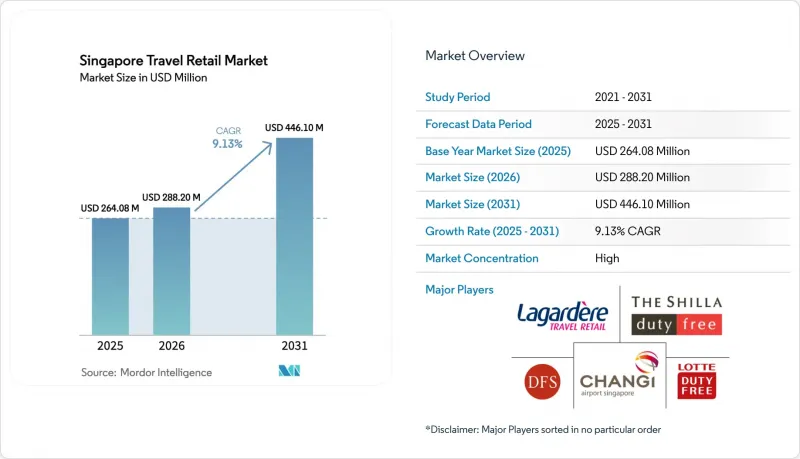
This report is Segmented by Product Type (Fashion & Accessories, Jewelry & Watches, Wines & Spirits, Food & Confectionery, Cosmetics & Fragrances, and More), Distribution Channel (Airports, Airlines, Ferries, and Other Channels), and Geography (Central Region, East Region, North Region, North-East Region, and West Region). The Market Forecasts are Provided in Terms of Value (USD).
Singapore Travel Retail Market Trends and Insights
Experiential "Retail-tainment" Strategies Boosting Spend-Per-Passenger
Immersive activations across Changi and Jewel focus on turning dwell time into high-value purchases with multi-sensory formats and exclusive premieres. L'Oreal Travel Retail Asia Pacific's "Beauty Shopper-tainment of the Future" and wide-scale, multi-terminal brand experiences illustrated how activation breadth increases reach and strengthens conversion among international travelers moving through multiple terminals. SkinCeuticals' first global travel retail presence at Terminal 3 introduces professional-grade skincare diagnostics into the airport setting, aligning premium skincare with unhurried transit moments that encourage consultation-led purchasing. Stronger spending intensity per traveler supports these high-end, experiential concepts even as overall visitor volumes continue to normalize. The East Region's integrated retail ecosystem, led by Jewel, reinforces this dynamic through rising footfall and improving sales productivity. The Singapore travel retail market benefits from a flywheel where each high-profile activation reinforces brand discovery, compounding returns as passengers circulate across terminals and the Jewel precinct.
Omni-Channel Pre-Order & Click-and-Collect Adoption at Changi
Omnichannel pre-order and click-and-collect capabilities at Changi are a structural growth driver for the Singapore travel retail market, as they redefine when and how consumers engage with duty-free shopping. By shifting purchase decisions upstream to the planning phase of a journey, retailers capture intent earlier and reduce reliance on in-terminal impulse alone. The ability to serve both travelers and non-travelers through digital storefronts keeps assortments visible year-round rather than limited to airport dwell time. A fully integrated digital ecosystem aligns inventory, pricing, promotions, and content across physical and online channels, improving execution efficiency and minimizing lost sales from stockouts. Loyalty programs and data-enabled partnerships allow targeted engagement based on travel behavior, increasing conversion and basket size. Convenience, certainty of availability, and frictionless fulfillment strengthen consumer trust, particularly in premium beauty and liquor categories. Together, these omnichannel mechanics expand the effective selling window around each trip and create a more stable, scalable demand engine for travel retail.
China Price Convergence Eroding Singapore's Duty-Free Advantage
Regional price differentials have narrowed as offshore duty-free zones in China and upgraded airport retail offer competitive pricing and expanded allowances, reducing pure price-led arbitrage for mass prestige SKUs. This shift drives Singapore operators to emphasize exclusive products, early launches, and experiential formats that preserve differentiation when baseline prices converge. The Singapore travel retail market's response is to focus on scarcity value and curated assortments that are difficult to replicate elsewhere, while amplifying the omnichannel pre-order model to lock in intent earlier in the journey. Singapore's diversified source market mix, which includes China as a top visitation source in 2024, helps sustain category traffic even as relative price advantages ease. The net effect is a compositional shift from volume-driven cosmetics toward niche beauty, prestige spirits, and exclusive editions that better withstand price-based competition.
Other drivers and restraints analyzed in the detailed report include:
- Cruise-Terminal Expansion Unlocking Non-Airport Duty-Free Traffic
- GST Hike Pull-Forward of High-Ticket Purchases
- Anti-Daigou Enforcement Limiting Bulk Buys
For complete list of drivers and restraints, kindly check the Table Of Contents.
Segment Analysis
Cosmetics & Fragrances commands 42.24% of the Singapore travel retail market share in 2025, while Wines & Spirits is projected as the fastest-growing category at an 8.11% CAGR through 2031. This divergence is driven by rising interest in niche fragrances and advanced skincare concepts that thrive on airport-led discovery and consultation, lifting spend per passenger even as visitor volumes continue to normalize. Changi Airport and Jewel reinforce beauty's role as a first-look channel through exclusive launches and immersive counters, including professional-grade skincare formats that translate engagement into higher-value baskets.
The strong outlook for wines and spirits is underpinned by premiumization, curated assortments, and limited-edition offerings that appeal to travelers seeking rarity and storytelling rather than price arbitrage. Omnichannel previews and pre-travel engagement further support intent-building ahead of departure, enhancing conversion at the airport. Food and confectionery operators are increasingly emphasizing quality, provenance, and trusted labeling to appeal to discerning international travelers, while tobacco faces structural constraints from strict regulatory policies. As a result, space and investment continue to shift toward high-margin beauty and prestige spirits, with slower categories refined to protect overall profitability.
Complete Report Scope:
- By Product Type
- Fashion & Accessories
- Jewelry & Watches
- Wines & Spirits
- Food & Confectionery
- Cosmetics & Fragrances
- Tobacco
- Other Product Types (Stationery, Electronics, etc.)
- By Distribution Channel
- Airports
- Airlines
- Ferries
- Other Channels (Railway Stations, Border Shops, Downtown)
- By Geography
- Central Region
- East Region
- North Region
- North-East Region
- West Region
List of Companies Covered in this Report:
- The Shilla Duty Free
- Ever Rich Duty Free
- Heinemann Asia Pacific
- Moet Hennessy Travel Retail
- L'Oreal Travel Retail APAC
- 3Sixty Duty Free
- Aer Rianta International (ARI Singapore)
- The Nuance Group Singapore
- Watsons Personal Care Stores
- Guardian Health & Beauty Singapore
- SMI Retail
- Lotte Duty Free
- DFASS (Singapore)
- DFS Group / DFS Venture Singapore
- Changi Airport Group (iShopChangi)
- Lagardere Travel Retail
- Gebr. Heinemann SE & Co. KG
- Dufry AG / Dufry Singapore
- King Power International
- Duty Free Americas Inc.
Additional Benefits:
- The market estimate (ME) sheet in Excel format
- 3 months of analyst support
TABLE OF CONTENTS
1 Introduction
- 1.1 Study Assumptions & Market Definition
- 1.2 Scope of the Study
2 Research Methodology
3 Executive Summary
4 Market Landscape
- 4.1 Market Overview
- 4.2 Market Drivers
- 4.2.1 Experiential "Retail-Tainment" Strategies Boosting Spend-Per-Passenger
- 4.2.2 Omni-Channel Pre-Order & Click-And-Collect Adoption At Changi
- 4.2.3 Surge In Premium Beauty & Niche Perfume Demand From Gen-Z Tourists
- 4.2.4 Cruise-Terminal Expansion Unlocking Non-Airport Duty-Free Traffic
- 4.2.5 Gst Hike Pull-Forward of High-Ticket Purchases
- 4.2.6 Pentarchy Data-Sharing (Airline-Airport-Brand-Retailer-Media) Lifting Conversions
- 4.3 Market Restraints
- 4.3.1 China Price Convergence Eroding Singapore's Duty-Free Advantage
- 4.3.2 Anti-Daigou Enforcement Limiting Bulk Buys
- 4.3.3 Rising Concession & Manpower Costs
- 4.3.4 Health-Driven Curbs on Tobacco & Alcohol Allowances
- 4.4 Value / Supply-Chain Analysis
- 4.5 Regulatory Landscape
- 4.6 Technological Outlook
- 4.7 Porter's Five Forces
- 4.7.1 Threat of New Entrants
- 4.7.2 Bargaining Power of Buyers
- 4.7.3 Bargaining Power of Suppliers
- 4.7.4 Threat of Substitutes
- 4.7.5 Competitive Rivalry
- 4.8 Duty & GST Allowance Framework Analysis
5 Market Size & Growth Forecasts (Value)
- 5.1 By Product Type
- 5.1.1 Fashion & Accessories
- 5.1.2 Jewelry & Watches
- 5.1.3 Wines & Spirits
- 5.1.4 Food & Confectionery
- 5.1.5 Cosmetics & Fragrances
- 5.1.6 Tobacco
- 5.1.7 Other Product Types (Stationery, Electronics, etc.)
- 5.2 By Distribution Channel
- 5.2.1 Airports
- 5.2.2 Airlines
- 5.2.3 Ferries
- 5.2.4 Other Channels (Railway Stations, Border Shops, Downtown)
- 5.3 By Geography
- 5.3.1 Central Region
- 5.3.2 East Region
- 5.3.3 North Region
- 5.3.4 North-East Region
- 5.3.5 West Region
6 Competitive Landscape
- 6.1 Market Concentration
- 6.2 Strategic Moves
- 6.3 Market Share Analysis
- 6.4 Company Profiles (includes Global level Overview, Market level overview, Core Segments, Financials as available, Strategic Information, Market Rank/Share for key companies, Products & Services, and Recent Developments)
- 6.4.1 The Shilla Duty Free
- 6.4.2 Ever Rich Duty Free
- 6.4.3 Heinemann Asia Pacific
- 6.4.4 Moet Hennessy Travel Retail
- 6.4.5 L'Oreal Travel Retail APAC
- 6.4.6 3Sixty Duty Free
- 6.4.7 Aer Rianta International (ARI Singapore)
- 6.4.8 The Nuance Group Singapore
- 6.4.9 Watsons Personal Care Stores
- 6.4.10 Guardian Health & Beauty Singapore
- 6.4.11 SMI Retail
- 6.4.12 Lotte Duty Free
- 6.4.13 DFASS (Singapore)
- 6.4.14 DFS Group / DFS Venture Singapore
- 6.4.15 Changi Airport Group (iShopChangi)
- 6.4.16 Lagardere Travel Retail
- 6.4.17 Gebr. Heinemann SE & Co. KG
- 6.4.18 Dufry AG / Dufry Singapore
- 6.4.19 King Power International
- 6.4.20 Duty Free Americas Inc.
7 Market Opportunities & Future Outlook
- 7.1 White-space & Unmet-Need Assessment

