PUBLISHER: Mordor Intelligence | PRODUCT CODE: 2124680

PUBLISHER: Mordor Intelligence | PRODUCT CODE: 2124680
Thailand Travel Retail - Market Share Analysis, Industry Trends & Statistics, Growth Forecasts (2026 - 2031)
According to Mordor Intelligence, the Thailand travel retail market size was valued at USD 3.28 billion in 2025 and is estimated to grow from USD 3.62 billion in 2026 to reach USD 5.84 billion by 2031, at a CAGR of 10.02% during the forecast period (2026-2031).
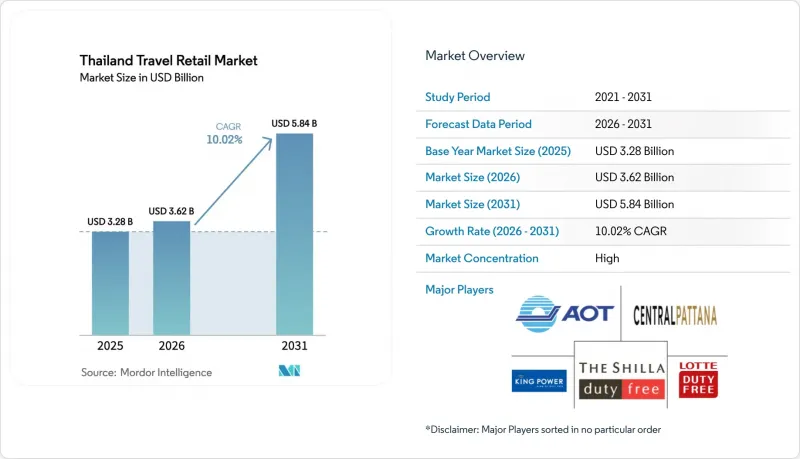
This report is Segmented by Product Type (Fashion & Accessories, Jewelry & Watches, Wines & Spirits, Food & Confectionery, Cosmetics & Fragrances, Tobacco, and Other Product Types), Distribution Channel (Airports, Airlines, Ferries, and Other Channels), and Geography (Central, Northern, Northeastern, Eastern, Western, and Southern Thailand). Market Forecasts are Provided in Terms of Value (USD).
Thailand Travel Retail Market Trends and Insights
Tourism Rebound Post-Pandemic & Tourist-Visa Liberalisation
Thailand's visa policies have been a clear tailwind since 2024, including the mutual visa-free arrangement with China that took effect in March 2024 and broader visa measures to support source-market recovery. Total international arrivals in 2025 remained in a stabilized range, with changes in source-market mix that elevate the share of long-haul and high-spending visitors for the Thailand travel retail market. The performance of the Thailand travel retail market is increasingly tied to dwell time and ticket size, which tend to be higher for independent travelers planning pre-orders and luxury purchases. Digital payment readiness, including cross-border QR interoperability, reduces frictions at checkout and helps the Thailand travel retail market convert intent into transactions more consistently.
Airport Capacity Expansion (Suvarnabhumi East, Don Mueang T3, Phuket)
Airports of Thailand is executing a multi-year capacity program that raises long-run passenger throughput and the platform's ability to capture non-aeronautical revenue, with upgrades at Bangkok's dual-airport system and in Phuket backed by defined timelines. Non-aeronautical revenue already accounts for a material share of AOT's total revenue, reinforcing the strategic role of commercial yield management in the Thailand travel retail market. Expansion phases occasionally require flow redesigns and space reconfiguration, but the long-term effect is to enlarge airside commercial canvases and staff productivity per square meter for the Thailand travel retail market. The August 2024 policy closure of inbound duty-free consolidated spend at departures and in selected downtown hubs that emphasize curated experiences and pre-order pickup. Infrastructure improvements, paired with optimized concessions, strengthen the tie between passenger growth and retail receipts, which should accrue to the Thailand travel retail market over the forecast horizon.
Dependence on Volatile Chinese Tourist Flows
The recovery of Chinese visitors remained uneven in 2025 despite visa facilitation, which keeps the outlook sensitive for operators exposed to this cohort. Segment volatility affects airport locations with merchandise mixes that historically skewed toward Chinese tour-group preferences. Operators have accelerated diversification across other source markets, which changes category priorities and language capabilities at frontline counters for the Thailand travel retail market. The mix shift increases the weight of long-haul travelers who buy premium categories, but it requires sustained investment in service design to stabilize conversion over time. Policy efforts remain supportive, yet demand-side caution reinforces the need for omnichannel and loyalty levers to balance the revenue base of the Thailand travel retail market.
Other drivers and restraints analyzed in the detailed report include:
- Premium Beauty & Personal-Care Boom Among Inbound Visitors
- Luxury-Tax and Wine-Duty Reforms Stimulate Duty-Free Spending
- High Concession Fees & Minimum-Guarantee Burdens
For complete list of drivers and restraints, kindly check the Table Of Contents.
Segment Analysis
Cosmetics & Fragrances commanded 44.12% of Thailand's travel retail market share in 2025, and this leadership reflects consistent buyer interest in premium beauty, curated sets, and travel-exclusive lines. The category benefits from pre-trip discovery and event-led visibility, which positions operators to capture demand through pre-order, collection timing, and loyalty benefits. Beauty, authenticity, and safety regulation under Thailand's Food and Drug Administration help preserve confidence at the point of sale, which underpins conversion in high-velocity airport environments. Wines & Spirits is the fastest-growing product group with a projected 9.11% CAGR through 2031, supported by 2024 tax reforms that broadened category participation and encouraged premium trading-up. Duty-free operators are leaning into exclusivity, limited releases, and concierge service to keep the Thailand travel retail market competitive, where domestic prices have moved closer to duty-free levels.
The wider luxury ecosystem is reinforcing high-aspiration purchasing through experiential concepts, visible in watch and jewelry showcases within flagship locations that add traffic and dwell to neighboring categories. Curated horology and fine jewelry help anchor premium positioning for the Thailand travel retail market, and they complement beauty and spirits in multi-category baskets. Tobacco remains managed by a tight regulatory regime and enforcement against prohibited products, which preserves clarity for compliant retail operations. Food & Confectionery maintains steady traveler appeal through gifting and impulse formats, and operators use seasonal assortments to support conversion among family and group travelers. Taken together, the breadth of assortment, exclusivity, and compliance underpin product strength and help sustain a premium mix within the Thailand travel retail market.
Complete Report Scope:
- By Product Type
- Fashion & Accessories
- Jewelry & Watches
- Wines & Spirits
- Food & Confectionery
- Cosmetics & Fragrances
- Tobacco
- Other Product Types (Stationery, Electronics, etc.)
- By Distribution Channel
- Airports
- Airlines
- Ferries
- Other Channels (Railway Stations, Border Shops, Downtown)
- By Geography
- Central Thailand
- Northern Thailand
- Northeastern Thailand (Isan)
- Eastern Thailand
- Western Thailand
- Southern Thailand
List of Companies Covered in this Report:
- King Power International Group
- Airports of Thailand PLC
- Lotte Duty Free
- The Shilla Duty Free
- Central Pattana PCL (Central Duty Free)
- The Mall Group Co. Ltd.
- Siam Gems Group Duty Free
- Jaidee Duty Free Co. Ltd.
- Paradise Duty Free
- Regent Plaza Group Duty Free
- DFS Group
- Dufry (Avolta) SE Asia
- Gebr. Heinemann
- Lagardere Travel Retail
- Duty Free Americas
- Thai Airways International (Sky Shop)
- Bangkok Airways Boutique Duty Free
- TRR (Travel Retailers Thailand) Co. Ltd.
- 7-Eleven Thailand (tourist channel)
- Karmarts PCL (T-Beauty)
Additional Benefits:
- The market estimate (ME) sheet in Excel format
- 3 months of analyst support
TABLE OF CONTENTS
1 Introduction
- 1.1 Study Assumptions & Market Definition
- 1.2 Scope of the Study
2 Research Methodology
3 Executive Summary
4 Market Landscape
- 4.1 Market Overview
- 4.2 Market Drivers
- 4.2.1 Tourism Rebound Post-Pandemic & Tourist-Visa Liberalisation
- 4.2.2 Airport Capacity Expansion (Suvarnabhumi East, Don Mueang T3, Phuket)
- 4.2.3 Luxury-Tax And Wine-Duty Reforms Stimulate Duty-Free Spending
- 4.2.4 Premium Beauty & Personal-Care Boom Among Inbound Visitors
- 4.2.5 Cancellation of Arrival Duty-Free Shifts Spend to Departures/Downtown
- 4.2.6 Omnichannel Pre-Order & E-Wallet Integration Lift Conversion Rates
- 4.3 Market Restraints
- 4.3.1 Dependence on Volatile Chinese Tourist Flows
- 4.3.2 High Concession Fees & Minimum-Guarantee Burdens
- 4.3.3 King Power Liquidity Crisis/Contract Renegotiation Risk
- 4.3.4 E-Commerce Price Transparency Erodes Duty-Free Price Advantage
- 4.4 Value / Supply-Chain Analysis
- 4.5 Regulatory Landscape
- 4.6 Technological Outlook
- 4.7 Porter's Five Forces
- 4.7.1 Threat of New Entrants
- 4.7.2 Bargaining Power of Buyers
- 4.7.3 Bargaining Power of Suppliers
- 4.7.4 Threat of Substitutes
- 4.7.5 Competitive Rivalry
- 4.8 Duty & GST Allowance Framework Analysis
5 Market Size & Growth Forecasts (Value)
- 5.1 By Product Type
- 5.1.1 Fashion & Accessories
- 5.1.2 Jewelry & Watches
- 5.1.3 Wines & Spirits
- 5.1.4 Food & Confectionery
- 5.1.5 Cosmetics & Fragrances
- 5.1.6 Tobacco
- 5.1.7 Other Product Types (Stationery, Electronics, etc.)
- 5.2 By Distribution Channel
- 5.2.1 Airports
- 5.2.2 Airlines
- 5.2.3 Ferries
- 5.2.4 Other Channels (Railway Stations, Border Shops, Downtown)
- 5.3 By Geography
- 5.3.1 Central Thailand
- 5.3.2 Northern Thailand
- 5.3.3 Northeastern Thailand (Isan)
- 5.3.4 Eastern Thailand
- 5.3.5 Western Thailand
- 5.3.6 Southern Thailand
6 Competitive Landscape
- 6.1 Market Concentration
- 6.2 Strategic Moves
- 6.3 Market Share Analysis
- 6.4 Company Profiles (includes Global level Overview, Market level overview, Core Segments, Financials as available, Strategic Information, Market Rank/Share for key companies, Products & Services, and Recent Developments)
- 6.4.1 King Power International Group
- 6.4.2 Airports of Thailand PLC
- 6.4.3 Lotte Duty Free
- 6.4.4 The Shilla Duty Free
- 6.4.5 Central Pattana PCL (Central Duty Free)
- 6.4.6 The Mall Group Co. Ltd.
- 6.4.7 Siam Gems Group Duty Free
- 6.4.8 Jaidee Duty Free Co. Ltd.
- 6.4.9 Paradise Duty Free
- 6.4.10 Regent Plaza Group Duty Free
- 6.4.11 DFS Group
- 6.4.12 Dufry (Avolta) SE Asia
- 6.4.13 Gebr. Heinemann
- 6.4.14 Lagardere Travel Retail
- 6.4.15 Duty Free Americas
- 6.4.16 Thai Airways International (Sky Shop)
- 6.4.17 Bangkok Airways Boutique Duty Free
- 6.4.18 TRR (Travel Retailers Thailand) Co. Ltd.
- 6.4.19 7-Eleven Thailand (tourist channel)
- 6.4.20 Karmarts PCL (T-Beauty)
7 Market Opportunities & Future Outlook
- 7.1 White-space & Unmet-Need Assessment

