PUBLISHER: Mordor Intelligence | PRODUCT CODE: 2116285

PUBLISHER: Mordor Intelligence | PRODUCT CODE: 2116285
North America Travel Retail - Market Share Analysis, Industry Trends & Statistics, Growth Forecasts (2026 - 2031)
According to Mordor Intelligence, the North America travel retail market size was valued at USD 12.76 billion in 2025 and estimated to grow from USD 13.24 billion in 2026 to reach USD 15.95 billion by 2031, at a CAGR of 3.79% during the forecast period (2026-2031).
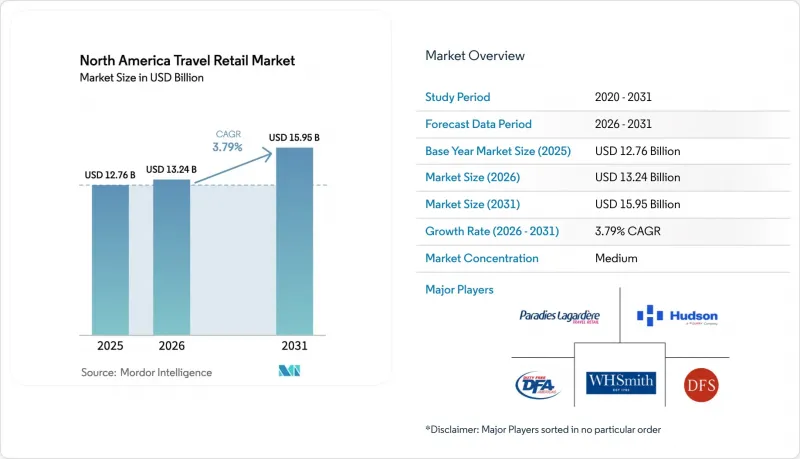
This report is Segmented by Product Type (Fashion and Accessories, Wine & Spirits, and Other), Distribution Channel (Airports, Cruise Liners, and Other), Traveler Demographics (Business Travelers, Leisure Travelers, and Other), and Geography (Canada, United States, and Mexico). The Market Forecasts are Provided in Terms of Value (USD).
North America Travel Retail Market Trends and Insights
Rebound in International Air Passenger Traffic
North American carriers recorded a 28.3% jump in traffic during 2023 compared with 2022, regaining 84.6% of 2023 volumes and restoring the essential passenger base that drives the North America travel retail market . International travellers typically out-spend domestic flyers by a factor of three to four, so the rebound instantly translates into stronger retail cash flow. Leisure traffic already surpasses pre-pandemic highs, while business travel remains lower; nevertheless, business travellers still generate premium category sales that cushion overall yields. Mexico contributed 4.002 million international passengers in December 2024, underscoring its emergence as a pivotal growth node linked to upgraded tourism infrastructure and new air-service agreements. Looking forward, Boeing's 20-year outlook for 43,975 aircraft deliveries ensures adequate lift to sustain volume expansion, reinforcing the long-range health of the North America travel retail market .
Expansion of Airport Retail Footprints & Concession Redevelopments
Massive infrastructure programs are redefining commercial space inside major hubs. JFK's USD 19 billion transformation adds a retail boulevard designed to anchor luxury, dining, and experiential activations, redefining shopping from a convenience add-on into a destination in its own right . Research shows that every 10% rise in passenger dwell time boosts non-aeronautical revenues by roughly 5%, validating airport authority priorities that extend seating, power outlets, and entertainment features to keep travellers engaged. Operators with the financial capability to invest in white-box build-outs, leverage integrated digital engagement strategies, and implement rapid assortment rotations are well-positioned to unlock incremental value within the North American travel retail market. These strategic capabilities allow businesses to respond effectively to evolving consumer preferences, optimize operational efficiency, and strengthen their competitive positioning in a highly dynamic and competitive market landscape.
Stringent Customs Limits on Tobacco & Alcohol Allowances
Regulatory restrictions are limiting growth opportunities in the high-margin liquor and tobacco markets. Canadian regulations impose strict limits on the quantities of alcohol that residents can bring back after trips lasting at least 48 hours. These limits include 1.5 liters of wine, 1.14 liters of spirits, or 8.5 liters of beer. Such constraints significantly restrict consumer purchase volumes, thereby impacting overall market expansion potential. Comparable U.S. restrictions similarly limit duty-free uptake, particularly at land-border outlets. Although USMCA raised Canada's courier de minimis threshold to CAD 150, the benefit flows mainly to e-commerce rather than bricks-and-mortar travel retail. Retailers respond by reallocating shelf space to beauty, fashion, and local gourmet lines that face lighter regulatory drag but yield comparable margins.
Other drivers and restraints analyzed in the detailed report include:
- Rising Spend Per Passenger via Premiumization
- Strong Performance of Fragrances & Cosmetics Category
- Competition from Downtown Duty-Free & E-Commerce
For complete list of drivers and restraints, kindly check the Table Of Contents.
Segment Analysis
Fragrances & Cosmetics dominated with 32.05% of the North America travel retail market share in 2025, and the sub-segment will add revenue at a 11.92% CAGR through 2031, underscoring its pivotal role in sustaining premiumization. Wine & Spirits holds strong average receipt value but labours under duty caps and wellness-driven moderation trends. Tobacco's structural decline continues, but it still drives footfall among committed smokers who also cross-shop high-margin snacks and accessories. Fashion & Accessories capture impulse luxury purchases through limited-edition drops timed with seasonal travel peaks. Food & Confectionery enjoys a stable gifting and souvenir niche, boosted by Mars Wrigley's refreshed M&M's and Maltesers lines geared toward premium flavour profiles. Other product types, including electronics, watches, and jewellery, retain relevance via hands-on testing and instant ownership satisfaction that online channels cannot match.
Retailers allocate prime post-security real estate to beauty because conversion spikes when passengers exit screening. Digital testers, augmented-reality mirrors, and expert-led curation speed shopper decision-making, vital when boarding time looms. Liquor brands shrink bottle sizes for compliance and highlight gift sets priced to align with customs allowances. Confectionery labels invest in storytelling around origin and sustainability, targeting ethically minded flyers. The net effect balances the North America travel retail market portfolio, reducing reliance on any single category and insulating revenue from regulatory swings.
Complete Report Scope:
- By Product Type
- Fashion and Accessories
- Wine and Spirits
- Tobacco
- Food and Confectionery
- Fragrances and Cosmetics
- Other Product Types (Stationery, Electronics, Watches, Jewelry, etc.)
- By Distribution Channel
- Airports
- Cruise Liners
- Railway Stations
- Other Distribution Channels
- By Traveler Demographics
- Business Travelers
- Leisure Travelers
- Visiting Friends and Relatives (VFR)
- Medical and Wellness Tourists
- Student Travelers
- By Geography
- Canada
- United States
- Mexico
List of Companies Covered in this Report:
- Dufry (Hudson)
- Duty Free Americas
- Paradies Lagardere
- WH Smith (InMotion)
- DFS Group
- 3Sixty Duty Free and More
- OTG Management
- Heinemann Americas
- SSP America
- Areas USA
- Unibail-Rodamco-Westfield Airports
- Sterling Duty Free
- Aer Rianta International NA
- Delaware North Travel Hospitality
- HMSHost
- InMotion Entertainment Group
- Hudson Nonstop
- Relay
- Valora Retail USA
- Lotte Duty Free (US)
Additional Benefits:
- The market estimate (ME) sheet in Excel format
- 3 months of analyst support
TABLE OF CONTENTS
1 Introduction
- 1.1 Study Assumptions and Market Definition
- 1.2 Scope of the Study
2 Research Methodology
3 Executive Summary
4 Market Landscape
- 4.1 Market Overview
- 4.2 Market Drivers
- 4.2.1 Rebound in international air passenger traffic
- 4.2.2 Expansion of airport retail footprints and concession redevelopments
- 4.2.3 Rising spend per passenger via premiumization
- 4.2.4 Strong performance of fragrances and cosmetics category
- 4.2.5 Growth of private-jet and FBO duty-free concepts
- 4.2.6 Contactless checkout technologies boosting conversion
- 4.3 Market Restraints
- 4.3.1 Stringent customs limits on tobacco and alcohol allowances
- 4.3.2 Competition from downtown duty-free and e-commerce
- 4.3.3 Slot-constrained U.S. gateway airports limit retail space
- 4.3.4 Shift to low-alcohol / wellness reduces wine and spirits basket
- 4.4 Value / Supply-Chain Analysis
- 4.5 Regulatory Landscape
- 4.6 Technological Outlook
- 4.7 Porter's Five Forces
- 4.7.1 Threat of New Entrants
- 4.7.2 Bargaining Power of Suppliers
- 4.7.3 Bargaining Power of Buyers
- 4.7.4 Threat of Substitutes
- 4.7.5 Competitive Rivalry
5 Market Size and Growth Forecasts
- 5.1 By Product Type
- 5.1.1 Fashion and Accessories
- 5.1.2 Wine and Spirits
- 5.1.3 Tobacco
- 5.1.4 Food and Confectionery
- 5.1.5 Fragrances and Cosmetics
- 5.1.6 Other Product Types (Stationery, Electronics, Watches, Jewelry, etc.)
- 5.2 By Distribution Channel
- 5.2.1 Airports
- 5.2.2 Cruise Liners
- 5.2.3 Railway Stations
- 5.2.4 Other Distribution Channels
- 5.3 By Traveler Demographics
- 5.3.1 Business Travelers
- 5.3.2 Leisure Travelers
- 5.3.3 Visiting Friends and Relatives (VFR)
- 5.3.4 Medical and Wellness Tourists
- 5.3.5 Student Travelers
- 5.4 By Geography
- 5.4.1 Canada
- 5.4.2 United States
- 5.4.3 Mexico
6 Competitive Landscape
- 6.1 Market Concentration
- 6.2 Strategic Moves
- 6.3 Market Share Analysis
- 6.4 Company Profiles (includes Global level Overview, Market level overview, Core Segments, Financials as available, Strategic Information, Market Rank/Share for key companies, Products and Services, and Recent Developments)
- 6.4.1 Dufry (Hudson)
- 6.4.2 Duty Free Americas
- 6.4.3 Paradies Lagardere
- 6.4.4 WH Smith (InMotion)
- 6.4.5 DFS Group
- 6.4.6 3Sixty Duty Free and More
- 6.4.7 OTG Management
- 6.4.8 Heinemann Americas
- 6.4.9 SSP America
- 6.4.10 Areas USA
- 6.4.11 Unibail-Rodamco-Westfield Airports
- 6.4.12 Sterling Duty Free
- 6.4.13 Aer Rianta International NA
- 6.4.14 Delaware North Travel Hospitality
- 6.4.15 HMSHost
- 6.4.16 InMotion Entertainment Group
- 6.4.17 Hudson Nonstop
- 6.4.18 Relay
- 6.4.19 Valora Retail USA
- 6.4.20 Lotte Duty Free (US)
7 Market Opportunities and Future Outlook
- 7.1 Omni-channel click-and-collect platforms linking airport and downtown duty-free
- 7.2 Hyper-local product curation (craft spirits, indigenous fashion) for sense-of-place retailing

