PUBLISHER: Mordor Intelligence | PRODUCT CODE: 2124665

PUBLISHER: Mordor Intelligence | PRODUCT CODE: 2124665
Japan Travel Retail - Market Share Analysis, Industry Trends & Statistics, Growth Forecasts (2026 - 2031)
According to Mordor Intelligence, the Japan travel retail market size is projected to expand from USD 4.04 billion in 2025 and USD 4.42 billion in 2026 to USD 7.55 billion by 2031, registering a CAGR of 9.33% between 2026 to 2031.
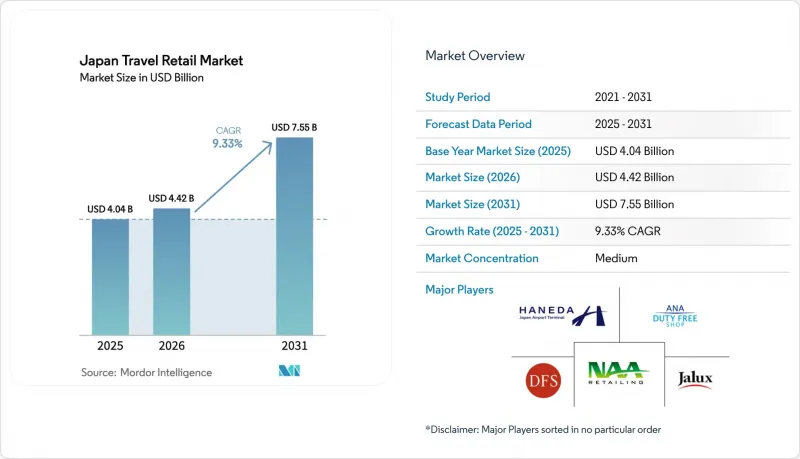
This report is Segmented by Product Type (Fashion & Accessories, Jewelry & Watches, Wines & Spirits, Food & Confectionery, Cosmetics & Fragrances, Tobacco, Other Product Types), Distribution Channel (Airports, Airlines, Ferries, Other Channels), and Geography (Hokkaido, Tohoku, Kanto, Chubu, Kansai/Kinki, Chugoku, Shikoku, Kyushu & Okinawa). The Market Forecasts are Provided in Terms of Value (USD).
Japan Travel Retail Market Trends and Insights
World-leading luxury brand store openings in Japan
Global operators expanded in 2025 as Avolta entered Japan with a 500 square meter food and beverage concession at Kansai International Airport, which adds recognized culinary brands and strengthens cross-channel engagement. Kansai's Terminal 1 program continues into summer 2026 with a planned slate of 23 stores that includes first airport boutiques for Gentle Monster and Moncler, which target premium traffic around Expo 2025. Lotte Duty Free renovated its Tokyo Ginza flagship in October 2024 and introduced a Korean fashion zone and a curated House of Suntory whisky offering by allocation, which aligns with demographic shifts toward younger and digitally engaged shoppers. Airport landlords deepen ties with luxury brands through co-financed boutique buildouts and exclusive placements that create scarcity and commit prime frontage to select operators for long leases. This clustering effect concentrates ultra-high net worth spending in priority terminals and elevates the role of airports within the Japan travel retail market.
Rising duty-free spend by Chinese & Korean travellers
South Korean arrivals led in 2024 and recorded year-on-year growth that changed the mix at key gateways, which raised demand for value-focused products and Korean language services at retail touchpoints. Korean card spending in Japan expanded through 2025, with department stores and duty-free clusters targeting this cohort with tailored counters and curated assortments to support higher frequency trips. Chinese demand turned more volatile in late 2025 as a travel advisory and currency pressure weighed on per-transaction spending and reduced luxury basket sizes at select hubs. Operators pivoted with localized experiences and more consumables to preserve conversion while strengthening their focus on United States and European high-value travelers to diversify exposure. This rebalancing helps stabilize performance in the Japan travel retail market as visitor flows shift and as traffic patterns favor independent travelers over large tour groups.
Yen volatility is squeezing margins on imported inventory.
Exchange rate swings tightened gross margins for operators carrying imported luxury inventory that had been purchased at prior currency levels, which forced shifts toward more resilient consumables. Haneda reported a lower luxury share through late 2025 that reflected price sensitivity and allocation discipline by brands to manage gray market risks. Some boutiques deferred fit-out expansions as the arbitrage gap to Europe and the United States narrowed, which diluted impulse splurges by price-aware travelers. Payment cost structures added to pressure as cross-border card fees compounded discounts and promotions that retailers used to keep traffic moving. Operators responded by emphasizing bundled sets and airport exclusives in categories like cosmetics to defend volume while accepting lower average transaction values in the near term.
Other drivers and restraints analyzed in the detailed report include:
- Airport retail-space expansion & refurbishment at Haneda, Narita, Kansai
- Digital tax-refund kiosks & cashless payments are boosting conversion
- Strict customs allowances on alcohol & tobacco purchases
For complete list of drivers and restraints, kindly check the Table Of Contents.
Segment Analysis
Cosmetics and fragrances captured 45.31% of 2025 product revenue and remained the anchor category for frequent buyers, while wines and spirits are forecast to grow at an 11.12% CAGR through 2031 as premiumization deepens. Airport operators raised the visibility of curated whisky and high-end spirits with allocation-based counters and education-led displays that translate scarcity into full price sell-through. The cosmetics mix leaned into airport-exclusive sets and giftable formats that raise average tickets while sustaining a broad penetration rate among shoppers from China and South Korea. Jewelry and watches faced tighter allocations from select brands, which pushed some buyers toward daily queues and reshaped spend toward accessories and footwear within budget thresholds. The Japan travel retail market benefits from this spread of premium and entry options because it supports conversion across diverse spending profiles and trip purposes.
The Japan travel retail market size for wines and spirits is projected to expand at an 11.12% CAGR between 2026 and 2031, which is driven by collector demand and brand storytelling that reward limited releases. Duty-free teams rely on lotteries, pre-order windows, and pick-up lockers to manage high-demand bottles while preserving fairness and regulating crowds near gates. Cosmetics and fragrances continue to anchor volume with sets designed for gifting and self-care, which helps offset volatility in large-ticket luxury when currency or policy shifts weigh on value perception. Food and confectionery sustain high purchase frequency and deliver predictable throughput that supports inventory turns in late-night operations, even if revenue contribution trails premium categories. This product mix helps the Japan travel retail industry balance margin and volume while protecting unit economics through cycles.
Complete Report Scope:
- By Product Type
- Fashion & Accessories
- Jewelry & Watches
- Wines & Spirits
- Food & Confectionery
- Cosmetics & Fragrances
- Tobacco
- Other Product Types (Stationery, Electronics, etc.)
- By Distribution Channel
- Airports
- Airlines
- Ferries
- Other Channels (Railway Stations, Border Shops, Downtown)
- By Geography
- Hokkaido
- Tohoku
- Kanto
- Chubu
- Kansai/Kinki
- Chugoku
- Shikoku
- Kyushu & Okinawa
List of Companies Covered in this Report:
- Japan Airport Terminal Co. Ltd.
- NAA Retailing (Fa-So-La)
- JALUX Inc.
- ANA Trading Duty Free
- DFS Group
- Dufry / Avolta AG
- Lagardere Travel Retail
- Lotte Duty Free
- The Shilla Duty Free
- King Power Group
- Gebr. Heinemann
- Duty Free Americas
- TIAT (Tokyo International Air Terminal)
- Isetan Mitsukoshi Duty Free
- Takashimaya Duty Free
- Kansai Airports Retail & Services
- Central Japan IA Store (Centrair Duty Free)
Additional Benefits:
- The market estimate (ME) sheet in Excel format
- 3 months of analyst support
TABLE OF CONTENTS
1 Introduction
- 1.1 Study Assumptions & Market Definition
- 1.2 Scope of the Study
2 Research Methodology
3 Executive Summary
4 Market Landscape
- 4.1 Market Overview
- 4.2 Market Drivers
- 4.2.1 World-Leading Luxury Brand Store Openings in Japan
- 4.2.2 Rising Duty-Free Spend by Chinese & Korean Travellers
- 4.2.3 Airport Retail-Space Expansion & Refurbishment at Haneda, Narita, Kansai
- 4.2.4 Digital Tax-Refund Kiosks & Cash-Less Payments Boosting Conversion
- 4.2.5 Limited-Edition Japanese Whisky Boom in Global Collector Circles
- 4.2.6 Osaka-Kansai Expo 2025 And Other Mega-Events Driving One-Off Visitor Spikes
- 4.3 Market Restraints
- 4.3.1 Yen Volatility Squeezing Margins on Imported Inventory
- 4.3.2 Strict Customs Allowances on Alcohol & Tobacco Purchases
- 4.3.3 Acute Airport-Retail Labour Shortages Curbing Store Hours
- 4.3.4 Grey-Market Price Arbitrage Eroding Brand Price Integrity
- 4.4 Value / Supply-Chain Analysis
- 4.5 Regulatory Landscape
- 4.6 Technological Outlook
- 4.7 Porter's Five Forces
- 4.7.1 Threat of New Entrants
- 4.7.2 Bargaining Power of Buyers
- 4.7.3 Bargaining Power of Suppliers
- 4.7.4 Threat of Substitutes
- 4.7.5 Competitive Rivalry
- 4.8 Duty & GST Allowance Framework Analysis
5 Market Size & Growth Forecasts (Value)
- 5.1 By Product Type
- 5.1.1 Fashion & Accessories
- 5.1.2 Jewelry & Watches
- 5.1.3 Wines & Spirits
- 5.1.4 Food & Confectionery
- 5.1.5 Cosmetics & Fragrances
- 5.1.6 Tobacco
- 5.1.7 Other Product Types (Stationery, Electronics, etc.)
- 5.2 By Distribution Channel
- 5.2.1 Airports
- 5.2.2 Airlines
- 5.2.3 Ferries
- 5.2.4 Other Channels (Railway Stations, Border Shops, Downtown)
- 5.3 By Geography
- 5.3.1 Hokkaido
- 5.3.2 Tohoku
- 5.3.3 Kanto
- 5.3.4 Chubu
- 5.3.5 Kansai/Kinki
- 5.3.6 Chugoku
- 5.3.7 Shikoku
- 5.3.8 Kyushu & Okinawa
6 Competitive Landscape
- 6.1 Market Concentration
- 6.2 Strategic Moves
- 6.3 Market Share Analysis
- 6.4 Company Profiles (includes Global level Overview, Market level overview, Core Segments, Financials as available, Strategic Information, Market Rank/Share for key companies, Products & Services, and Recent Developments)
- 6.4.1 Japan Airport Terminal Co. Ltd.
- 6.4.2 NAA Retailing (Fa-So-La)
- 6.4.3 JALUX Inc.
- 6.4.4 ANA Trading Duty Free
- 6.4.5 DFS Group
- 6.4.6 Dufry / Avolta AG
- 6.4.7 Lagardere Travel Retail
- 6.4.8 Lotte Duty Free
- 6.4.9 The Shilla Duty Free
- 6.4.10 King Power Group
- 6.4.11 Gebr. Heinemann
- 6.4.12 Duty Free Americas
- 6.4.13 TIAT (Tokyo International Air Terminal)
- 6.4.14 Isetan Mitsukoshi Duty Free
- 6.4.15 Takashimaya Duty Free
- 6.4.16 Kansai Airports Retail & Services
- 6.4.17 Central Japan IA Store (Centrair Duty Free)
7 Market Opportunities & Future Outlook
- 7.1 White-space & Unmet-Need Assessment

