
PUBLISHER: Mordor Intelligence | PRODUCT CODE: 2063419

PUBLISHER: Mordor Intelligence | PRODUCT CODE: 2063419
Basal Insulin - Market Share Analysis, Industry Trends & Statistics, Growth Forecasts (2026 - 2031)
According to Mordor Intelligence, the basal insulin market size is expected to increase from USD 7.40 billion in 2025 to USD 7.70 billion in 2026 and reach USD 9.80 billion by 2031, growing at a CAGR of 4.85% over 2026-2031.
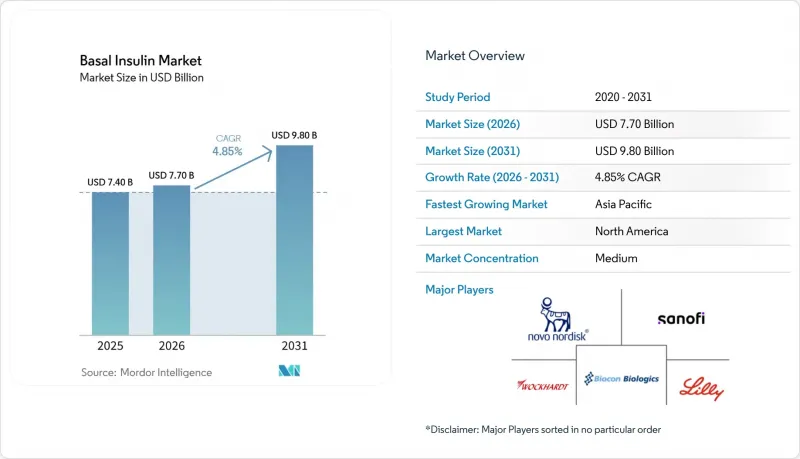
This report is Segmented by Molecule (Glargine, Detemir, Degludec, Others), Delivery Device (Vials & Syringes, Pre-Filled Disposable Pens, and More), Patient Type (Type-1 Diabetes, and More), Distribution Channel (Hospital Pharmacies, Retail Pharmacies, and More), and Geography (North America, Europe, Asia-Pacific, Middle East & Africa, South America). The Market Forecasts are Provided in Terms of Value (USD).
Global Basal Insulin Market Trends and Insights
Rising Global Diabetes Prevalence
According to NCD Alliance over one in nine adults worldwide now live with diabetes, with projections indicating a rise to 853 million by 2045. Low- and middle-income nations now account for most new diagnoses, but therapeutic access lags epidemiologic need. Aggressive local-pricing strategies such as Novo Nordisk's USD 24-per-week Ozempic launch in India in December 2025 unlock volume yet compress margins. In the United States, the CDC estimates 38 million people have diabetes; A modest share of Medicare beneficiaries gained GLP-1 coverage under 2026 pilots, redirecting many prospective insulin starts to incretin therapy. The basal insulin market therefore expands in absolute terms while facing a shrinking eligible numerator as treatment algorithms evolve.
Adoption of Long-Acting Insulin Analogues
Glargine, degludec, and detemir displaced NPH insulin on safety grounds, but biosimilar competition now erodes the analogue premium. Semglee launched at 64% below Lantus list price and delivered equivalent glycemic control in real-world evidence from UC Health . Sanofi's Merilog became the first rapid-acting biosimilar approved in the United States in February 2026, establishing precedent that accelerates basal-analogue follow-ons. Updated 2026 Diabetes Canada guidelines caution about hypoglycemia risk for icodec in type-1 diabetes, indicating analogue uptake will plateau in developed markets but rise in emerging regions where biosimilars bridge affordability gaps.
GLP-1 Uptake Delaying Basal Starts
SURPASS-4 showed tirzepatide reduced insulin initiation by 71% versus glargine, pushing basal insulin deeper into treatment lines . SUSTAIN-4 and subsequent trials confirm semaglutide's dual benefit of HbA1c lowering and 10-15% body-weight reduction, making GLP-1s the preferred injectable for type-2 diabetes. Oral formulations-Novo's semaglutide (approved December 2025) and Lilly's orforglipron (approved April 2026) at USD 149 per month-remove injection barriers and equalize cost with basal insulin starter packs. Medicare's negotiated USD 274 monthly semaglutide price effective 2027 cements payer bias toward GLP-1s, compressing basal starts in developed markets.
Other drivers and restraints analyzed in the detailed report include:
- Once-Weekly Basal Insulin Pipeline Momentum
- Integration with CGM-Enabled Smart Pens
- High Analogue Pricing & Reimbursement Gaps
For complete list of drivers and restraints, kindly check the Table Of Contents.
Segment Analysis
Detemir is projected to grow at a 5.67% CAGR through 2031, the fastest rate among basal insulin molecules. Three factors explain the rebound. First, emerging-market biosimilars launch at prices significantly below branded analogues, making twice-daily detemir attractive where drug budgets are tight. Second, payers in cost-sensitive regions steer formularies toward these lower-priced options rather than premium once-daily products. Third, clinicians see value in detemir's weight-neutral profile for obese type-2 patients who cannot afford GLP-1 combinations.
Glargine still led with 45.67% of molecule share in 2025, supported by Sanofi's Lantus and Toujeo, but biosimilars such as Semglee and Rezvoglar are eroding that position with price discounts. Degludec, marketed as Tresiba, retains a dosing-flexibility edge yet faces U.S. price pressure and biosimilar competition that limits its growth to low-single digits. The Others group-once-weekly icodec and Lilly's pipeline efsitora alfa-secured a toehold after Awiqli won FDA approval in March 2026 for type-2 diabetes, though exclusion from type-1 indications confines uptake to majority of insulin users.
Pre-filled pens led with 58.34% share in 2025; however, reusable and smart pens outpace overall basal insulin market growth at 6.12% CAGR through 2031. The basal insulin market share commanded by traditional vials has fallen in North America, whereas India and sub-Saharan Africa still rely on them for significant portion of doses. Smart-pen-CGM bundles are rapidly gaining preferred-drug-list placement among U.S. payers following ADA guideline changes. Insulet's Omnipod GO basal-only tubeless pump-positioned between pens and full-loop pumps-could capture notable share by 2030.
Ypsomed-BD autoinjector development targets high-viscosity biologics, anticipating concentrated insulin growth. Vendor lock-in strengthens as data platforms pair proprietary pens with branded CGMs, raising patient switching costs and reinforcing manufacturer share.
Geography Analysis
North America retained 43.89% of basal insulin market size in 2025, buoyed by Medicare copay caps but constrained by rapid GLP-1 substitution and biosimilar price pressure. Federal negotiation reducing semaglutide pricing significantly from 2027 will likely further shift formularies away from insulin. Capacity expansions Novo's USD 4.1 billion North Carolina fill-finish plant and Lilly's USD 3 billion Wisconsin site-hedge demand across insulin and incretin portfolios.
Asia-Pacific is projected to grow at a 6.32% CAGR, outpacing all regions. India's March 2026 semaglutide patent lapse opened a flood of more than 50 branded generics, compressing GLP-1 prices and reshaping therapeutic sequencing. China's regulatory reforms accelerate local biosimilar approvals; Sihuan's degludec filing underlines domestic challengers to multinationals. Manufacturers invest more than USD 2 billion in regional plants to secure "local-for-local" supply and tariff advantages.
Europe and Middle East & Africa register mid-single-digit growth. Stringent interchangeability rules slow biosimilar penetration, while heterogeneous reimbursement frameworks fragment market access for novel formulations. Sanofi's EUR 1.3 billion Frankfurt expansion (completion 2029) aims to support regional demand once Lantus and Toujeo biosimilars proliferate.
- Biocon Biologics Ltd
- Biosidus S.A.
- Bioton
- Eli Lilly and Company
- Emcure Pharmaceuticals
- Gan & Lee Pharmaceuticals
- Gedeon Richter Plc
- Geropharm
- Lupin
- Novo Nordisk
- Pfizer
- Sanofi
- SEDICO Pharmaceutical Co.
- Tonghua Dongbao
- Viatris
- Wanbang Biopharma
- Wockhardt
- Zhuhai United Laboratories
Additional Benefits:
- The market estimate (ME) sheet in Excel format
- 3 months of analyst support
TABLE OF CONTENTS
1 Introduction
- 1.1 Study Assumptions & Market Definition
- 1.2 Scope of the Study
2 Research Methodology
3 Executive Summary
4 Market Landscape
- 4.1 Market Overview
- 4.2 Market Drivers
- 4.2.1 Rising Global Diabetes Prevalence
- 4.2.2 Biosimilar Insulin Market Expansion
- 4.2.3 Adoption of Long-Acting Insulin Analogues
- 4.2.4 Once-Weekly Basal Insulin Pipeline Momentum
- 4.2.5 Shift From Vials to Pre-Filled Pens
- 4.2.6 Integration With CGM-Enabled Smart Pens
- 4.3 Market Restraints
- 4.3.1 High Analogue Pricing & Reimbursement Gaps
- 4.3.2 Regulatory Complexity for Biosimilars
- 4.3.3 GLP-1 Uptake Delaying Basal Starts
- 4.3.4 Manufacturing Scale-Up Bottlenecks
- 4.4 Supply-Chain Analysis
- 4.5 Regulatory Landscape
- 4.6 Technological Outlook
- 4.7 Porter's Five Forces Analysis
- 4.7.1 Bargaining Power of Suppliers
- 4.7.2 Bargaining Power of Buyers
- 4.7.3 Threat of New Entrants
- 4.7.4 Threat of Substitutes
- 4.7.5 Intensity of Rivalry
5 Market Size & Growth Forecasts (Value, USD)
- 5.1 By Molecule
- 5.1.1 Glargine
- 5.1.2 Detemir
- 5.1.3 Degludec
- 5.1.4 Others
- 5.2 By Delivery Device
- 5.2.1 Vials & Syringes
- 5.2.2 Pre-filled Disposable Pens
- 5.2.3 Re-usable / Smart Pens
- 5.2.4 Pump-based Basal Delivery
- 5.3 By Patient Type
- 5.3.1 Type-1 Diabetes
- 5.3.2 Type-2 Diabetes
- 5.3.3 Gestational Diabetes
- 5.4 By Distribution Channel
- 5.4.1 Hospital Pharmacies
- 5.4.2 Retail Pharmacies
- 5.4.3 Online Pharmacies
- 5.5 By Geography
- 5.5.1 North America
- 5.5.1.1 United States
- 5.5.1.2 Canada
- 5.5.1.3 Mexico
- 5.5.2 Europe
- 5.5.2.1 Germany
- 5.5.2.2 United Kingdom
- 5.5.2.3 France
- 5.5.2.4 Italy
- 5.5.2.5 Spain
- 5.5.2.6 Rest of Europe
- 5.5.3 Asia-Pacific
- 5.5.3.1 China
- 5.5.3.2 India
- 5.5.3.3 Japan
- 5.5.3.4 South Korea
- 5.5.3.5 Australia
- 5.5.3.6 Rest of Asia-Pacific
- 5.5.4 Middle East and Africa
- 5.5.4.1 GCC
- 5.5.4.2 South Africa
- 5.5.4.3 Rest of Middle East and Africa
- 5.5.5 South America
- 5.5.5.1 Brazil
- 5.5.5.2 Argentina
- 5.5.5.3 Rest of South America
- 5.5.1 North America
6 Competitive Landscape
- 6.1 Market Concentration
- 6.2 Market Share Analysis
- 6.3 Company Profiles (includes Global level Overview, Market level overview, Core Segments, Financials as available, Strategic Information, Market Rank/Share for key companies, Products & Services, and Recent Developments)
- 6.3.1 Biocon Biologics Ltd
- 6.3.2 Biosidus S.A.
- 6.3.3 Bioton S.A.
- 6.3.4 Eli Lilly and Company
- 6.3.5 Emcure Pharmaceuticals Ltd.
- 6.3.6 Gan & Lee Pharmaceuticals
- 6.3.7 Gedeon Richter Plc
- 6.3.8 Geropharm
- 6.3.9 Lupin Limited
- 6.3.10 Novo Nordisk A/S
- 6.3.11 Pfizer Inc.
- 6.3.12 Sanofi S.A.
- 6.3.13 SEDICO Pharmaceutical Co.
- 6.3.14 Tonghua Dongbao
- 6.3.15 Viatris Inc.
- 6.3.16 Wanbang Biopharma
- 6.3.17 Wockhardt Ltd
- 6.3.18 Zhuhai United Laboratories Co., Ltd.
7 Market Opportunities & Future Outlook
- 7.1 White-space & Unmet-need Assessment

