PUBLISHER: Mordor Intelligence | PRODUCT CODE: 2063695

PUBLISHER: Mordor Intelligence | PRODUCT CODE: 2063695
Japan Folding Carton - Market Share Analysis, Industry Trends & Statistics, Growth Forecasts (2026 - 2031)
According to Mordor Intelligence, the japan folding carton market size is expected to increase from USD 2.96 billion in 2025 to USD 3.14 billion in 2026 and reach USD 4.29 billion by 2031, growing at a CAGR of 6.44% over 2026-2031.
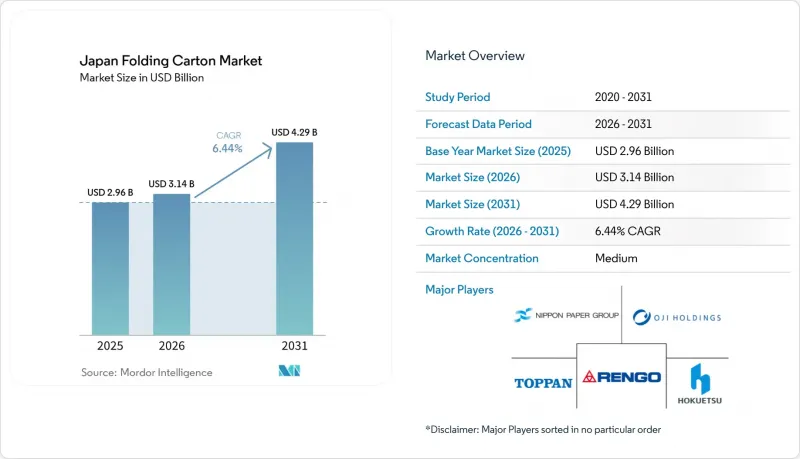
This report is Segmented by Material Type (Solid Bleached Sulfate, Folding Boxboard, Coated Unbleached Kraft, White Line Chipboard, and More), Printing Technology (Lithographic Printing, Flexographic Printing, Digital Printing, and More), and End-User Industry (Food and Beverage, Healthcare/Pharmaceuticals, Electrical and Electronics, and More). The Market Forecasts are Provided in Terms of Value (USD).
Japan Folding Carton Market Trends and Insights
Shift Toward Sustainable Packaging Materials
Japan's Plastic Resource Circulation Act mandates a 25% cut in single-use plastic by 2030, pushing brand owners to specify FSC-certified or recycled cartons that meet design-for-recycling guidelines. Retailers such as Lawson target 80% eco-friendly packaging, raising demand for paperboard that can displace polystyrene clamshells and polyethylene pouches. Toppan plans to raise sustainable packaging sales to 80% by 2030, reflecting the willingness of cosmetics and personal-care brands to pay premiums for verifiable green claims. Supply, however, is constrained because Japan's ban on exporting contaminated recovered paper tightened the domestic pool of post-consumer fiber. Converters integrated into collection networks, like Oji Holdings through its Renewa program, thereby gaining a cost and sourcing advantage. The sustainability pivot, therefore, rewards mills able to certify chain-of-custody, formulate water-based inks, and guarantee closed-loop take-back, while penalizing operators limited to virgin-fiber grades.
Government Plastic Waste Reduction Targets Boosting Paperboard Use
National plastic-reduction targets set at 25% by 2030 are steering pharmaceutical, personal-care, and food companies toward paperboard that matches the barrier performance of plastic blister or clamshell packs. Cartons engineered with tear notches and thumb-lift tabs cut opening force by up to 40%, improving medicine adherence among seniors and aligning with ISO 8317 child-resistance requirements. Nippon Paper's partnership with Elopak to localize Pure-Pak liquid cartons creates a domestic source of non-aluminum, recyclable aseptic packaging, giving brand owners a path to compliance with extended producer responsibility. Municipalities that impose strict waste-sorting accelerate adoption, creating pull-through demand for converters that certify mono-material structures. Over the long term, the policy lock-in ensures baseline growth for fiber-based formats even if commodity pulp costs fluctuate.
Volatility in Virgin Fiber Pulp Prices
South American long-fiber bleached kraft pulp reached USD 655 per ton in February 2026, 14% higher than five months earlier, squeezing converters that lack hedging programs. Energy shocks stemming from the Strait of Hormuz closure also added 60% to naphtha input costs, spilling over into secondary packaging consumables. Smaller plants struggle most because they cannot fully pass increases to brand owners or lock in multiyear supply contracts. Dai Nippon Printing warned of margin pressure in its fiscal-year 2025 results, and Nippon Paper trimmed its FY 2026 operating-income outlook by JPY 4 billion (USD 27 million) for similar reasons. Vertically integrated players, notably Oji Holdings with 636,000 hectares of forestry assets, enjoy partial insulation. Nonetheless, prolonged pulp gyrations erode profitability across the value chain and curb capital-expenditure appetite.
Other drivers and restraints analyzed in the detailed report include:
- E-commerce Boom Accelerating Custom Carton Demand
- Premiumization of Ready-To-Eat Meals Requiring High-Graphics Cartons
- Supply Chain Disruptions from Imported Paperboard Feedstock
For complete list of drivers and restraints, kindly check the Table Of Contents.
Segment Analysis
Solid Bleached Sulfate accounted for 38.47% of the Japan folding carton market share in 2025 because its brightness and stiffness meet the aesthetics demanded by cosmetics and pharmaceutical brands. Yet White Line Chipboard, priced 20-30% below virgin grades, is projected to outpace all others at a 7.26% CAGR through 2031 as grocery retailers and e-commerce shippers accept gray-back board for inner surfaces where appearance matters less. The Japan folding carton market size tied to recycled substrates therefore rises in tandem with corporate plastic-reduction pledges that favor lower-carbon, post-consumer fiber.
Converters are expanding their portfolios to switch rapidly between virgin and recycled recipes as pulp prices swing. Mills equipped with twin-wire formers and multilayer coaters can laminate thin specialty layers over economical core plies, balancing cost against performance. Brand owners increasingly request life-cycle assessment data, prompting suppliers to certify their CO2 footprints under ISO 14064. As a result, those offering cradle-to-grave metrics gain a sales advantage, particularly in export channels where EU packaging regulations are tightening. The pivot toward recycled fiber aligns with Japan's goal of a 60% recycling rate for plastic packaging by 2030, anchoring long-term growth for White Line Chipboard and allied recovered-fiber grades.
List of Companies Covered in this Report:
- Rengo Co., Ltd.
- Oji Holdings Corporation
- Nippon Paper Industries Co., Ltd.
- Toppan Inc.
- Dai Nippon Printing Co., Ltd.
- Hokuetsu Corporation
- Tokan Kogyo Co., Ltd.
- Tomoku Co., Ltd.
- Kyoshin Printing Co., Ltd.
- Hinojosa Group Japan Co., Ltd.
- Seihon Printing Co., Ltd.
- Cartocan Japan Ltd.
- Graphic Packaging International, LLC
- Huhtamaki Oyj
Additional Benefits:
- The market estimate (ME) sheet in Excel format
- 3 months of analyst support
TABLE OF CONTENTS
1 INTRODUCTION
- 1.1 Study Assumptions and Market Definition
- 1.2 Scope of the Study
2 RESEARCH METHODOLOGY
3 EXECUTIVE SUMMARY
4 MARKET LANDSCAPE
- 4.1 Market Overview
- 4.2 Market Drivers
- 4.2.1 E-commerce Boom Accelerating Custom Carton Demand
- 4.2.2 Shift Toward Sustainable Packaging Materials
- 4.2.3 Premiumization of Ready-to-Eat Meals Requiring High-Graphics Cartons
- 4.2.4 Government Plastic Waste Reduction Targets Boosting Paperboard Use
- 4.2.5 Retailers' Private-Label Expansion Driving Short-Run Digital Print Jobs
- 4.2.6 Aging Population Increasing Demand for Easy-Open Pharmaceutical Cartons
- 4.3 Market Restraints
- 4.3.1 Volatility in Virgin Fiber Pulp Prices
- 4.3.2 Supply Chain Disruptions from Imported Paperboard Feedstock
- 4.3.3 Labor Shortages in Converting Facilities Limiting Capacity
- 4.3.4 Rising Popularity of Flexible Pouches in Snacks Segment
- 4.4 Industry Value Chain Analysis
- 4.5 Regulatory Landscape
- 4.6 Technological Outlook
- 4.7 Porter's Five Forces Analysis
- 4.7.1 Threat of New Entrants
- 4.7.2 Bargaining Power of Suppliers
- 4.7.3 Bargaining Power of Buyers
- 4.7.4 Threat of Substitutes
- 4.7.5 Competitive Rivalry
5 MARKET SIZE AND GROWTH FORECASTS (VALUE)
- 5.1 By Material Type
- 5.1.1 Solid Bleached Sulfate
- 5.1.2 Folding Boxboard
- 5.1.3 Coated Unbleached Kraft
- 5.1.4 White Line Chipboard
- 5.1.5 Other Material Types
- 5.2 By Printing Technology
- 5.2.1 Lithographic Printing
- 5.2.2 Flexographic Printing
- 5.2.3 Digital Printing
- 5.2.4 Gravure Printing
- 5.2.5 Other Printing Technologies
- 5.3 By End-User Industry
- 5.3.1 Food and Beverage
- 5.3.2 Healthcare/Pharmaceuticals
- 5.3.3 Personal Care and Cosmetics
- 5.3.4 Electrical and Electronics
- 5.3.5 Household and Industrial Goods
- 5.3.6 Tobacco
- 5.3.7 E-commerce and Retail-ready Packaging
- 5.3.8 Other End-User Industries
6 COMPETITIVE LANDSCAPE
- 6.1 Market Concentration
- 6.2 Strategic Moves
- 6.3 Market Share Analysis
- 6.4 Company Profiles (includes Global level Overview, Market level overview, Core Segments, Financials as available, Strategic Information, Market Rank/Share for key companies, Products and Services, and Recent Developments)
- 6.4.1 Rengo Co., Ltd.
- 6.4.2 Oji Holdings Corporation
- 6.4.3 Nippon Paper Industries Co., Ltd.
- 6.4.4 Toppan Inc.
- 6.4.5 Dai Nippon Printing Co., Ltd.
- 6.4.6 Hokuetsu Corporation
- 6.4.7 Tokan Kogyo Co., Ltd.
- 6.4.8 Tomoku Co., Ltd.
- 6.4.9 Kyoshin Printing Co., Ltd.
- 6.4.10 Hinojosa Group Japan Co., Ltd.
- 6.4.11 Seihon Printing Co., Ltd.
- 6.4.12 Cartocan Japan Ltd.
- 6.4.13 Graphic Packaging International, LLC
- 6.4.14 Huhtamaki Oyj
7 MARKET OPPORTUNITIES AND FUTURE OUTLOOK
- 7.1 White-Space and Unmet-Need Assessment

