
PUBLISHER: Mordor Intelligence | PRODUCT CODE: 2063760

PUBLISHER: Mordor Intelligence | PRODUCT CODE: 2063760
North America Folding Carton - Market Share Analysis, Industry Trends & Statistics, Growth Forecasts (2026 - 2031)
According to Mordor Intelligence, the north america folding cartons market size is projected to expand from USD 12.27 billion in 2025 and USD 13.14 billion in 2026 to USD 18.88 billion by 2031, registering a CAGR of 7.52% between 2026 to 2031.
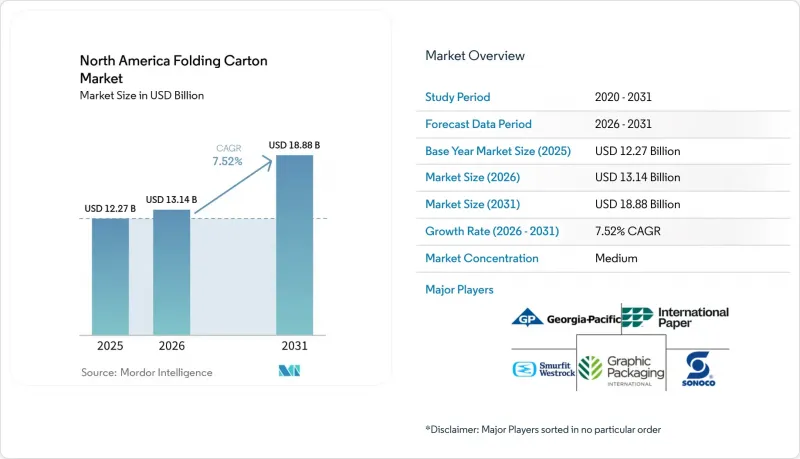
This report is Segmented by Material Type (Solid Bleached Sulfate, Folding Boxboard, Coated Unbleached Kraft, and More), Printing Technology (Lithographic, Flexographic, Digital, and More), End-User Industry (Food and Beverage, Healthcare/Pharmaceuticals, Personal Care and Cosmetics, Electrical and Electronics, and More), and Geography. The Market Forecasts are Provided in Terms of Value (USD).
North America Folding Carton Market Trends and Insights
Surge in E-Commerce Shipments Requiring Shelf-Ready Packaging
E-commerce retailers now ask suppliers to deliver folding cartons that move straight from inbound docks to store shelves, eliminating secondary handling. Amazon, Walmart, and Target introduced mandatory scannable, pre-printed carton specifications in 2025, prompting converters to invest in high-graphic digital and litho printing that supports RFID tagging. Same-day turnaround has become a decisive differentiator, and converters with automated die-cutters near fulfillment hubs are gaining a growing share of the North America folding cartons market. Mexico is feeling the pull as new manufacturing clusters in Monterrey and Guadalajara demand localized, shelf-ready packaging.
Growing Preference for Sustainable Fiber-Based Substitutes to Plastics
Extended producer responsibility laws in California and Canada compel brands to switch from plastic to recyclable paperboard, lifting demand for premium fiber grades certified by the Forest Stewardship Council and the Sustainable Forestry Initiative. Stora Enso's Performa Lumi paperboard achieved broad adoption in cosmetics by 2025 because it pairs high graphic fidelity with high recycled content. Integrated producers have responded with portfolio-wide "plastic-to-paper" programs, further enlarging the North America folding cartons market footprint.
Volatility in Recycled Fiber Supply Prices
Mill closures in China and new Asian export restrictions cut recovered-paper availability, pushing North American recycled-paperboard prices up or down by double digits in back-to-back quarters. Integrated producers that control curbside collection and possess pulp mills lock in long-term fiber contracts, shielding margins and concentrating North America's folding cartons market share among the top tier. This volatility is also prompting brand owners to diversify sourcing strategies and prioritize suppliers with stable fiber access and pricing visibility.
Other drivers and restraints analyzed in the detailed report include:
- Advances in Water-Based Barrier Coatings Enabling Frozen Food Cartons
- Automation of High-Speed Die-Cutting and Gluing Lines
- Capital-Intensive Compliance With PFAS Regulations
For complete list of drivers and restraints, kindly check the Table Of Contents.
Segment Analysis
White Line Chipboard is projected to grow at a 7.94% CAGR, outpacing the overall 7.52% expansion, as e-commerce retailers accept its lower brightness for secondary and shelf-ready applications. Solid Bleached Sulfate retained the largest 34.21% share of the North America folding cartons market in 2025, a position secured by pharmaceutical and cosmetic serialization demands. Supply tightened when Smurfit WestRock shuttered its Quebec SBS machine, lifting price discipline and nudging converters toward chipboard when print fidelity is less critical. Folding Boxboard maintains steady food and beverage orders, yet snack brands continue to migrate to lightweight pouches for on-the-go convenience. Coated Unbleached Kraft serves niche organic food labels that value the natural brown appearance. Overall, material decisions now pivot more on total delivered cost and recyclability certification than on historical substrate loyalties. Converters that can switch grades quickly capture incremental opportunities in the North America folding carton market as brand-owner priorities evolve.
Demand for White Line Chipboard is most visible in the United States, where e-commerce penetration breached 15% of retail sales in 2025. Retailers' focus on cost control encourages brand owners to trade down to a lower-cost substrate without sacrificing shelf impact. In Mexico, nearshoring has sparked interest in chipboard for consumer electronics cartons, as a low-cost substrate offsets higher logistics overhead. Canada continues to support premium SBS for regulated pharmaceuticals, but rising freight costs and a strong U.S. dollar are opening conversations about chipboard substitution. As supply chains regionalize, mills able to furnish multiple grades from a single complex can rebalance output faster, protecting margins and deepening engagement across the North America folding cartons market.
List of Companies Covered in this Report:
- Graphic Packaging Holding Company
- Smurfit Westrock plc
- International Paper Company
- Georgia-Pacific LLC
- Sonoco Products Company
- Huhtamaki Oyj
- Packaging Corporation of America
- Cascades Inc.
- Pratt Industries Inc.
- Rengo Co., Ltd.
- Mayr-Melnhof Karton AG
- AR Packaging Group AB
- Multi Packaging Solutions International LLC
- Caraustar Industries, Inc. (Greif, Inc.)
- Americraft Carton, Inc.
- Edelmann Group
- Great Little Box Company Ltd.
- Unicorr Packaging Group
- Bell Incorporated
Additional Benefits:
- The market estimate (ME) sheet in Excel format
- 3 months of analyst support
TABLE OF CONTENTS
1 INTRODUCTION
- 1.1 Study Assumptions and Market Definition
- 1.2 Scope of the Study
2 RESEARCH METHODOLOGY
3 EXECUTIVE SUMMARY
4 MARKET LANDSCAPE
- 4.1 Market Overview
- 4.2 Market Drivers
- 4.2.1 Surge in E-commerce Shipments Requiring Shelf-Ready Packaging
- 4.2.2 Growing Preference for Sustainable Fiber-Based Substitutes to Plastics
- 4.2.3 Lightweighting of Paperboard to Cut Logistics Costs
- 4.2.4 Advances in Water-Based Barrier Coatings Enabling Frozen Food Cartons
- 4.2.5 Automation of High-Speed Die-Cutting and Gluing Lines
- 4.2.6 Retailer Mandates for Scannable, High-Graphic Packaging
- 4.3 Market Restraints
- 4.3.1 Volatility in Recycled Fiber Supply Prices
- 4.3.2 Competition From Flexible Pouch Formats in Snacks
- 4.3.3 Capital-Intensive Compliance With PFAS Regulations
- 4.3.4 Limited Commercial Scaling of Digital Print for Long Runs
- 4.4 Industry Value Chain Analysis
- 4.5 Regulatory Landscape
- 4.6 Technological Outlook
- 4.7 Impact of Macroeconomic Factors on the Market
- 4.8 Porter's Five Forces Analysis
- 4.8.1 Threat of New Entrants
- 4.8.2 Bargaining Power of Suppliers
- 4.8.3 Bargaining Power of Buyers
- 4.8.4 Threat of Substitutes
- 4.8.5 Competitive Rivalry
5 MARKET SIZE AND GROWTH FORECASTS (VALUE)
- 5.1 By Material Type
- 5.1.1 Solid Bleached Sulfate
- 5.1.2 Folding Boxboard
- 5.1.3 Coated Unbleached Kraft
- 5.1.4 White Line Chipboard
- 5.1.5 Other Material Types
- 5.2 By Printing Technology
- 5.2.1 Lithographic Printing
- 5.2.2 Flexographic Printing
- 5.2.3 Digital Printing
- 5.2.4 Gravure Printing
- 5.2.5 Other Printing Technologies
- 5.3 By End-User Industry
- 5.3.1 Food and Beverage
- 5.3.2 Healthcare/Pharmaceuticals
- 5.3.3 Personal Care and Cosmetics
- 5.3.4 Electrical and Electronics
- 5.3.5 Household and Industrial Goods
- 5.3.6 Tobacco
- 5.3.7 E-commerce and Retail-ready Packaging
- 5.3.8 Other End-User Industries
- 5.4 By Country
- 5.4.1 United States
- 5.4.2 Mexico
- 5.4.3 Canada
6 COMPETITIVE LANDSCAPE
- 6.1 Market Concentration
- 6.2 Strategic Moves
- 6.3 Market Share Analysis
- 6.4 Company Profiles (includes Global Level Overview, Market Level Overview, Core Segments, Financials as available, Strategic Information, Market Rank/Share, Products and Services, Recent Developments)
- 6.4.1 Graphic Packaging Holding Company
- 6.4.2 Smurfit Westrock plc
- 6.4.3 International Paper Company
- 6.4.4 Georgia-Pacific LLC
- 6.4.5 Sonoco Products Company
- 6.4.6 Huhtamaki Oyj
- 6.4.7 Packaging Corporation of America
- 6.4.8 Cascades Inc.
- 6.4.9 Pratt Industries Inc.
- 6.4.10 Rengo Co., Ltd.
- 6.4.11 Mayr-Melnhof Karton AG
- 6.4.12 AR Packaging Group AB
- 6.4.13 Multi Packaging Solutions International LLC
- 6.4.14 Caraustar Industries, Inc. (Greif, Inc.)
- 6.4.15 Americraft Carton, Inc.
- 6.4.16 Edelmann Group
- 6.4.17 Great Little Box Company Ltd.
- 6.4.18 Unicorr Packaging Group
- 6.4.19 Bell Incorporated
7 MARKET OPPORTUNITIES AND FUTURE OUTLOOK
- 7.1 White-Space and Unmet-Need Assessment

