
PUBLISHER: Mordor Intelligence | PRODUCT CODE: 2063764

PUBLISHER: Mordor Intelligence | PRODUCT CODE: 2063764
United States Folding Carton - Market Share Analysis, Industry Trends & Statistics, Growth Forecasts (2026 - 2031)
According to Mordor Intelligence, the united states folding carton market size was valued at USD 9.94 billion in 2025 and is estimated to grow from USD 10.63 billion in 2026 to reach USD 14.91 billion by 2031, at a CAGR of 7% during the forecast period (2026-2031).
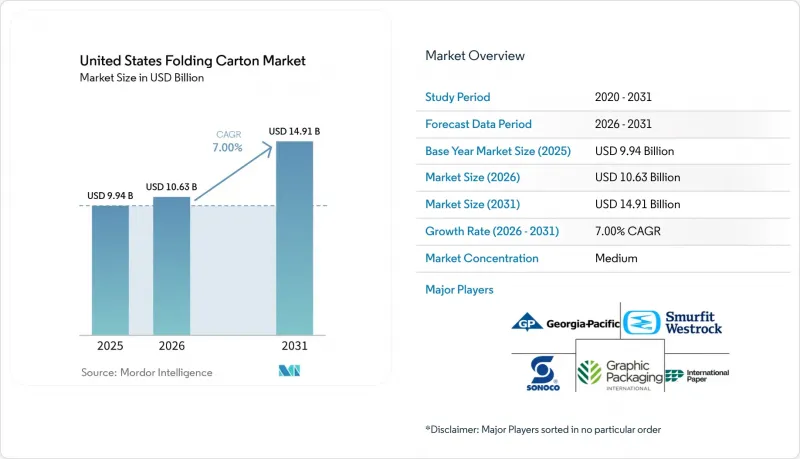
This report is Segmented by Material Type (Solid Bleached Sulfate, Folding Boxboard, Coated Unbleached Kraft, and More), Printing Technology (Lithographic, Flexographic, Digital, Gravure, and More), End-User Industry (Food and Beverage, Healthcare/Pharmaceuticals, Personal Care and Cosmetics, Electrical and Electronics, and More). The Market Forecasts are Provided in Terms of Value (USD).
United States Folding Carton Market Trends and Insights
E-Commerce Boom Driving Demand for Lightweight Protective Packaging
Boxes and cartons account for 40% of all e-commerce packaging formats, compelling converters to engineer right-sized structures that survive both shelf display and parcel networks. Automated systems that trim void space have cut average package weight by 43% in North America and lowered shipping damage by 24%, pushing demand toward folding cartons with ISTA-validated edges and reinforced corner scores. Digital presses now add variable QR codes that link to loyalty sites, meeting the 50% of consumers who scan codes and the retailers who plan universal 2D barcode acceptance by 2027. This convergence of automation, traceability, and omnichannel aesthetics is steering the United States folding cartons market away from commodity grades toward engineered formats.
Increasing Demand for Sustainable and Recyclable Packaging Solutions
Seven states enacted EPR statutes requiring producers to finance collection and recycling, with Minnesota mandating that all packaging be recyclable, reusable, refillable, or compostable by 2032 and to fund at least 90% of system costs by 2031. Washington's program phases in 90% reimbursement by 2032 and earmarks USD 5 million for reuse infrastructure starting in 2029. These laws impose eco-modulated fees that privilege recycled-fiber cartons with verifiable recovery rates, driving brand owners to swap virgin bleached board for folding boxboard containing higher post-consumer fiber. Oregon's 2026 constitutional challenge over fee transparency has heightened producer scrutiny of cost pass-through strategies, yet the long-term trajectory still favors recyclable-coated barriers and lightweight calipers. As a result, sustainable substrate selection is now intertwined with finance and compliance, giving recycled paperboard a lasting tailwind in the United States folding cartons market.
Volatility in Recovered Paper and Virgin Pulp Prices
Old corrugated containers (OCC) averaged USD 44 per ton in November 2025, sinking 41% from the prior year before rebounding USD 1 per ton in January 2026 as mills pre-bought for spring downtime. The Producer Price Index for high-grade recyclable pulp whipsawed from 77.411 in November 2025 to 87.545 in October 2025 and back to 82.723 by February 2026, underscoring monthly cost swings that distort contract budgeting. Chinese policy shifts requiring disclosure of wet versus dry recycled pulp imports cut export pull-through, intensifying domestic price uncertainty. Because folding carton converters typically adjust customer pricing with a 3- to 6-month lag, margin compression surfaces whenever OCC or virgin pulp spikes mid-cycle. Persistent volatility complicates strategic sourcing and discourages long-term price commitments in the United States folding carton industry.
Other drivers and restraints analyzed in the detailed report include:
- Premiumization in Food and Beverage Boosting High-Quality Printing
- State-Level Extended Producer Responsibility Legislation Accelerating Carton Adoption
- Capacity Expansion of Flexible Packaging Displacing Folding Cartons
For complete list of drivers and restraints, kindly check the Table Of Contents.
Segment Analysis
The United States folding carton market size for solid bleached sulfate captured 38.21% market share in 2025, underpinned by food, beverage, and pharmaceutical SKUs that require flawless ink laydown and certified food-contact surfaces. Folding boxboard is projected to outpace the overall market at an 8.19% CAGR, buoyed by EPR fee schedules that reward recycled content and by plentiful OCC priced at USD 44 per ton. Coated unbleached kraft serves grease-resistant, natural-aesthetic niches, while white line chipboard competes on cost for non-food secondary packs. Net recycled board capacity rose modestly in 2025 as Graphic Packaging's Waco mill ramp offset closures in Minnesota and Texas. Minnesota's EPR eco-modulation rules that favor weight reduction are pushing brands toward lighter caliper folding boxboard, reinforcing momentum away from virgin bleached substrates.
Converters that secure high-quality recycled furnish enjoy price resilience, because EPR fees linked to recycled content narrow the cost gap versus virgin grades. Packaging Corporation of America's acquisition of Greif's recycled mills raised its recycled mix from 20% to 30%, highlighting a strategic pivot toward fee-friendly substrates. These fiber-mix adjustments suggest that the United States folding cartons market will continue tilting toward recycled fiber, especially in regulated coastal states where fee structures directly impact total delivered cost.
List of Companies Covered in this Report:
- Smurfit Westrock plc
- Graphic Packaging Holding Company
- International Paper Company
- Sonoco Products Company
- Georgia-Pacific LLC
- Pratt Industries Inc.
- Atlantic Packaging Corp.
- Mayr-Melnhof Karton AG
- AR Packaging Group AB
- Clearwater Paper Corporation
- Hood Container Corporation
- PaperWorks Industries Inc.
- Bell Incorporated
- L Industrial Packaging
- JohnsByrne Company
- Curtis Packaging Corporation
- All Packaging Company
- American Carton Company
- Diamond Packaging
Additional Benefits:
- The market estimate (ME) sheet in Excel format
- 3 months of analyst support
TABLE OF CONTENTS
1 INTRODUCTION
- 1.1 Study Assumptions and Market Definition
- 1.2 Scope of the Study
2 RESEARCH METHODOLOGY
3 EXECUTIVE SUMMARY
4 MARKET LANDSCAPE
- 4.1 Market Overview
- 4.2 Industry Value Chain Analysis
- 4.3 Regulatory Landscape
- 4.4 Technological Outlook
- 4.5 Impact of Macroeconomic Factors on the Market
- 4.6 Porter's Five Forces Analysis
- 4.6.1 Threat of New Entrants
- 4.6.2 Bargaining Power of Suppliers
- 4.6.3 Bargaining Power of Buyers
- 4.6.4 Threat of Substitute Products
- 4.6.5 Competitive Rivalry
- 4.7 Market Drivers
- 4.7.1 E-commerce Boom Driving Demand for Lightweight Protective Packaging
- 4.7.2 Increasing Demand for Sustainable and Recyclable Packaging Solutions
- 4.7.3 Premiumization in Food and Beverage Boosting High-Quality Printing
- 4.7.4 Rapid Growth of Meal Kit and Ready-to-Eat Delivery Services
- 4.7.5 State-Level Extended Producer Responsibility Legislation Accelerating Carton Adoption
- 4.7.6 Rise of Pharmaceutical Cold-Chain Shipments Requiring Specialized Folding Cartons
- 4.8 Market Restraints
- 4.8.1 Volatility in Recovered Paper and Virgin Pulp Prices
- 4.8.2 Capacity Expansion of Flexible Packaging Displacing Folding Cartons
- 4.8.3 Supply Chain Disruptions from Trucker Shortages Increasing Lead Times
- 4.8.4 Labor Shortage in Skilled Press Operators Restricting Output Growth
5 MARKET SIZE AND GROWTH FORECASTS (VALUE)
- 5.1 By Material Type
- 5.1.1 Solid Bleached Sulfate
- 5.1.2 Folding Boxboard
- 5.1.3 Coated Unbleached Kraft
- 5.1.4 White Line Chipboard
- 5.1.5 Other Material Types
- 5.2 By Printing Technology
- 5.2.1 Lithographic Printing
- 5.2.2 Flexographic Printing
- 5.2.3 Digital Printing
- 5.2.4 Gravure Printing
- 5.2.5 Other Printing Technologies
- 5.3 By End-User Industry
- 5.3.1 Food and Beverage
- 5.3.2 Healthcare/Pharmaceuticals
- 5.3.3 Personal Care and Cosmetics
- 5.3.4 Electrical and Electronics
- 5.3.5 Household and Industrial Goods
- 5.3.6 Tobacco
- 5.3.7 E-commerce and Retail-ready Packaging
- 5.3.8 Other End-User Industries
6 COMPETITIVE LANDSCAPE
- 6.1 Market Concentration
- 6.2 Strategic Moves
- 6.3 Market Share Analysis
- 6.4 Company Profiles (includes Global Level Overview, Market Level Overview, Core Segments, Financials as available, Strategic Information, Market Rank/Share, Products and Services, Recent Developments)
- 6.4.1 Smurfit Westrock plc
- 6.4.2 Graphic Packaging Holding Company
- 6.4.3 International Paper Company
- 6.4.4 Sonoco Products Company
- 6.4.5 Georgia-Pacific LLC
- 6.4.6 Pratt Industries Inc.
- 6.4.7 Atlantic Packaging Corp.
- 6.4.8 Mayr-Melnhof Karton AG
- 6.4.9 AR Packaging Group AB
- 6.4.10 Clearwater Paper Corporation
- 6.4.11 Hood Container Corporation
- 6.4.12 PaperWorks Industries Inc.
- 6.4.13 Bell Incorporated
- 6.4.14 L Industrial Packaging
- 6.4.15 JohnsByrne Company
- 6.4.16 Curtis Packaging Corporation
- 6.4.17 All Packaging Company
- 6.4.18 American Carton Company
- 6.4.19 Diamond Packaging
7 MARKET OPPORTUNITIES AND FUTURE OUTLOOK
- 7.1 White-space and Unmet-Need Assessment

