PUBLISHER: Mordor Intelligence | PRODUCT CODE: 2063780

PUBLISHER: Mordor Intelligence | PRODUCT CODE: 2063780
China Roadside Safety Barriers Construction - Market Share Analysis, Industry Trends & Statistics, Growth Forecasts (2026 - 2031)
According to Mordor Intelligence, the china roadside safety barriers construction market size is projected to be USD 1.92 billion in 2025, USD 2.02 billion in 2026, and reach USD 2.63 billion by 2031, growing at a CAGR of 5.43% from 2026 to 2031.
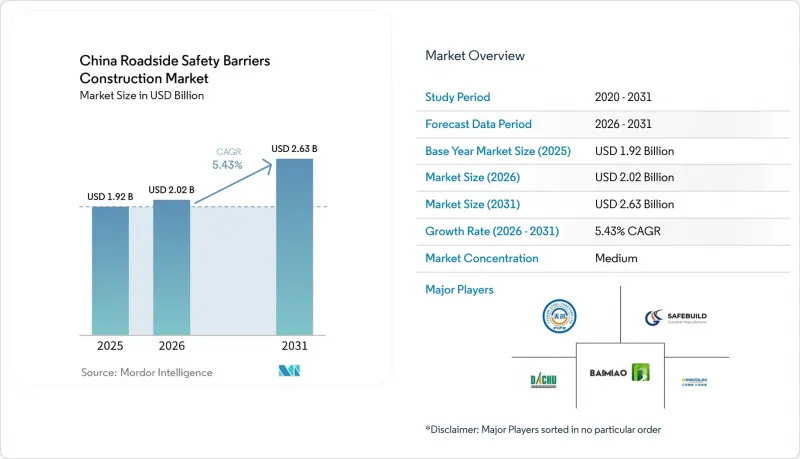
This report is Segmented by Product Type (Metal Guardrails, Concrete Barriers, and More), by Material (Steel, and More), by Application (Highways & Expressways, Urban Roads & Streets, and More), by Installation Type (New Installation, Renovation/Retrofit/Repair), and by Geography (Beijing, Shanghai, Shenzhen, and More). The Market Forecasts are Provided in Terms of Value (USD).
China Roadside Safety Barriers Construction Market Trends and Insights
Expansion of National Expressways and Intercity Highway Networks
China achieved record-high expansions of high-speed roadways in 2025, with projects already funded for 2026-2028 expected to sustain installation activities. In Hebei province alone, over USD 16.9 billion is allocated for new road construction next year, driving demand for barriers across six ongoing and seven new expressway sections. New lanes require continuous median and shoulder protection, meaning that each kilometer of roadway constructed directly correlates to increased demand for guardrails or cable systems. Provinces predominantly opt for standard W-beam barriers due to their proven crashworthiness, while flexible multi-rope cable solutions are increasingly specified for long, sweeping curves. This steady project pipeline provides manufacturers with clear volume forecasts, prompting them to localize production near emerging expressway hubs.
Strong Government Emphasis on Road-Safety Upgrades
GB 5768.9-2025, set to take effect in 2026, strengthens national regulations for traffic devices in accident-prone areas and increases the minimum crash-worthiness standards. Several provinces have promptly allocated funds for guardrail retrofits. Guizhou, Henan, Shanxi, and Fujian collectively spent over USD 5.5 million to replace sub-standard guardrails on critical expressways. Shanxi has taken an additional step by introducing DB 14/T 3328-2025, a local specification for low-carbon alloy steel, designed to ensure a service life of 25-30 years for new installations. Stricter barrier regulations are closely tied to reduced fatality targets, leading to robust enforcement and making compliance a mandatory criterion for bids. Suppliers with pre-certified products now hold a competitive advantage in provincial tenders.
High Costs of Installing and Maintaining Advanced Barrier Systems
Smart cables or composite barriers are 15-40% more expensive per kilometer than traditional galvanized steel, posing a challenge for counties with limited capital budgets. Despite their greater energy-absorption capacity, decision-makers often prioritize immediate needs, such as resurfacing or bridge repairs, over the higher upfront costs. Operating expenses are also higher, as tensioned wire-rope lines require calibrated retensioning, and sensor-equipped modules incur server fees and periodic software updates. Additionally, recent increases in rebar and wire prices have affected fixed-price contracts signed in 2024, leading several local agencies to postpone upgrades by 1 or 2 fiscal years. Without changes to subsidy formulas that account for lifecycle savings, these premium solutions are likely to remain limited to high-profile corridors.
Other drivers and restraints analyzed in the detailed report include:
- Rising Vehicle Ownership and Traffic Volumes
- Growth of Freight Corridors and Industrial Transport Routes
- Pricing Pressure in Large-Scale Public Road Projects
For complete list of drivers and restraints, kindly check the Table Of Contents.
Segment Analysis
Metal guardrails accounted for 63.4% of the China roadside safety barrier market share in 2025 and remain the standard choice for most new expressway projects. These W-beam and Thrie-beam units are manufactured from Q235B or Q355B steel and are compatible with the post-pounding equipment commonly used by contractors. With replacement installations achievable at a rate of 250-350 meters per crew-day, these guardrails are considered cost-effective and schedule-efficient by agencies. Ongoing supplier investments in thicker zinc-aluminum coatings and precise pre-punched slot tolerances have significantly reduced corrosion-related issues, further solidifying metal guardrails' dominance in the market.
Cable systems represent the fastest-growing sub-segment, with a projected compound annual growth rate (CAGR) of 6.05% through 2031. Their flexibility makes them particularly suitable for tight curves and narrow medians. Multi-rope arrays can withstand higher-energy impacts and can be quickly repaired after collisions by retensioning the wires rather than replacing damaged panels. Products such as Trinity Highway's ArmorWire and Valmont's ArmorGuard portable sections have successfully passed MASH TL-4 tests, providing provinces with reliable options for freight corridors. Although the initial capital cost per meter is approximately 20% higher than that of W-beam guardrails, lifecycle studies indicate repair costs are 15-20% lower, making cable systems an attractive choice for areas where minimizing lane closures is a priority.
Steel accounted for 70.3% of the China roadside safety barrier construction market in 2025 due to its consistent quality and compliance with GB/T 31439-2025 mechanical standards. Q355B sections, with a yield strength of 422 megapascals, are now priced only 3% higher than Q235B, leading more provinces to adopt the stronger grade. Additionally, zinc-aluminum-magnesium coatings extend the time-to-red-rust by 30% compared to pure zinc, reducing the frequency of repainting. These advancements ensure that steel remains a key component in transport agencies' procurement budgets.
Composites are projected to grow at a CAGR of 6.21% through 2031, driven by their non-corrosive properties, 25% higher impact absorption, and up to 30% lighter weight compared to steel, which simplifies logistics in mountainous regions of western China. Fiber-reinforced polymer posts were first used on the double-deck Shiziyang Link, where high salt-spray levels would typically cause metal corrosion. Pilot contracts often include 5-kilometer test sections to evaluate wear before broader adoption. If durability results continue to be favorable, the market share of composites could increase significantly, particularly for coastal bridges and tunnels where corrosion-related costs are higher.
List of Companies Covered in this Report:
- Jiangsu Guoqiang Singsun Energy Co., Ltd.
- Wuhan Dachu Traffic Facilities Co., Ltd.
- Hebei Tianchuang Pipe Co., Ltd.
- Shandong Baimiao New Materials Co., Ltd.
- Shandong Safebuild Traffic Facilities Co., Ltd.
- Shandong Guanxian Huiquan Traffic Facilities Co., Ltd.
- HuaAn Traffic Facilities Co., Ltd.
- Hebei Hongda Traffic Facility Co., Ltd.
- Shandong Hongda Traffic Facility Co., Ltd.
- Qingdao TaiCheng Transportation Facilities Co., Ltd.
- Beijing Roadsafe Technology Co., Ltd.
- Hunan ADTO Building Industrial Group Co., Ltd.
- Anping Baochuan Wire Mesh Products Co., Ltd.
- Suzhou Tongsu Traffic Engineering Co., Ltd.
- Nanjing Roadsky Traffic Facility Co., Ltd.
- Valmont China Structures Co., Ltd.
- Trinity Highway (Suzhou) Co., Ltd.
- Lindsay Asia-Pacific Barrier Systems
- Hill & Smith Barrier (Shanghai) Ltd.
- Cangzhou Develop Traffic Products Co., Ltd.
Additional Benefits:
- The market estimate (ME) sheet in Excel format
- 3 months of analyst support
TABLE OF CONTENTS
1 Introduction
- 1.1 Study Assumptions & Market Definition
- 1.2 Scope of the Study
2 Research Methodology
3 Executive Summary
4 Market Insights and Dynamics
- 4.1 Market Overview
- 4.2 Market Drivers
- 4.2.1 Expansion of national expressways and intercity highway networks
- 4.2.2 Strong government emphasis on road safety upgrades
- 4.2.3 Rising vehicle ownership and traffic volumes across urban regions
- 4.2.4 Growth of freight corridors and industrial transport routes
- 4.2.5 Modernization of existing highways with higher-grade safety systems
- 4.3 Market Restraints
- 4.3.1 High costs of installing and maintaining advanced barrier systems
- 4.3.2 Pricing pressure in large-scale public road projects
- 4.3.3 Regional inconsistency in material quality and installation practices
- 4.4 Value / Supply-Chain Analysis
- 4.5 Regulatory Landscape
- 4.6 Technological Outlook
- 4.7 Porter's Five Forces
- 4.7.1 Bargaining Power of Suppliers
- 4.7.2 Bargaining Power of Consumers
- 4.7.3 Threat of New Entrants
- 4.7.4 Threat of Substitutes
- 4.7.5 Intensity of Competitive Rivalry
5 Market Size & Growth Forecasts(Value, USD)
- 5.1 By Product Type
- 5.1.1 Metal Guardrails (W-beam, Thrie-beam)
- 5.1.2 Concrete Barriers (Jersey, F-shape)
- 5.1.3 Cable Barrier Systems
- 5.1.4 Crash Cushions & Impact Attenuators
- 5.1.5 Others (Motorcyclist Protection, Hybrid, Emerging)
- 5.2 By Material
- 5.2.1 Steel
- 5.2.2 Concrete
- 5.2.3 Plastic & Composite
- 5.2.4 Others (Aluminum, Rubber, Recycled Blends)
- 5.3 By Application
- 5.3.1 Highways & Expressways
- 5.3.2 Urban Roads & Streets
- 5.3.3 Bridges & Flyovers
- 5.3.4 Others (Rural, Industrial/Private, Parking, Tunnels, Temp Zones)
- 5.4 By Installation Type
- 5.4.1 New Installation
- 5.4.2 Renovation / Retrofit / Repair
- 5.5 By Major Cities
- 5.5.1 Beijing
- 5.5.2 Shanghai
- 5.5.3 Shenzhen
- 5.5.4 Guangzhou
- 5.5.5 Chengdu
- 5.5.6 Rest of China
6 Competitive Landscape
- 6.1 Market Concentration
- 6.2 Strategic Moves
- 6.3 Company Profiles (includes Global-level Overview, Market-level Overview, Core Segments, Financials as available, Strategic Information, Products & Services, Recent Developments)
- 6.3.1 Jiangsu Guoqiang Singsun Energy Co., Ltd.
- 6.3.2 Wuhan Dachu Traffic Facilities Co., Ltd.
- 6.3.3 Hebei Tianchuang Pipe Co., Ltd.
- 6.3.4 Shandong Baimiao New Materials Co., Ltd.
- 6.3.5 Shandong Safebuild Traffic Facilities Co., Ltd.
- 6.3.6 Shandong Guanxian Huiquan Traffic Facilities Co., Ltd.
- 6.3.7 HuaAn Traffic Facilities Co., Ltd.
- 6.3.8 Hebei Hongda Traffic Facility Co., Ltd.
- 6.3.9 Shandong Hongda Traffic Facility Co., Ltd.
- 6.3.10 Qingdao TaiCheng Transportation Facilities Co., Ltd.
- 6.3.11 Beijing Roadsafe Technology Co., Ltd.
- 6.3.12 Hunan ADTO Building Industrial Group Co., Ltd.
- 6.3.13 Anping Baochuan Wire Mesh Products Co., Ltd.
- 6.3.14 Suzhou Tongsu Traffic Engineering Co., Ltd.
- 6.3.15 Nanjing Roadsky Traffic Facility Co., Ltd.
- 6.3.16 Valmont China Structures Co., Ltd.
- 6.3.17 Trinity Highway (Suzhou) Co., Ltd.
- 6.3.18 Lindsay Asia-Pacific Barrier Systems
- 6.3.19 Hill & Smith Barrier (Shanghai) Ltd.
- 6.3.20 Cangzhou Develop Traffic Products Co., Ltd.
7 Market Opportunities & Future Outlook
- 7.1 White-space & Unmet-Need Assessment

