PUBLISHER: Mordor Intelligence | PRODUCT CODE: 2063811

PUBLISHER: Mordor Intelligence | PRODUCT CODE: 2063811
India Roadside Safety Barriers Construction - Market Share Analysis, Industry Trends & Statistics, Growth Forecasts (2026 - 2031)
According to Mordor Intelligence, the india roadside safety barriers construction market size was valued at USD 0.75 billion in 2025 and is estimated to grow from USD 0.81 billion in 2026 to reach USD 1.17 billion by 2031, at a CAGR of 7.69% during the forecast period (2026-2031).
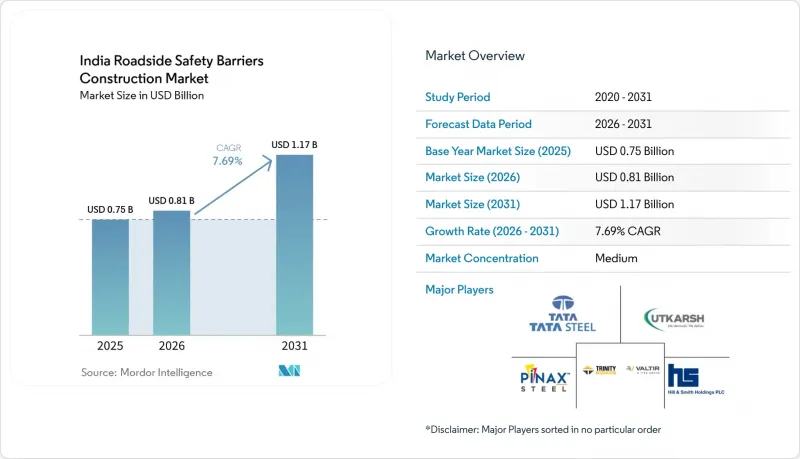
This report is Segmented by Product Type (Metal Guardrails, Concrete Barriers, and More), by Material (Steel, Concrete, and More), by Application (Highways & Expressways, and More), by Installation Type (New Installation, Renovation/Retrofit/Repair), and by Cities (Mumbai Metropolitan Region, Delhi NCR, and More). The Market Forecasts are Provided in Terms of Value (USD).
India Roadside Safety Barriers Construction Market Trends and Insights
Bharatmala, Expressway, and Access-Controlled Highway Expansion
The 34,800 km Phase-I scope under Bharatmala has significantly increased the demand for barriers, as each kilometer of a four-lane expressway requires approximately 2 km of median and roadside guardrails. The National Highways Authority of India (NHAI) plans to commission 23 expressways, spanning a total of about 7,800 km, by 2025. These expressways will feature full access control, necessitating continuous H2-rated thrie-beam systems at ramps, bridge approaches, and animal overpasses. Notable projects, such as the 1,380 km Delhi-Mumbai Expressway and the 343 km Bengaluru-Kadapa-Vijayawada corridor, highlight this shift, with barrier tonnage per route kilometer nearly doubling compared to older two-lane roads. With the national highway network expected to expand to 200,000 km by 2030, this growth is projected to sustain long-term demand for all types of roadside safety systems.
MoRTH and IRC Compliance Requirements for Standardized Barriers
Since 2024, the IRC:119-2015 crash-test certification has been a mandatory requirement for all highway projects exceeding USD 12 million. Contractors are required to provide NATRAX or EN 1317-2 test evidence before achieving payment milestones. A directive issued by the NHAI in December 2024 further strengthened these requirements by mandating embossed batch identifiers and QR codes on every metal-beam element, enabling a digital audit trail. This development has excluded smaller mills lacking the budget for testing. Premium accredited suppliers, such as Utkarsh India, Prakash Asphalting & Toll Highways (PATH), and Valmont India, now dominate expressway orders due to their H2 crash reports, which facilitate faster concessionaire approvals. As more state public works departments implement similar requirements between 2026 and 2028, standardized and traceable safety hardware is expected to become the default specification in the market.
Cost-Sensitive State Road Projects Limiting Higher-Spec Systems
Several financially constrained states continue to award contracts based solely on the lowest price, accepting underweight W-beam rails as thin as 2.5 mm and omitting galvanization to reduce costs by 15-20%. Limited central safety funding-amounting to just 0.2% of MoRTH's 2025 allocation-prevents the adoption of premium three-beam or cable solutions on many state highways, despite high fatality rates. Unless states allocate dedicated budgets for crash barriers or implement QR-code traceability similar to NHAI, a dual-quality market is likely to persist until at least 2028.
Other drivers and restraints analyzed in the detailed report include:
- Black-Spot Rectification Programs on Hazardous Stretches
- Rise in Bridge, Ghat-Road, and Elevated Corridor Construction
- Inconsistent Installation Quality and Maintenance
For complete list of drivers and restraints, kindly check the Table Of Contents.
Segment Analysis
In 2025, metal guardrails accounted for 49.1% of the India roadside safety barriers construction market, driven by their low installation cost of approximately USD 27 per meter and crash-tested performance suitable for four-lane highways. Major fabricators, such as Utkarsh India, supply up to 500 km of W- or thrie-beam guardrails monthly, enabling EPC contractors to complete entire projects without relying on overseas procurement. Frequent expressway contracts sustain the demand for bulk steel rails, black-spot retrofitting projects, and Indian Railways parallel-track developments. Additionally, the introduction of digital QR coding facilitates on-site compliance verification by inspectors.
The crash cushion and impact attenuator segment is the fastest-growing category, projected to achieve a CAGR of 8.19% by 2031. This growth is supported by the National Highways Authority of India's (NHAI) mandate for energy-absorbing devices at toll plazas, median openings, and ramp gores. International suppliers, such as Valtir's QuadGuard, compete with domestic manufacturers like Dhawal Safety India, prompting increased local investment in crash testing. Since attenuators contribute only 1-2% to overall civil costs while significantly reducing the severity of collisions, concessionaires are increasingly incorporating them early in Hybrid Annuity Model (HAM) bids. Over time, stricter enforcement of IRC: SP:84-2019 guidelines may shift the market share from purely steel rails to integrated systems that combine cushions and terminal treatments into certified solutions.
Steel accounted for 60.9% of the India roadside safety barriers construction market in 2025, supported by 16 million tons of new capacity from JSW Steel, which ensured steady coil availability despite global price increases. Additionally, ResponsibleSteel-certified meltshops enable builders to secure sustainability credits under the new federal tender scoring system. Tier-one fabricators maintain stocks of Fe360/Fe410 rails in 2.8-3.0 mm gauges and have integrated embossing, bending, and galvanizing processes under one facility, reducing lead times to less than one week for highway packages.
However, plastic and composite materials are projected to grow at the fastest rate, with a CAGR of 8.08% through 2031. PATH has already implemented an automated pultrusion line for producing glass-fiber-reinforced polymer (GFRP) rebars, capable of manufacturing 40,000 running meters daily. Furthermore, the installation of the world's first bamboo-steel hybrid barrier on Maharashtra's Vani-Warora highway in 2023 demonstrated that natural fibers can meet NATRAX impact test standards while reducing embodied carbon by 50%. If the Directorate General of Trade Remedies (DGTR) imposes anti-dumping duties on flat steel imports, concessionaires may expedite the adoption of bio-composites, particularly for greenfield projects with environmental performance requirements.
List of Companies Covered in this Report:
- Tata Steel Long Products
- Utkarsh India Ltd.
- Pinax Steel Industries
- Hill & Smith India
- Valtir (Trinity Highway Products India)
- Saral Industries
- Prakash Asphalting's & Toll Highways (India) Limited (PATH)
- Shreeram Guardrail Systems
- Shyam Metalics
- Lindsay Linyi Lindsay H-Shields (JV)
- Om Wire & Wire Products Industries
- Eros Metal Works
- JSW Steel Limited
- Vikas Industries
- Jindal SAW Infrastructure
- Valmont Structures India
- G R Infraprojects Limited (GRIL)
- Larsen & Toubro Limited (L&T)
- DG Road Safety Pvt. Ltd.
- Eastman Industries
Additional Benefits:
- The market estimate (ME) sheet in Excel format
- 3 months of analyst support
TABLE OF CONTENTS
1 Introduction
- 1.1 Study Assumptions & Market Definition
- 1.2 Scope of the Study
2 Research Methodology
3 Executive Summary
4 Market Insights and Dynamics
- 4.1 Market Overview
- 4.2 Market Drivers
- 4.2.1 Bharatmala, expressway, and access-controlled highway expansion increasing crash barrier installations
- 4.2.2 MoRTH and IRC compliance requirements driving adoption of standardized roadside and median barriers
- 4.2.3 Black-spot rectification programs increasing deployment of guardrails on hazardous highway stretches
- 4.2.4 Rising bridge, ghat-road, and elevated corridor construction boosting demand for edge protection barriers
- 4.2.5 EPC and HAM project models accelerating execution and integration of roadside safety systems
- 4.3 Market Restraints
- 4.3.1 Cost-sensitive state road projects limiting use of higher-spec roadside safety barrier systems
- 4.3.2 Inconsistent installation quality and maintenance reducing barrier performance on operational roads
- 4.3.3 Approval delays and fragmented execution across NHAI, state PWDs, and contractors slowing deployment
- 4.4 Value / Supply-Chain Analysis
- 4.5 Government Initiatives & Road Safety Programs
- 4.6 Regulatory Landscape
- 4.7 Technological Developments
- 4.8 Porter's Five Forces
- 4.8.1 Bargaining Power of Suppliers
- 4.8.2 Bargaining Power of Consumers
- 4.8.3 Threat of New Entrants
- 4.8.4 Threat of Substitutes
- 4.8.5 Intensity of Competitive Rivalry
- 4.9 Pricing Analysis
- 4.10 Supply-Demand Gap Analysis
- 4.10.1 Overview of Local Supply (Production and Key Players)
- 4.10.2 Overview of Market Demand (Projects and Usage)
- 4.10.3 Role of Imports in Meeting Demand
- 4.10.4 Overall Supply-Demand Gap Assessment
- 4.11 Key Projects & Infrastructure Pipeline
5 Market Size & Growth Forecasts (Value, USD)
- 5.1 By Product Type
- 5.1.1 Metal Guardrails (W-beam, Thrie-beam)
- 5.1.2 Concrete Barriers (Jersey, F-shape)
- 5.1.3 Cable Barrier Systems
- 5.1.4 Crash Cushions & Impact Attenuators
- 5.1.5 Others (Motorcyclist protection systems, hybrid/specialty barriers, emerging safety solutions)
- 5.2 By Material
- 5.2.1 Steel
- 5.2.2 Concrete
- 5.2.3 Plastic & Composite
- 5.2.4 Others (Aluminum, rubber-based materials, composite blends, recycled materials)
- 5.3 By Application
- 5.3.1 Highways & Expressways
- 5.3.2 Urban Roads & Streets
- 5.3.3 Bridges & Flyovers
- 5.3.4 Others (Rural roads, industrial/private roads, parking areas, tunnels, temporary traffic zones)
- 5.4 By Installation Type
- 5.4.1 New Installation
- 5.4.2 Renovation / Retrofit / Repair
- 5.5 By Cities
- 5.5.1 Mumbai Metropolitan Region
- 5.5.2 Delhi NCR
- 5.5.3 Pune
- 5.5.4 Bengaluru
- 5.5.5 Hyderabad
- 5.5.6 Chennai
- 5.5.7 Kolkata
- 5.5.8 Rest of India
6 Competitive Landscape
- 6.1 Market Concentration
- 6.2 Strategic Moves
- 6.3 Company Profiles (includes Global level Overview, Market level overview, Core Segments, Financials as available, Strategic Information, Products & Services, and Recent Developments)
- 6.3.1 Tata Steel Long Products
- 6.3.2 Utkarsh India Ltd.
- 6.3.3 Pinax Steel Industries
- 6.3.4 Hill & Smith India
- 6.3.5 Valtir (Trinity Highway Products India)
- 6.3.6 Saral Industries
- 6.3.7 Prakash Asphalting's & Toll Highways (India) Limited (PATH)
- 6.3.8 Shreeram Guardrail Systems
- 6.3.9 Shyam Metalics
- 6.3.10 Lindsay Linyi Lindsay H-Shields (JV)
- 6.3.11 Om Wire & Wire Products Industries
- 6.3.12 Eros Metal Works
- 6.3.13 JSW Steel Limited
- 6.3.14 Vikas Industries
- 6.3.15 Jindal SAW Infrastructure
- 6.3.16 Valmont Structures India
- 6.3.17 G R Infraprojects Limited (GRIL)
- 6.3.18 Larsen & Toubro Limited (L&T)
- 6.3.19 DG Road Safety Pvt. Ltd.
- 6.3.20 Eastman Industries
7 Market Opportunities & Future Outlook
- 7.1 White-space & Unmet-Need Assessment

