PUBLISHER: Mordor Intelligence | PRODUCT CODE: 2066656

PUBLISHER: Mordor Intelligence | PRODUCT CODE: 2066656
North America Lead Acid Battery - Market Share Analysis, Industry Trends & Statistics, Growth Forecasts (2026 - 2031)
According to Mordor Intelligence, the north america lead acid battery market size is expected to increase from USD 11.06 billion in 2025 to USD 11.53 billion in 2026 and reach USD 14.29 billion by 2031, growing at a CAGR of 4.39% over 2026-2031.
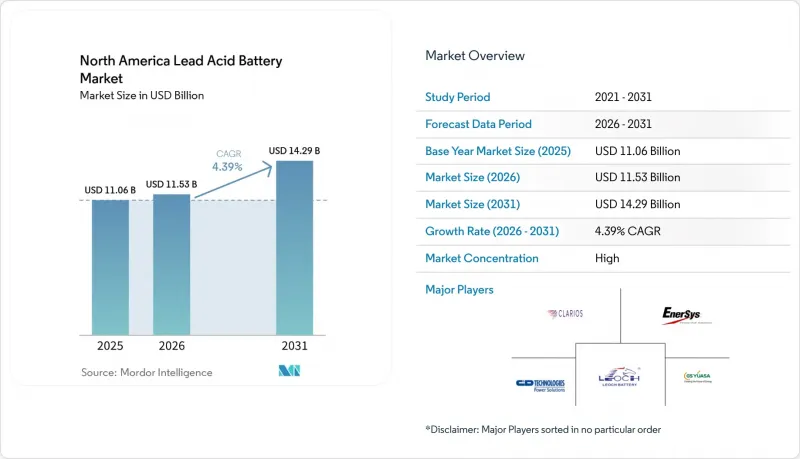
This report is Segmented by Construction Method (Flooded, VRLA), Application (Starting-Lighting-Ignition (SLI), Stationary, Motive/Traction (Forklifts, Golf-Carts), Portable and Others), and Geography (United States, Canada, Mexico). The Market Forecasts are Provided in Terms of Value (USD).
North America Lead Acid Battery Market Trends and Insights
Replacement Demand from Aging ICE-Vehicle Fleet
The U.S. fleet's record 12.6-year average age underpins a structural replacement wave because vehicles 11 years or older post a 37% annual battery swap rate. Battery Council International tracked 159 million lead acid units shipped in 2024, the bulk tied to replacement rather than factory-install volume. Growing electrical loads from start-stop technology and driver-assistance features hasten the shift from flooded batteries to absorbed-glass-mat (AGM) VRLA designs, which S&P Global projects will reach 19% of all aftermarket installs by 2027. O'Reilly Auto Parts named East Penn its 2025 Supplier of the Year after the vendor scaled DIN-size AGM output that could cover over 40% of vehicles in operation. Crucially, rural and lower-income buyers who retain internal-combustion vehicles longer slow EV cannibalization, extending the tail of the North America lead acid battery market.
Data-Center & Telecom UPS Expansion Boom
Hyperscale builds to serve artificial-intelligence workloads are lifting global data-center electricity demand toward 945 TWh by 2030, up from 460 TWh in 2022. VRLA batteries, especially AGM variants, still held 58% of the USD 4.33 billion global UPS battery segment in 2025. Texas Senate Bill 6 of 2024 requires on-site backup, which is spurring retrofit purchases even while greenfield projects choose lithium-ion for densification advantages. 5G tower roll-outs likewise favor VRLA at remote sites where sealed, maintenance-free units cut service visits. Although lithium-ion offers a 39% lower 10-year TCO, capital budgets and well-established recycling channels preserve VRLA relevance across a large installed base.
Rapid Cost Decline of Lithium-Ion Packs
DOE data show lithium-ion pack prices fell to USD 128-133 per kWh in 2024 from USD 150 per kWh in 2022, an 85% drop versus 2014 levels. In UPS service, that translates to a 39% lower 10-year TCO relative to VRLA, thanks to 8-15 year service life and 3,000-5,000 charge cycles. Forklift fleets mirror the shift: lithium-ion units recharge in 1-2 hours and deliver up to 4,000 cycles, saving on battery-swap rooms and spare-pack inventory. Global lithium-ion penetration in electric forklifts could jump from 32% in 2024 to over 70% by 2034, with the U.S. lagging because 50-60% of facilities still need costly electrical upgrades. Nonetheless, once upfront cost parity is crossed, lead acid must lean on its safety and circular-economy image to defend share in high-utilization segments.
Other drivers and restraints analyzed in the detailed report include:
- 48 V Mild-Hybrid Auxiliary Battery Adoption
- Closed-Loop Recycling Mandates Accelerating Supply Security
- Environmental & Health Concerns over Lead Toxicity
For complete list of drivers and restraints, kindly check the Table Of Contents.
Segment Analysis
VRLA units captured 64.3% of the North America lead acid battery market in 2025 and are expected to compound at 5.7% annually through 2031, outpacing conventional flooded cells. This leadership stems from sealed architectures that eliminate watering labor, reduce gas emissions, and simplify compliance with OSHA indoor-air rules. Within VRLA, AGM variants command momentum because faster charge acceptance slashes turnaround time for delivery vans and ride-hail vehicles that cycle hundreds of times per year. EnerSys invested USD 6.7 million in Sumter, South Carolina, during 2025 to expand thin-plate-pure-lead (TPPL) and AGM lines that promise 8-10 year life versus 3-5 years for flooded rivals.
Flooded batteries still serve cost-sensitive aftermarket channels and heavy-duty haul trucks where buyers prize deep-cycle robustness and lower list prices. Incremental innovation is emerging through lead-carbon hybrids that embed carbon in negative plates to boost partial-state-of-charge performance; pilot projects in Canadian Arctic micro-grids illustrate the chemistry's tolerance of -40 °C ambient temperatures without external heaters. Regulatory codes also tilt subtly toward VRLA UL 1989 certification, which is simpler for sealed units, and VRLA's spill-proof shell satisfies increasingly stringent local fire marshals overseeing data-center retrofit work. These factors collectively sustain VRLA's expanding role inside the North America lead acid battery market size even as flooded sales taper.
List of Companies Covered in this Report:
- Clarios
- East Penn Manufacturing
- EnerSys
- Exide Technologies
- C&D Technologies
- GS Yuasa Corporation
- Leoch International
- Power-Sonic Corporation
- Panasonic Holdings Corp
- Crown Battery Manufacturing
- Trojan Battery Company
- NorthStar Battery Company
Additional Benefits:
- The market estimate (ME) sheet in Excel format
- 3 months of analyst support
TABLE OF CONTENTS
1 Introduction
- 1.1 Study Assumptions & Market Definition
- 1.2 Scope of the Study
2 Research Methodology
3 Executive Summary
4 Market Landscape
- 4.1 Market Overview
- 4.2 Market Drivers
- 4.2.1 Replacement demand from aging ICE-vehicle fleet
- 4.2.2 Data-center & telecom UPS expansion boom
- 4.2.3 Cost competitiveness vs. lithium alternatives in SLI use-cases
- 4.2.4 48 V mild-hybrid auxiliary battery adoption
- 4.2.5 Lead-carbon batteries for remote micro-grids (Canada Arctic, off-grid mining)
- 4.2.6 Closed-loop recycling mandates accelerating domestic supply security
- 4.3 Market Restraints
- 4.3.1 Rapid cost decline of lithium-ion packs
- 4.3.2 Environmental & health concerns over lead toxicity
- 4.3.3 Impending tighter U.S. EPA ambient-lead limits
- 4.3.4 Recycled-lead supply volatility from scrap-export flows
- 4.4 Supply-Chain Analysis
- 4.5 Regulatory Landscape
- 4.6 Technological Outlook
- 4.7 Porter's Five Forces
- 4.7.1 Bargaining Power of Suppliers
- 4.7.2 Bargaining Power of Buyers
- 4.7.3 Threat of New Entrants
- 4.7.4 Threat of Substitutes
- 4.7.5 Intensity of Rivalry
5 Market Size & Growth Forecasts
- 5.1 By Construction Method
- 5.1.1 Flooded
- 5.1.2 VRLA
- 5.2 By Application
- 5.2.1 Starting-Lighting-Ignition (SLI)
- 5.2.2 Stationary
- 5.2.3 Motive/Traction (Forklifts, Golf-carts)
- 5.2.4 Portable and Others
- 5.3 By Geography
- 5.3.1 United States
- 5.3.2 Canada
- 5.3.3 Mexico
6 Competitive Landscape
- 6.1 Market Concentration
- 6.2 Strategic Moves (M&A, Partnerships, PPAs)
- 6.3 Market Share Analysis (Market Rank/Share for key companies)
- 6.4 Company Profiles (includes Global level Overview, Market level overview, Core Segments, Financials as available, Strategic Information, Products & Services, and Recent Developments)
- 6.4.1 Clarios
- 6.4.2 East Penn Manufacturing
- 6.4.3 EnerSys
- 6.4.4 Exide Technologies
- 6.4.5 C&D Technologies
- 6.4.6 GS Yuasa Corporation
- 6.4.7 Leoch International
- 6.4.8 Power-Sonic Corporation
- 6.4.9 Panasonic Holdings Corp
- 6.4.10 Crown Battery Manufacturing
- 6.4.11 Trojan Battery Company
- 6.4.12 NorthStar Battery Company
7 Market Opportunities & Future Outlook
- 7.1 White-space & Unmet-Need Assessment

