PUBLISHER: Mordor Intelligence | PRODUCT CODE: 2066672

PUBLISHER: Mordor Intelligence | PRODUCT CODE: 2066672
North America Automotive Adhesives And Sealants - Market Share Analysis, Industry Trends & Statistics, Growth Forecasts (2026 - 2031)
According to Mordor Intelligence, the north america automotive adhesives and sealants market size is expected to grow from USD 1.35 billion in 2025 to USD 1.44 billion in 2026 and is forecast to reach USD 1.96 billion by 2031 at 6.38% CAGR over 2026-2031.
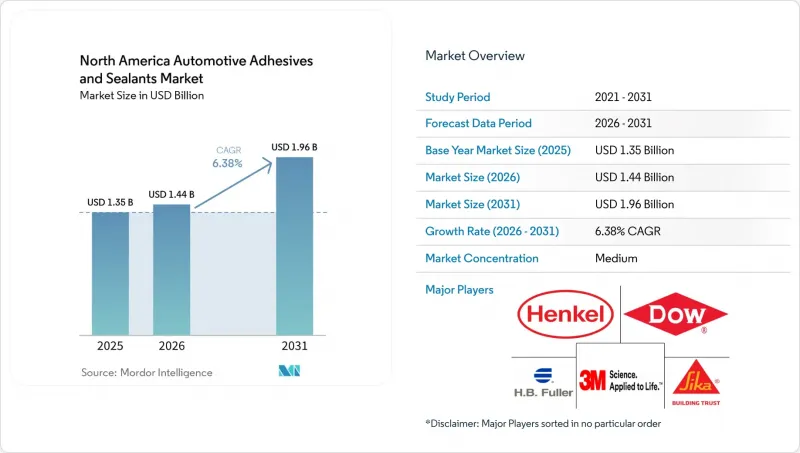
This report is Segmented by Resin (Polyurethane, Acrylic, Cyanoacrylate, Epoxy, Silicone, VAE/EVA, and Other Resins), Technology (Reactive, Hot-Melt, Sealants, Solvent-Borne, UV-Cured, and Water-Borne), and Geography (United States, Canada, and Mexico). The Market Forecasts are Provided in Terms of Value (USD).
North America Automotive Adhesives And Sealants Market Trends and Insights
Surging EV-Specific Bonding Requirements
Gigafactory investments are redefining adhesive specifications. Panasonic Energy's Kansas plant requires epoxies with thermal conductivity exceeding 2 W/m*K, while Volkswagen's Ontario facility has approved silicone thermal interface materials that retain 80% bond strength after 3,000 thermal cycles. Dispensing robots at the Tesla-LG joint venture in Michigan utilize UV-cured chemistries that achieve a tack-free state in under 10 seconds, enabling automation-compatible products that reduce cycle times without compromising dielectric performance. Federal grants worth USD 100 million are supporting R&D into solid-state cell encapsulation, driving demand for flame-retardant adhesives that meet UL 94 V-0 flammability standards.
Lightweighting Mandates Across USMCA
USMCA content rules are accelerating the transition from steel to aluminum and carbon-fiber composites, which cannot be welded. Compliance rates for Mexican-origin vehicles reached 76.1% by July 2025, an increase of 8 percentage points over two years. Ford's F-150 Lightning and GM's Silverado EV rely on crash-resistant epoxies to bond aluminum extrusions to steel subframes, with associated surface-preparation primers now contributing an 8-12% increase in adhesive system costs.
Raw-Material Volatility for Petro-Resins
Unplanned outages at BASF and Wanhua caused TDI spot prices to rise by 8.13% in March 2026, while aniline, a key feedstock, increased by 18% in Q4 2024 due to gas price spikes and higher ocean freight costs. Acrylic monomer supply tightened by 12% in 2025 as Chinese producers reduced output to meet carbon-intensity targets, squeezing margins for North American compounders. While formulators implemented quarterly adjustment clauses, Tier-1 suppliers bound by annual contracts faced USD 40-60 million in margin erosion during 2025.
Other drivers and restraints analyzed in the detailed report include:
- OEM Shift to Mixed-Material Body-in-White
- Rapid Growth of Battery Gigafactories
- Limited High-Temperature Recyclability
For complete list of drivers and restraints, kindly check the Table Of Contents.
Segment Analysis
Polyurethane accounted for 25.35% of the 2025 demand in the North America automotive adhesives and sealants market due to its adaptability in structural bonding, NVH damping, and seam sealing. However, VAE/EVA resins are anticipated to grow at a 6.45% CAGR through 2031, as interior-trim manufacturers prioritize low-temperature activation, which reduces oven energy consumption by 30% and supports recycling efforts. Epoxy remains critical for crash-critical joints requiring tensile strength above 25 MPa, while silicone usage is increasing in battery thermal-management applications due to its stability across a temperature range of -40 °C to +150 °C. Acrylics, including cyanoacrylates, are gaining traction in niche rapid-assembly applications, such as sensor brackets, due to their sub-60-second fixture-free curing times. Additionally, "other resins," such as polyimides, command premium margins in thermal-barrier applications.
The growth of VAE/EVA aligns with OEM commitments to increase recycled content, while Henkel's 60% bio-based polyurethane demonstrates how polyurethanes can meet sustainability goals without compromising lap-shear strength below 5 MPa. Epoxy suppliers are developing toughened grades to address differential expansion in mixed-material joints, and silicone formulators are enhancing dielectric strength beyond 20 kV/mm to meet the requirements of high-voltage battery designs. Cyanoacrylate developers are integrating UV and moisture curing for shadowed areas, expanding their use in automated ADAS module production lines. Overall, resin selection is shifting toward chemistries that balance mechanical performance with reduced energy consumption and improved end-of-life recyclability, reflecting the ongoing transition in the North America automotive adhesives and sealants market.
List of Companies Covered in this Report:
- 3M
- Arkema
- Ashland
- Avery Dennison Corp.
- Dow
- DuPont
- Dymax
- H.B. Fuller Company
- Henkel AG & Co. KGaA
- Huntsman International
- ITW Performance Polymers
- Jowat SE
- MasterBond
- Matrix Adhesives Group
- PARKER HANNIFIN CORP
- Permabond LLC
- Sika AG
- Wacker Chemie AG
Additional Benefits:
- The market estimate (ME) sheet in Excel format
- 3 months of analyst support
TABLE OF CONTENTS
1 Introduction
- 1.1 Study Assumptions and Market Definition
- 1.2 Scope of the Study
2 Research Methodology
3 Executive Summary
4 Market Landscape
- 4.1 Market Overview
- 4.2 Market Drivers
- 4.2.1 Surging EV-specific bonding requirements
- 4.2.2 Lightweighting mandates across USMCA
- 4.2.3 OEM shift to mixed-material body-in-white
- 4.2.4 Rapid growth of battery gigafactories
- 4.2.5 Tier-1 adoption of smart curing lines
- 4.2.6 IRA-driven reshoring of supply chains
- 4.3 Market Restraints
- 4.3.1 Raw-material volatility for petro-resins
- 4.3.2 Limited high-temperature recyclability
- 4.3.3 OSHA scrutiny on isocyanate exposure
- 4.3.4 Scale-up risk for bio-based chemistries
- 4.4 Value Chain Analysis
- 4.5 Porter's Five Forces
- 4.5.1 Threat of New Entrants
- 4.5.2 Bargaining Power of Suppliers
- 4.5.3 Bargaining Power of Buyers
- 4.5.4 Threat of Substitutes
- 4.5.5 Competitive Rivalry
5 Market Size and Growth Forecasts (Value)
- 5.1 By Resin
- 5.1.1 Polyurethane
- 5.1.2 Acrylic
- 5.1.3 Cyanoacrylate
- 5.1.4 Epoxy
- 5.1.5 Silicone
- 5.1.6 VAE/EVA
- 5.1.7 Other Resins
- 5.2 By Technology
- 5.2.1 Reactive
- 5.2.2 Hot-melt
- 5.2.3 Sealants
- 5.2.4 Solvent-borne
- 5.2.5 UV-cured
- 5.2.6 Water-borne
- 5.3 By Geography
- 5.3.1 United States
- 5.3.2 Canada
- 5.3.3 Mexico
6 Competitive Landscape
- 6.1 Market Concentration
- 6.2 Strategic Moves
- 6.3 Market Share (%)/Ranking Analysis
- 6.4 Company Profiles (includes Global level Overview, Market level overview, Core Segments, Financials as available, Strategic Information, Products and Services, and Recent Developments)
- 6.4.1 3M
- 6.4.2 Arkema
- 6.4.3 Ashland
- 6.4.4 Avery Dennison Corp.
- 6.4.5 Dow
- 6.4.6 DuPont
- 6.4.7 Dymax
- 6.4.8 H.B. Fuller Company
- 6.4.9 Henkel AG & Co. KGaA
- 6.4.10 Huntsman International
- 6.4.11 ITW Performance Polymers
- 6.4.12 Jowat SE
- 6.4.13 MasterBond
- 6.4.14 Matrix Adhesives Group
- 6.4.15 PARKER HANNIFIN CORP
- 6.4.16 Permabond LLC
- 6.4.17 Sika AG
- 6.4.18 Wacker Chemie AG
7 Market Opportunities and Future Outlook
- 7.1 White-space and Unmet-Need Assessment

