
PUBLISHER: Mordor Intelligence | PRODUCT CODE: 2073415

PUBLISHER: Mordor Intelligence | PRODUCT CODE: 2073415
Europe Pet Nutraceuticals - Market Share Analysis, Industry Trends & Statistics, Growth Forecasts (2026 - 2031)
According to Mordor Intelligence, the europe pet nutraceuticals market size is expected to grow from USD 1.81 billion in 2025 to USD 1.96 billion in 2026 and is forecast to reach USD 2.88 billion by 2031 at 8.05% CAGR over 2026-2031.
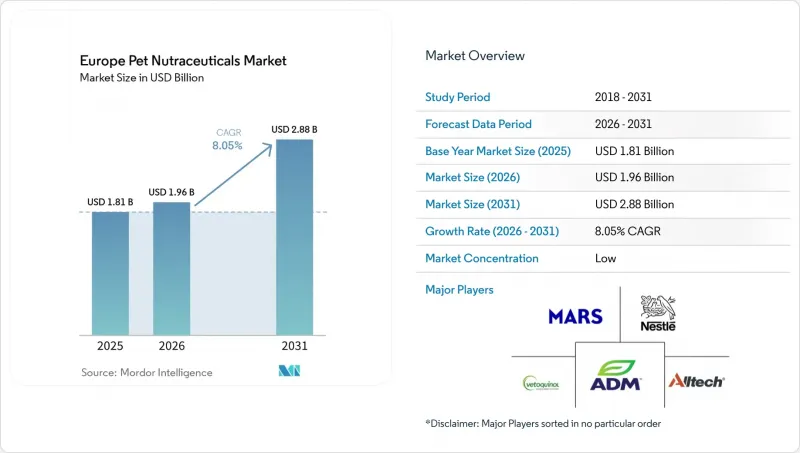
This report is Segmented by Sub Product (Milk Bioactives, Omega-3 Fatty Acids, Probiotics, and More), Pets (Cats, Dogs, and More), Distribution Channel (Convenience Stores, Online Channel, and More), and Country (France, Germany, Italy, and More). The Market Forecasts are Provided in Terms of Value (USD) and Volume (Metric Tons).
Europe Pet Nutraceuticals Market Trends and Insights
Pet Humanization and Premium Spending Trends
European pet owners are increasingly viewing their companions as family members, which is fundamentally altering their purchasing behavior toward premium, functional products. In 2023, European owners are increasingly treating their pets as family members, and 85% of consumers believe that nutrition and supplements are equally important for pets and humans. [1]. The phenomenon creates market opportunities for cognitive support formulations targeting aging pets, where owners seek to maintain their companions' mental acuity and quality of life. Premium positioning enables manufacturers to achieve higher margins by investing in clinical validation studies that differentiate their products from commodity offerings. This trend particularly benefits specialized nutraceutical companies that can articulate clear health benefits through veterinary partnerships and evidence-based marketing.
Preventive Pet Healthcare Awareness and Veterinary Recommendations
Veterinarians across Europe integrate nutraceutical protocols into routine wellness visits, moving intervention upstream from disease treatment to prevention. Research on glucosamine, lactoferrin, and species-specific probiotics underpins evidence-based recommendations that foster long-term purchasing patterns. The European pet nutraceuticals market benefits as owners purchase subscription packs tailored to life-stage needs, supporting predictable revenue for manufacturers. Veterinary endorsement also mitigates consumer skepticism about functional claims. This professional alignment elevates product standards and intensifies demand for third-party laboratory verification of ingredient purity.
Fragmented European Regulatory Frameworks Prolong Market Entry
The fragmented nature of Europe's pet supplement regulations creates significant barriers for companies seeking to introduce novel ingredients or make health claims across multiple member states. EFSA's (European Food Safety Authority) rigorous approval processes for feed additives, while ensuring safety, can extend product development timelines by 18-24 months compared with other global markets . Companies must navigate varying national interpretations of European directives, creating compliance costs that disproportionately impact smaller innovators. The regulatory burden particularly affects functional ingredients with novel mechanisms of action, where extensive safety and efficacy documentation requirements favor established players with regulatory expertise and financial resources.
Other drivers and restraints analyzed in the detailed report include:
- Online And Direct-to-Consumer Channel Expansion
- Veterinary Microbiome Diagnostics Enabling Personalized Nutrition
- Marine Oil and Probiotic Ingredient Cost Inflation
For complete list of drivers and restraints, kindly check the Table Of Contents.
Segment Analysis
Proteins and Peptides captured 22.95% of Europe pet nutraceuticals market share in 2025. Proteins and Peptides segments capitalize on bioactive collagen research demonstrating joint health benefits in clinical trials, while Vitamins and Minerals maintain steady demand through foundational nutrition applications. Other Nutraceuticals encompasses emerging categories, including botanical extracts and novel functional ingredients awaiting regulatory approval. It reflects the increasing sophistication of European pet owners in understanding the benefits of specific pet food ingredients, creating opportunities for companies that can communicate complex nutritional science through veterinary partnerships and educational marketing initiatives.
Milk Bioactives is achieving the fastest growth, with a 6.86% CAGR through 2031, driven by the clinical validation of immunoglobulin and lactoferrin benefits for immune system support. Emerging research on postbiotic metabolites represents a significant innovation opportunity beyond traditional probiotic formulations, with companies developing heat-stable alternatives that maintain efficacy through manufacturing processes .
Complete Report Scope:
- Sub Product
- Milk Bioactives
- Omega-3 Fatty Acids
- Probiotics
- Proteins and Peptides
- Vitamins and Minerals
- Other Nutraceuticals
- Pets
- Cats
- Dogs
- Other Pets
- Distribution Channel
- Convenience Stores
- Online Channel
- Specialty Stores
- Supermarkets/Hypermarkets
- Other Channels
- Country
- France
- Germany
- Italy
- Netherlands
- Poland
- Russia
- Spain
- United Kingdom
- Rest of Europe
List of Companies Covered in this Report:
- Mars, Incorporated
- ADM
- Clearlake Capital Group, L.P. (Wellness Pet Company, Inc.)
- Nestle (Purina)
- Nutramax Laboratories, Inc.
- Vetoquinol
- Alltech
- Virbac
- VAFO Group a.s.
- Dechra Pharmaceuticals PLC
- Zesty Paws
- Blue Buffalo (General Mills)
- Kemin Industries
- DSM-Firmenich
- Symrise AG
Additional Benefits:
- The market estimate (ME) sheet in Excel format
- 3 months of analyst support
TABLE OF CONTENTS
1 INTRODUCTION
- 1.1 Study Assumptions & Market Definition
- 1.2 Scope of the Study
- 1.3 Research Methodology
2 REPORT OFFERS
3 EXECUTIVE SUMMARY & KEY FINDINGS
4 KEY INDUSTRY TRENDS
- 4.1 Pet Population
- 4.1.1 Cats
- 4.1.2 Dogs
- 4.1.3 Other Pets
- 4.2 Pet Expenditure
- 4.3 Consumer Trends
5 SUPPLY AND PRODUCTION DYNAMICS
- 5.1 Trade Analysis
- 5.2 Ingredient Trends
- 5.3 Value Chain & Distribution Channel Analysis
- 5.4 Regulatory Framework
- 5.5 Market Drivers
- 5.5.1 Pet humanization and premium spending trends
- 5.5.2 Preventive pet healthcare awareness and veterinary recommendations
- 5.5.3 Online and direct-to-consumer channel expansion
- 5.5.4 Veterinary microbiome diagnostics enabling personalized nutrition
- 5.5.5 Europe Green Deal incentives for sustainable ingredient sourcing
- 5.5.6 Aging pet population demographics are driving geriatric formulations
- 5.6 Market Restraints
- 5.6.1 Fragmented European regulatory frameworks prolong market entry
- 5.6.2 Marine oil and probiotic ingredient cost inflation
- 5.6.3 Raw diet trends reducing supplement dependency
- 5.6.4 Dairy bioactive supply chain vulnerabilities
6 MARKET SIZE AND GROWTH FORECASTS (VALUE AND VOLUME)
- 6.1 Sub Product
- 6.1.1 Milk Bioactives
- 6.1.2 Omega-3 Fatty Acids
- 6.1.3 Probiotics
- 6.1.4 Proteins and Peptides
- 6.1.5 Vitamins and Minerals
- 6.1.6 Other Nutraceuticals
- 6.2 Pets
- 6.2.1 Cats
- 6.2.2 Dogs
- 6.2.3 Other Pets
- 6.3 Distribution Channel
- 6.3.1 Convenience Stores
- 6.3.2 Online Channel
- 6.3.3 Specialty Stores
- 6.3.4 Supermarkets/Hypermarkets
- 6.3.5 Other Channels
- 6.4 Country
- 6.4.1 France
- 6.4.2 Germany
- 6.4.3 Italy
- 6.4.4 Netherlands
- 6.4.5 Poland
- 6.4.6 Russia
- 6.4.7 Spain
- 6.4.8 United Kingdom
- 6.4.9 Rest of Europe
7 COMPETITIVE LANDSCAPE
- 7.1 Key Strategic Moves
- 7.2 Market Share Analysis
- 7.3 Brand Positioning Matrix
- 7.4 Market Claim Analysis
- 7.5 Company Landscape
- 7.6 Company Profiles (includes Global Level Overview, Market Level Overview, Core Business Segments, Financials, Key Information, Market Rank, Market Share, Products and Services, and Analysis of Recent Developments).
- 7.6.1 Mars, Incorporated
- 7.6.2 ADM
- 7.6.3 Clearlake Capital Group, L.P. (Wellness Pet Company, Inc.)
- 7.6.4 Nestle (Purina)
- 7.6.5 Nutramax Laboratories, Inc.
- 7.6.6 Vetoquinol
- 7.6.7 Alltech
- 7.6.8 Virbac
- 7.6.9 VAFO Group a.s.
- 7.6.10 Dechra Pharmaceuticals PLC
- 7.6.11 Zesty Paws
- 7.6.12 Blue Buffalo (General Mills)
- 7.6.13 Kemin Industries
- 7.6.14 DSM-Firmenich
- 7.6.15 Symrise AG
8 KEY STRATEGIC QUESTIONS FOR PET NUTRACEUTICALS CEOS

