PUBLISHER: Mordor Intelligence | PRODUCT CODE: 2073586

PUBLISHER: Mordor Intelligence | PRODUCT CODE: 2073586
ASEAN Cyber Security - Market Share Analysis, Industry Trends & Statistics, Growth Forecasts (2026 - 2031)
According to Mordor Intelligence, the ASEAN cybersecurity market size was valued at USD 5.51 billion in 2025 and estimated to grow from USD 6.44 billion in 2026 to reach USD 14.1 billion by 2031, at a CAGR of 16.95% during the forecast period (2026-2031).
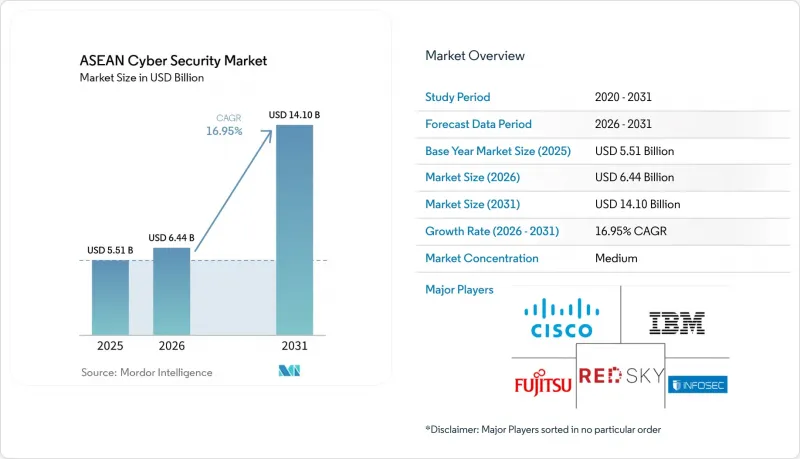
This report Segments the Industry Into by Offering (Solutions, and Services), Deployment Mode (On-Premise, and Cloud), End-User Vertical (BFSI, Healthcare, IT and Telecom, Industrial and Defense, Manufacturing, Retail and E-Commerce, Energy and Utilities, Manufacturing, and Others), End-User Enterprise Size (Small and Medium Enterprises (SMEs), and Large Enterprises), and Country.
ASEAN Cyber Security Market Trends and Insights
Intensifying Zero-Trust Adoption in Singapore-led BFSI Sector
Banks in Singapore accelerated zero-trust rollouts after the Monetary Authority updated its technology risk guidelines in 2024. Financial institutions across Malaysia and Thailand now mirror the approach to secure open-banking APIs, mobile wallets and cloud cores. Globe's GCash grew its internal cyber team five-fold to protect PHP 1 trillion in annual transactions, illustrating how headcount expansion parallels architectural change. Vendors gain from higher licence volumes for identity governance, micro-segmentation and continuous authentication, while service providers benefit from design and managed detection mandates. As regulators emphasise resilience tests, zero-trust has moved from best practice to baseline, underpinning sustained spending momentum in the ASEAN cybersecurity market.
Explosive IoT-Inflicted Attack Surface in Indonesian Manufacturing and Smart-Cities
Industry 4.0 pilots across Java and Sumatra add sensors, AGVs and edge gateways that were never hardened for hostile networks. Alliance Laundry Systems' 5G-enabled line in Batam mirrors projects across ASEAN, with each plant hosting tens of thousands of unmanaged endpoints that demand network segmentation, NAC and anomaly analytics. Local system integrators partner global OEMs to retrofit OT-security, while insurers increasingly insist on asset-discovery audits before underwriting. Similar smart-city grids in Bangkok and Ho Chi Minh City amplify the region-wide call for IoT-centric threat modelling, sustaining double-digit growth in the ASEAN cybersecurity market.
High Total-Cost-of-Ownership for Multi-Cloud SecOps in SMEs
Only 11% of Vietnamese firms report incident preparedness despite facing 659,000 attacks in 2024. The need for dedicated tooling across AWS, Azure and Google Cloud drives licence duplication, complex integration and spiraling analyst workloads. Training, threat-intel feeds and 24/7 monitoring further elevate opex, forcing many SMEs to opt for baseline controls, widening the exposure gap inside the ASEAN cybersecurity market.
Other drivers and restraints analyzed in the detailed report include:
- ASEAN Government-Funded SOC and CERT Investments
- Surging E-Commerce Data-Leak Fines Under PDPA
- Fragmented Data-Protection Regulations Across 10 Member States
For complete list of drivers and restraints, kindly check the Table Of Contents.
Segment Analysis
Solutions captured 54.12% of ASEAN cybersecurity market share in 2025, anchored by demand for integrated platforms that unify endpoint, network and cloud controls. Identity-and-access suites, next-generation firewalls and XDR stacks dominate initial purchase cycles, creating lock-in effects that fortify vendor renewals. Professional and managed services rise at 18.95% CAGR as enterprises confront skills shortages and regulatory audits that require continuous monitoring and bespoke compliance mapping. Malaysia's plan to train 25,000 cyber defenders by 2025 underscores the services imperative.
The ASEAN cybersecurity market size attributable to services will likely reach mid-single-billion-dollar levels by 2031 as organizations outsource tier-one alert handling, purple-team simulations and compliance documentation. Regional MSSPs bundle advisory, integration and operations in outcome-based contracts, accelerating adoption among late-digitizing sectors such as manufacturing and utilities.
Cloud deployments held 57.34% of the ASEAN cybersecurity market size in 2025, rising on the back of SaaS adoption among SMEs and greenfield ventures. Prisma Cloud, GuardDuty and Defender for Cloud enable rapid threat-hunting, posture scoring and automated remediation without upfront capex, making them attractive in price-sensitive economies. Hybrid reference architecture remains for banks and healthcare groups bound by data-residency mandates, yet even these institutions extend visibility tooling to multi-cloud workloads.
The ASEAN cybersecurity market continues to record 19.88% CAGR in cloud-security spend as shift-left DevSecOps, container security and CNAPP platforms become default procurement. On-premise appliance refresh cycles stretch to five years or more, solidifying the structural tilt toward cloud-native controls.
Complete Report Scope:
- By Offering
- Solutions
- Application Security
- Cloud Security
- Data Security
- Identity and Access Management
- Infrastructure Protection
- Integrated Risk Management
- Network Security Equipment
- Endpoint Security
- Other Services
- Services
- Professional Services
- Managed Services
- Solutions
- By Deployment Mode
- On-Premise
- Cloud
- By End-User Vertical
- BFSI
- Healthcare
- IT and Telecom
- Industrial and Defense
- Manufacturing
- Retail and E-commerce
- Energy and Utilities
- Manufacturing
- Others
- By End-User Enterprise Size
- Small and Medium Enterprises (SMEs)
- Large Enterprises
- By Country
- Singapore
- Malaysia
- Thailand
- Indonesia
- Philippines
- Vietnam
- Rest of ASEAN (Brunei, Cambodia, Laos, Myanmar)
List of Companies Covered in this Report:
- Cisco Systems Inc.
- Fortinet Inc.
- Palo Alto Networks Inc.
- Trend Micro Incorporated
- IBM Corporation
- Check Point Software Technologies Ltd.
- Huawei Technologies Co. Ltd.
- Microsoft Corp.
- Kaspersky Lab
- Dell Technologies Inc.
- Broadcom Inc. (Symantec Enterprise)
- Splunk Inc.
- Sophos Ltd.
- Darktrace plc
- Zscaler Inc.
- F5 Inc.
- CrowdStrike Holdings Inc.
- Imperva Inc.
- Cybereason Inc.
- SEC Consult (Atos Group)
Additional Benefits:
- The market estimate (ME) sheet in Excel format
- 3 months of analyst support
TABLE OF CONTENTS
1 INTRODUCTION
- 1.1 Study Assumptions and Market Definition
- 1.2 Scope of the Study
2 RESEARCH METHODOLOGY
3 EXECUTIVE SUMMARY
4 MARKET LANDSCAPE
- 4.1 Market Overview
- 4.2 Market Drivers
- 4.2.1 Intensifying Zero-Trust Adoption in Singapore-led BFSI Sector
- 4.2.2 Explosive IoT-inflicted Attack Surface in Indonesian Manufacturing & Smart-Cities
- 4.2.3 ASEAN Government-Funded SOC & CERT Investments
- 4.2.4 Rapid SASE Roll-outs Among Thai Telcos to Monetise 5G Enterprise Edge
- 4.2.5 Growing Cyber-Insurance Mandates for Listed Firms on SGX & Bursa Malaysia
- 4.2.6 Surging e-Commerce Data-Leak Fines under PDPA (Thailand & Philippines)
- 4.3 Market Restraints
- 4.3.1 High Total-Cost-of-Ownership for Multi-Cloud SecOps in SMEs
- 4.3.2 Fragmented Data-Protection Regulations Across 10 Member States
- 4.3.3 Shortage of GIAC-Certified Professionals in Emerging CLMV Cluster
- 4.3.4 Low Cyber-Resilience Culture within Family-Owned Conglomerates
- 4.4 Evaluation of Critical Regulatory Framework
- 4.5 Value Chain Analysis
- 4.6 Technological Outlook
- 4.7 Porter's Five Forces
- 4.7.1 Bargaining Power of Suppliers
- 4.7.2 Bargaining Power of Buyers
- 4.7.3 Threat of New Entrants
- 4.7.4 Threat of Substitutes
- 4.7.5 Competitive Rivalry
- 4.8 Key Use Cases and Case Studies
- 4.9 Impact on Macroeconomic Factors of the Market
- 4.10 Investment Analysis
5 MARKET SEGMENTATION
- 5.1 By Offering
- 5.1.1 Solutions
- 5.1.1.1 Application Security
- 5.1.1.2 Cloud Security
- 5.1.1.3 Data Security
- 5.1.1.4 Identity and Access Management
- 5.1.1.5 Infrastructure Protection
- 5.1.1.6 Integrated Risk Management
- 5.1.1.7 Network Security Equipment
- 5.1.1.8 Endpoint Security
- 5.1.1.9 Other Services
- 5.1.2 Services
- 5.1.2.1 Professional Services
- 5.1.2.2 Managed Services
- 5.1.1 Solutions
- 5.2 By Deployment Mode
- 5.2.1 On-Premise
- 5.2.2 Cloud
- 5.3 By End-User Vertical
- 5.3.1 BFSI
- 5.3.2 Healthcare
- 5.3.3 IT and Telecom
- 5.3.4 Industrial and Defense
- 5.3.5 Manufacturing
- 5.3.6 Retail and E-commerce
- 5.3.7 Energy and Utilities
- 5.3.8 Manufacturing
- 5.3.9 Others
- 5.4 By End-User Enterprise Size
- 5.4.1 Small and Medium Enterprises (SMEs)
- 5.4.2 Large Enterprises
- 5.5 By Country
- 5.5.1 Singapore
- 5.5.2 Malaysia
- 5.5.3 Thailand
- 5.5.4 Indonesia
- 5.5.5 Philippines
- 5.5.6 Vietnam
- 5.5.7 Rest of ASEAN (Brunei, Cambodia, Laos, Myanmar)
6 COMPETITIVE LANDSCAPE
- 6.1 Market Concentration
- 6.2 Strategic Moves
- 6.3 Market Share Analysis
- 6.4 Company Profiles {(includes Global level Overview, Market level overview, Core Segments, Financials as available, Strategic Information, Market Rank/Share for key companies, Products and Services, and Recent Developments)}
- 6.4.1 Cisco Systems Inc.
- 6.4.2 Fortinet Inc.
- 6.4.3 Palo Alto Networks Inc.
- 6.4.4 Trend Micro Incorporated
- 6.4.5 IBM Corporation
- 6.4.6 Check Point Software Technologies Ltd.
- 6.4.7 Huawei Technologies Co. Ltd.
- 6.4.8 Microsoft Corp.
- 6.4.9 Kaspersky Lab
- 6.4.10 Dell Technologies Inc.
- 6.4.11 Broadcom Inc. (Symantec Enterprise)
- 6.4.12 Splunk Inc.
- 6.4.13 Sophos Ltd.
- 6.4.14 Darktrace plc
- 6.4.15 Zscaler Inc.
- 6.4.16 F5 Inc.
- 6.4.17 CrowdStrike Holdings Inc.
- 6.4.18 Imperva Inc.
- 6.4.19 Cybereason Inc.
- 6.4.20 SEC Consult (Atos Group)
7 MARKET OPPORTUNITIES AND FUTURE OUTLOOK
- 7.1 White-space and Unmet-Need Assessment

