
PUBLISHER: Mordor Intelligence | PRODUCT CODE: 2097065

PUBLISHER: Mordor Intelligence | PRODUCT CODE: 2097065
United Kingdom Food Flavors And Enhancers - Market Share Analysis, Industry Trends & Statistics, Growth Forecasts (2026 - 2031)
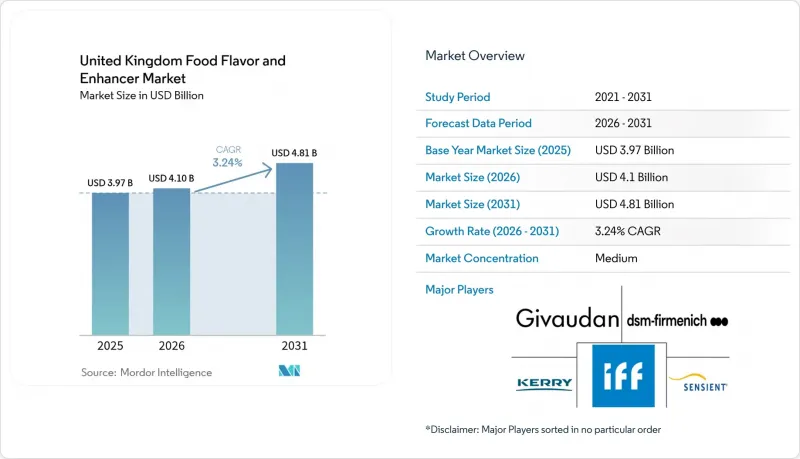
According to Mordor Intelligence, the United Kingdom food flavors and enhancers market size was valued at USD 3.97 billion in 2025 and estimated to grow from USD 4.1 billion in 2026 to reach USD 4.81 billion by 2031, at a CAGR of 3.24% during the forecast period (2026-2031).
This report is Segmented by Product Type (Food Flavor, and Food Enhancer), Form (Powder, Liquid, and Others), and Distribution Channels (Dairy, Bakery, Confectionery, Savory Snack, and More). The Market Forecasts are Provided in Terms of Value (USD) and Volume (tonnes).
United Kingdom Food Flavors And Enhancers Market Trends and Insights
Growing preference for clean-label, natural, minimally processed flavors in packaged foods
Consumer scrutiny of ingredient lists has intensified, with 68% of shoppers in the United Kingdom actively seeking natural flavorings and 63% preferring recognizable ingredients, according to 2024 survey data . This growing demand has resulted in a decline in the use of synthetic aroma chemicals and propylene glycol carriers, encouraging a transition toward water-soluble botanical extracts and supercritical carbon dioxide (CO2) isolates. Precision fermentation has emerged as a practical alternative, enabling microorganisms that are specifically engineered to produce compounds such as vanillin or citrus aldehydes to achieve "natural" status under Food Standards Agency (FSA) guidelines. This is possible as long as the precursor substrate used in the process is plant-derived. Additionally, this method helps address the cost fluctuations associated with sourcing vanilla beans or bergamot peel. In 2024, Melt&Marble successfully raised EUR 5 million to expand the production of fermentation-derived animal-free fats that closely replicate dairy lipid profiles. These fats are targeted for use in hybrid yogurt and cheese applications, where clean-label claims play a significant role in supporting premium product positioning.
Rising demand for advanced flavors in plant-based, vegan, and flexitarian diets
The United Kingdom plant-based retail market experienced a contraction in its year-on-year performance, drawing attention to a significant gap in taste satisfaction. Among consumers who have discontinued purchasing, a majority attributed their decision to inferior flavor, while a substantial portion pointed to higher price points as a deterrent. Meat-alternative products have achieved household penetration in a considerable number of homes; however, the frequency of repeat purchases remains lower compared to dairy-alternative products. This trend suggests that current flavor enhancers, such as umami and kokumi additives, are not effectively replicating the complex flavors associated with the Maillard reaction, which is responsible for the savory taste of grilled beef or roasted chicken. Kerry Group's SucculencePB platform seeks to address the perception of juiciness by utilizing hydrocolloid-lipid emulsions, while Biospringer's yeast extracts provide savory, glutamate-rich flavor profiles without the need for a monosodium glutamate declaration, which is crucial for maintaining clean-label product positioning. Hybrid formulations, which combine animal protein with plant-based ingredients in varying proportions, are gaining traction as a practical compromise. These formulations require advanced flavor systems that can effectively mask undesirable pea or soy aftertastes while enhancing the overall meaty flavor profile. Research published in the Foods journal highlighted that consumers in the United Kingdom tend to reject cream cheese alternatives with nutty or oat-forward flavor notes. Instead, they show a clear preference for options that deliver creamy, smooth, and savory taste profiles.
Strict United Kingdom and European Union regulations on food additives, labeling, and usage limits
The Food Standards Agency's (FSA) removal of 22 flavouring substances from the authorised list in 2024, along with the reduction of ethylene oxide residue limits to 0.1 milligrams per kilogram, has necessitated widespread reformulation in spice blends, seasonings, and savory snacks. Post-Brexit regulatory divergence has further increased compliance challenges as Great Britain follows retained European Union (EU) law with incremental amendments, while Northern Ireland remains aligned with EU Regulation 1334/2008. This divergence requires suppliers serving both markets to conduct dual-specification production runs. Obtaining Novel Foods authorisation for fermentation-derived ingredients can take over 18 months and incur costs exceeding GBP 100,000 (approximately USD 127,000) due to dossier preparation, toxicology studies, and administrative fees. These factors delay the commercialisation of precision-fermented products such as vanillin, cocoa, and dairy proteins. Additionally, maximum usage levels for glutamates (E620-E635) are restricted to 10 grams per kilogram in most categories, limiting formulation flexibility in high-umami applications like bouillon cubes and instant noodles. Traceability requirements under the Food Information to Consumers Regulation mandate full ingredient disclosure, which exposes proprietary flavor blends to potential reverse engineering. This poses a significant challenge for smaller formulators, as it undermines their competitive advantage.
Other drivers and restraints analyzed in the detailed report include:
- Expansion of the United Kingdom beverage sector driving liquid and specialty flavor demand
- Foodservice innovation requiring stable process flavors and enhancers
- Evolving clean-label demands limiting synthetic flavor and enhancer usage
For complete list of drivers and restraints, kindly check the Table Of Contents.
Segment Analysis
In 2025, food flavors accounted for 65.48% of the market share and are projected to grow at a compound annual growth rate (CAGR) of 4.59% through 2031. This growth surpasses that of food enhancers, driven by the broader application versatility and premiumization opportunities in segments such as beverages, dairy, and confectionery. Natural flavors, extracted through methods like steam distillation, solvent extraction, or supercritical carbon dioxide (CO2), are increasingly replacing synthetic alternatives. This shift is influenced by retailers enforcing private-label standards that exclude nature-identical compounds, even when chemically identical to botanical sources.
Precision fermentation is emerging as a hybrid production method. Companies like Ginkgo Bioworks and Melt&Marble are engineering microorganisms to produce vanillin, cocoa butter equivalents, and dairy lipids that meet the "natural" criteria under Food Standards Agency (FSA) definitions. This approach helps mitigate the cost volatility of raw materials such as vanilla beans, priced at USD 400-600 per kilogram in 2024, and cocoa, priced at USD 3,000-4,000 per metric ton.
Complete Report Scope:
- By Product Type
- Food Flavor
- Natural
- Synthetic
- Food Enhancer
- Glutamates
- Yeast Extracts
- Others Types
- Food Flavor
- By Form
- Powder
- Liquid
- Others
- By Application
- Dairy
- Bakery
- Confectionery
- Savory Snack
- Meat
- Beverage
- Other Applications
List of Companies Covered in this Report:
- Givaudan SA
- dsm-firmenich AG
- Kerry Group plc
- International Flavors & Fragrances Inc.
- Sensient Technologies Corporation
- Symrise AG
- Takasago International Corporation
- Sensate Pty Ltd
- MANE
- Ajinomoto Co Inc.
- Lesaffre (Biospringer)
- Orora Nutritionals
- Archer Daniels Midland
- McCormick & Company
- Kalsec Inc.
- Universal Flavours & Fragrances
- Olam Food Ingredients
- Blue Pacific Flavors
- Flavor Makers Pty Ltd
- Queensland Essential Oils
Additional Benefits:
- The market estimate (ME) sheet in Excel format
- 3 months of analyst support
TABLE OF CONTENTS
1 INTRODUCTION
- 1.1 Study Assumptions and Market Definition
- 1.2 Scope of the Study
2 RESEARCH METHODOLOGY
3 EXECUTIVE SUMMARY
4 MARKET LANDSCAPE
- 4.1 Market Overview
- 4.2 Market Drivers
- 4.2.1 Growing preference for clean-label, natural, minimally processed flavors in packaged foods
- 4.2.2 Rising demand for advanced flavors in plant-based, vegan, and flexitarian diets
- 4.2.3 Expansion of the United Kingdom beverage sector driving liquid and specialty flavor demand
- 4.2.4 Foodservice innovation requiring stable process flavors and enhancers
- 4.2.5 Increased demand for sugar-reduced products boosting sweetness modulators and enhancers usage
- 4.2.6 Flavor enhancers in meat substitutes delivering umami and savory depth
- 4.3 Market Restraints
- 4.3.1 Strict United Kingdom and European Union regulations on food additives, labeling, and usage limits
- 4.3.2 Evolving clean-label demands limiting synthetic flavor and enhancer usage
- 4.3.3 Supply-chain challenges for specific botanicals and plant-based flavor precursors
- 4.3.4 High Research and Development costs for customized clean-label flavor systems
- 4.4 Supply Chain Analysis
- 4.5 Regulatory Outlook
- 4.6 Porter's Five Forces
- 4.6.1 Threat of New Entrants
- 4.6.2 Bargaining Power of Buyers/Consumers
- 4.6.3 Bargaining Power of Suppliers
- 4.6.4 Threat of Substitute Products
- 4.6.5 Intensity of Competitive Rivalry
5 MARKET SIZE and GROWTH FORECASTS (VALUE AND VOLUME)
- 5.1 By Product Type
- 5.1.1 Food Flavor
- 5.1.1.1 Natural
- 5.1.1.2 Synthetic
- 5.1.2 Food Enhancer
- 5.1.2.1 Glutamates
- 5.1.2.2 Yeast Extracts
- 5.1.2.3 Others Types
- 5.1.1 Food Flavor
- 5.2 By Form
- 5.2.1 Powder
- 5.2.2 Liquid
- 5.2.3 Others
- 5.3 By Application
- 5.3.1 Dairy
- 5.3.2 Bakery
- 5.3.3 Confectionery
- 5.3.4 Savory Snack
- 5.3.5 Meat
- 5.3.6 Beverage
- 5.3.7 Other Applications
6 COMPETITIVE LANDSCAPE
- 6.1 Market Concentration
- 6.2 Strategic Moves
- 6.3 Market Share Analysis
- 6.4 Company Profiles (includes Global-level Overview, Market-level Overview, Core Segments, Financials (if available), Strategic Information, Market Rank/Share, Products and Services, Recent Developments)
- 6.4.1 Givaudan SA
- 6.4.2 dsm-firmenich AG
- 6.4.3 Kerry Group plc
- 6.4.4 International Flavors & Fragrances Inc.
- 6.4.5 Sensient Technologies Corporation
- 6.4.6 Symrise AG
- 6.4.7 Takasago International Corporation
- 6.4.8 Sensate Pty Ltd
- 6.4.9 MANE
- 6.4.10 Ajinomoto Co Inc.
- 6.4.11 Lesaffre (Biospringer)
- 6.4.12 Orora Nutritionals
- 6.4.13 Archer Daniels Midland
- 6.4.14 McCormick & Company
- 6.4.15 Kalsec Inc.
- 6.4.16 Universal Flavours & Fragrances
- 6.4.17 Olam Food Ingredients
- 6.4.18 Blue Pacific Flavors
- 6.4.19 Flavor Makers Pty Ltd
- 6.4.20 Queensland Essential Oils
7 MARKET OPPORTUNITIES AND FUTURE OUTLOOK

