PUBLISHER: Mordor Intelligence | PRODUCT CODE: 2113260

PUBLISHER: Mordor Intelligence | PRODUCT CODE: 2113260
Europe Food Flavor - Market Share Analysis, Industry Trends & Statistics, Growth Forecasts (2026 - 2031)
According to Mordor Intelligence, the European food flavoring market size was valued at USD 5.58 billion in 2025 and estimated to grow from USD 5.84 billion in 2026 to reach USD 7.31 billion by 2031, at a CAGR of 4.62% during the forecast period (2026-2031).
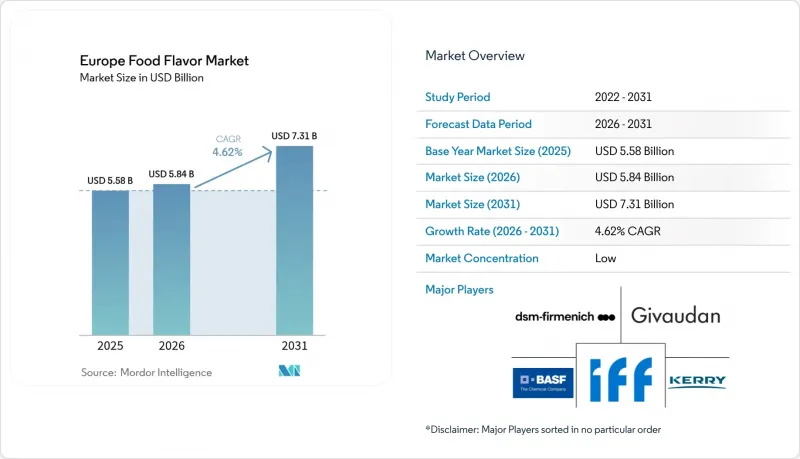
This report is Segmented by Type (Synthetic, Natural), Form (Powder, Liquid, Micro-Encapsulated), Application (Dairy, Bakery, Confectionery, Savory Snack, Meat, Beverage, Other Applications), and Geography (United Kingdom, Germany, France, Spain, Italy, Netherlands, Belgium, Russia, Rest of Europe). The Market Forecasts are Provided in Terms of Value (USD).
Europe Food Flavor Market Trends and Insights
Rising Demand for Natural and Clean-Label Ingredients
With consumers increasingly favoring natural flavoring substances, regulators are aligning safety standards with market demands. The European Food Safety Authority (EFSA) recently assessed naringenin, a citrus-derived compound, as a new food flavoring. Following extensive toxicological evaluations, EFSA determined there were no safety concerns at the proposed usage levels. This decision highlights the growing acceptance of naturally-derived flavoring compounds that meet strict safety criteria. In Europe, importers are placing greater emphasis on sustainability credentials and traceability documentation from natural ingredient suppliers, driven by initiatives like the European Green Deal and the Corporate Sustainability Due Diligence Directive. Additionally, the focus on transparency extends beyond consumer preferences, with companies implementing blockchain-based systems to trace the origins of natural ingredients, according to the CBI. Biotechnology firms are also advancing fermentation-based production methods, ensuring consistent quality while meeting clean-label requirements, thereby accelerating the adoption of natural flavorings in the market.
Growth of Functional Foods, Beverages, and Wellness Products
Modern functional beverage formulations demand advanced flavor masking and enhancement techniques that traditional methods cannot adequately address. According to Kerry's 2025 consumer research conducted across 18 countries, cognitive health, immune health, and digestive health are the primary consumer priorities. This has driven the need for flavoring solutions that integrate seamlessly with functional ingredients while preserving their effectiveness. The functional foods market increasingly relies on specialized flavoring expertise to mask bitter compounds, improve the palatability of protein isolates, and develop appealing taste profiles for innovative ingredients like plant-based proteins and bioactive compounds. European manufacturers are heavily investing in flavor encapsulation technologies, which protect sensitive functional ingredients and deliver precise taste experiences. This trend aligns with the rise of personalized nutrition, where flavoring systems must address individual dietary needs and preferences without compromising functional benefits. The complexity of functional food formulations calls for stronger collaboration between flavor houses and functional ingredient suppliers to enhance both taste and efficacy.
Stringent European Regulations on the Use of Additives
In 2023, the European Food Safety Authority (EFSA) conducted a reassessment of smoke flavoring primary products, concluding that all eight reviewed compounds were unsafe due to genotoxic concerns. This determination, supported by the German Federal Institute for Risk Assessment, could lead to the removal of entire product categories from European markets. The stricter regulations align with updated scientific guidelines that call for more sensitive genotoxicity testing and detailed evaluations of complex flavor mixtures. In 2024, the International Agency for Research on Cancer categorized methyleugenol as "probably carcinogenic to humans" (Group 2A) and isoeugenol as "possibly carcinogenic to humans" (Group 2B), illustrating how advancing scientific knowledge can challenge the use of previously accepted flavoring compounds. European manufacturers are facing higher compliance costs as regulatory authorities demand extensive safety data for new flavoring substances and re-evaluate existing approvals using modern testing methods. This changing regulatory environment benefits companies with strong regulatory affairs capabilities, while smaller players, lacking the resources for comprehensive safety assessments, may struggle to compete.
Other drivers and restraints analyzed in the detailed report include:
- Increasing Popularity of Personalized and Customized Flavor Solutions
- Expansion of Processed Food & Beverage Industry
- Volatility in Raw Material Prices
For complete list of drivers and restraints, kindly check the Table Of Contents.
Segment Analysis
In 2025, natural flavoring substances accounted for 55.10% of the market share and are expected to grow at a strong 6.25% CAGR from 2026 to 2031. This trend highlights their sustained momentum, reinforcing their current dominance and signaling continued growth. This dual leadership reflects increasing consumer preferences aligned with regulatory trends favoring naturally-derived compounds over synthetic alternatives. Although synthetic flavoring retains a significant market share, its growth rate is slower. Synthetic options cater to applications where cost efficiency and consistent supply are prioritized over clean-label attributes. On the other hand, the natural segment benefits from advancements in biotechnology and fermentation, enabling scalable production of complex flavor compounds that were previously achievable only through synthetic chemistry.
EFSA's (European Food Safety Authority) evolving regulatory framework is reshaping the competitive landscape, favoring natural ingredient suppliers with strong safety documentation and traceability systems. For instance, EFSA's recent approval of naringenin derived from grapefruit peel extraction illustrates the potential for commercializing natural compounds. However, the extensive toxicological evaluations required create significant barriers for smaller suppliers. To address concerns about batch-to-batch variability in plant-derived ingredients, biotechnology companies are developing precision fermentation techniques that ensure consistent quality in natural flavoring compounds. The growth of the natural segment is further supported by increased investments in sustainable production methods and supply chain transparency initiatives, aligning with strict European sustainability standards.
Complete Report Scope:
- Type
- Synthetic
- Natural
- Form
- Powder
- Liquid
- Micro-Encapsulated
- Application
- Dairy
- Bakery
- Confectionery
- Savory Snack
- Meat
- Beverage
- Other Applications
- Geography
- United Kingdom
- Germany
- France
- Spain
- Italy
- Netherlands
- Belgium
- Russia
- Rest of Europe
List of Companies Covered in this Report:
- Givaudan SA
- DSM-Firmenich
- International Flavors & Fragrances Inc. (IFF)
- Symrise AG
- Sensient Technologies Corporation
- Takasago International Corporation
- Mane SA
- Robertet Group
- Bell Flavors & Fragrances
- Ungerer & Company
- European Flavours & Fragrances PLC
- Nactarome SPA
- Kerry Group PLC
- Corbion N.V.
- BASF SE
- Treatt PLC
- De Monchy Aromatics
- T Hasegawa Co., Ltd.
- Huabao International Holdings
- Biolandes SAS
Additional Benefits:
- The market estimate (ME) sheet in Excel format
- 3 months of analyst support
TABLE OF CONTENTS
1 INTRODUCTION
- 1.1 Study Assumptions & Market Definition
- 1.2 Scope of the Study
2 RESEARCH METHODOLOGY
3 EXECUTIVE SUMMARY
4 MARKET LANDSCAPE
- 4.1 Market Overview
- 4.2 Market Drivers
- 4.2.1 Rising demand for natural and clean-label ingredients
- 4.2.2 Growth of functional foods, beverages, and wellness products
- 4.2.3 Increasing popularity of personalized and customized flavor solutions
- 4.2.4 Expansion of processed food & beverage industry
- 4.2.5 Growing interest in vegan and cruelty-free ingredients
- 4.2.6 AI-driven flavor co-creation with European craft brands
- 4.3 Market Restraints
- 4.3.1 Stringent European regulations on the use of additives
- 4.3.2 Volatility in raw material prices
- 4.3.3 Challenges in scaling up new sustainable or biotechnology-derived ingredients
- 4.3.4 Rising Health Concerns over the use of Artificial Flavoring
- 4.4 Supply Chain Analysis
- 4.5 Regulatory Outlook
- 4.6 Porter's Five Forces
- 4.6.1 Threat of New Entrants
- 4.6.2 Bargaining Power of Buyers/Consumers
- 4.6.3 Bargaining Power of Suppliers
- 4.6.4 Threat of Substitute Products
- 4.6.5 Intensity of Competitive Rivalry
5 MARKET SIZE AND GROWTH FORECAST
- 5.1 Type
- 5.1.1 Synthetic
- 5.1.2 Natural
- 5.2 Form
- 5.2.1 Powder
- 5.2.2 Liquid
- 5.2.3 Micro-Encapsulated
- 5.3 Application
- 5.3.1 Dairy
- 5.3.2 Bakery
- 5.3.3 Confectionery
- 5.3.4 Savory Snack
- 5.3.5 Meat
- 5.3.6 Beverage
- 5.3.7 Other Applications
- 5.4 Geography
- 5.4.1 United Kingdom
- 5.4.2 Germany
- 5.4.3 France
- 5.4.4 Spain
- 5.4.5 Italy
- 5.4.6 Netherlands
- 5.4.7 Belgium
- 5.4.8 Russia
- 5.4.9 Rest of Europe
6 COMPETITIVE LANDSCAPE
- 6.1 Market Concentration
- 6.2 Strategic Moves
- 6.3 Market Ranking Analysis
- 6.4 Company Profiles (includes Global-level Overview, Market-level Overview, Core Segments, Financials (if available), Strategic Information, Market Rank/Share, Products & Services, Recent Developments)
- 6.4.1 Givaudan SA
- 6.4.2 DSM-Firmenich
- 6.4.3 International Flavors & Fragrances Inc. (IFF)
- 6.4.4 Symrise AG
- 6.4.5 Sensient Technologies Corporation
- 6.4.6 Takasago International Corporation
- 6.4.7 Mane SA
- 6.4.8 Robertet Group
- 6.4.9 Bell Flavors & Fragrances
- 6.4.10 Ungerer & Company
- 6.4.11 European Flavours & Fragrances PLC
- 6.4.12 Nactarome SPA
- 6.4.13 Kerry Group PLC
- 6.4.14 Corbion N.V.
- 6.4.15 BASF SE
- 6.4.16 Treatt PLC
- 6.4.17 De Monchy Aromatics
- 6.4.18 T Hasegawa Co., Ltd.
- 6.4.19 Huabao International Holdings
- 6.4.20 Biolandes SAS
7 MARKET OPPORTUNITIES AND FUTURE OUTLOOK

