PUBLISHER: Mordor Intelligence | PRODUCT CODE: 2100521

PUBLISHER: Mordor Intelligence | PRODUCT CODE: 2100521
France Food Flavors And Enhancers - Market Share Analysis, Industry Trends & Statistics, Growth Forecasts (2026 - 2031)
According to Mordor Intelligence, the France food flavors and enhancers market was valued at USD 1.07 billion in 2025 and estimated to grow from USD 1.12 billion in 2026 to reach USD 1.41 billion by 2031, registering a compound annual growth rate (CAGR) of 4.73% during the forecast period.
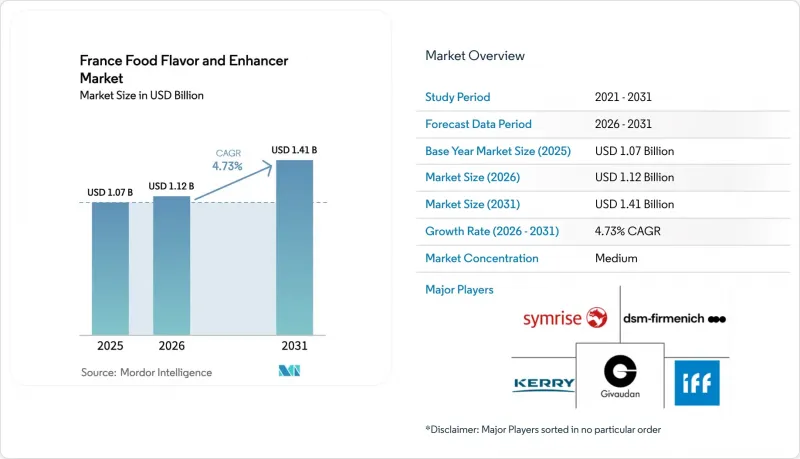
This report is Segmented by Product Type (Food Flavors, Enhancers) and Application (Bakery Products, Sauces, Soups, and Condiments, Dairy Products, Savory Snacks, Meat and Meat Products, Beverages, Others). Market Forecasts are Provided in Terms of Value (USD).
France Food Flavors And Enhancers Market Trends and Insights
Growing clean-label preference is boosting demand for natural and nature-identical flavors
In France, consumer preferences for food ingredients are increasingly influenced by concerns over transparency and safety, resulting in a notable shift toward clean-label formulations. Consumers are now more attentive to ingredient lists, actively avoiding artificial additives. This trend is prompting food manufacturers to replace synthetic flavorings with natural extracts, fermentation-derived enhancers, essential oils, and nature-identical compounds that provide familiar tastes while being perceived as more acceptable on product labels. This shift is further supported by regulatory developments across the European Union. Commission Regulation (EU) 2024/234, effective from January 15, 2024, amended Annex I to Regulation (EC) No 1334/2008 by removing certain flavoring substances from the Union list. Consequently, French food manufacturers, spanning categories such as dairy, bakery, ready meals, and snacks, are reformulating their products to preserve taste while aligning with both regulatory requirements and consumer expectations. This has significantly accelerated the demand for natural and nature-identical flavor and enhancer solutions in the market.
Health awareness is encouraging low-sugar, low-sodium, and additive-free flavor solutions
Increasing public concern in France regarding cardiovascular health, obesity, and overall nutrition is prompting food manufacturers to reformulate products with reduced sugar, salt, and artificial additives while maintaining taste. This trend has led to a growing reliance on advanced flavor and enhancer technologies. Consumers are demanding healthier packaged foods without compromising on flavor, driving the adoption of umami enhancers, bitterness blockers, sweetness modulators, and fermentation-based flavor systems to offset reduced sodium or sugar levels. Government initiatives are further supporting this transition. In 2019, France set a national goal to reduce salt consumption by 30%, and in 2022, authorities and bread producers signed a voluntary agreement to lower salt content by 2025. Bread, particularly the baguette, is a dietary staple in France and traditionally accounted for approximately 25% of the recommended daily salt intake. Reformulation has become essential, and by 2023, most bread produced in France already meet the new sodium standards. These regulatory measures and public health priorities are driving demand for flavor enhancers that preserve taste intensity in healthier formulations. As a result, reduced-salt, reduced-sugar, and additive-free flavor solutions are emerging as a significant growth driver in the French food flavor and enhancer market.
Strict EU Regulatory & EFSA Approval Complexity
The France Food Flavors And Enhancers Market is significantly constrained by the stringent regulatory framework governing food ingredients within the European Union. Any introduction of a new flavoring substance or modification of an existing one requires extensive safety evaluations, toxicological assessments, and comprehensive documentation. This approval process is often both time-consuming and costly. Additionally, the periodic re-assessment of previously approved compounds can necessitate sudden reformulations, compelling manufacturers to invest in new ingredient sourcing, stability testing, and label updates. Smaller flavor houses and food producers are particularly impacted, as compliance demands specialized expertise, detailed traceability, and repeated validation across various product categories. Furthermore, strict labeling requirements and limitations on certain additives restrict formulation flexibility, delaying product launches and slowing innovation compared to markets with less stringent regulations. Consequently, the complexity of EU and EFSA approval procedures increases operational costs, extends development timelines, and poses a significant restraint on the growth of the France Food Flavors And Enhancers Market.
Other drivers and restraints analyzed in the detailed report include:
- Expansion of plant-based diets is driving development of plant-derived taste enhancers
- Demand for ethnic and fusion flavor profiles
- High Reformulation cost
For complete list of drivers and restraints, kindly check the Table Of Contents.
Segment Analysis
Food flavors accounted for 85.25% of the market value in 2025 and are projected to grow CAGR of 5.81% through 2031, surpassing enhancers as manufacturers focus on sensory complexity rather than basic taste modulation. The demand for food flavors in France is driven by consumers seeking premium taste experiences in packaged foods, bakery products, dairy items, and ready meals, while prioritizing natural ingredient labels. The rising popularity of international cuisines, the growth of convenience foods, and the expansion of plant-based alternatives compel manufacturers to develop authentic and stable flavor profiles that can withstand industrial processing. Simultaneously, reformulation efforts aimed at reducing artificial additives are promoting the use of botanical extracts, fermented notes, and nature-identical flavorings, encouraging food companies to invest in ongoing flavor innovation.
The food enhancers market in France is primarily driven by health-focused reformulations, as producers reduce salt, sugar, and fat levels while maintaining taste intensity. Umami compounds, yeast extracts, and masking agents are increasingly utilized to restore mouthfeel and balance bitterness in healthier recipes and plant-based foods. Additionally, strong demand from food-service chains and ready-to-eat meals emphasizes the need for consistent taste across large production volumes. This makes enhancers crucial for flavor standardization and shelf-life stability, thereby contributing to steady market growth.
Complete Report Scope:
- By Product Type
- Food Flavors
- Natural Flavors
- Synthetic Flavors
- Nature-Identical Flavors
- Enhancers
- Food Flavors
- By Application
- Bakery Products
- Sauces, Soups, and Condiments
- Dairy Products
- Savory Snacks
- Meat and Meat Products
- Beverages
- Alcoholic
- Non-Alcoholic
- Carbonated Beverages
- Fruit and Vegetable Juice
- Sports and Energy Drinks
- Other Non-Alcoholic Beverages
- Others
List of Companies Covered in this Report:
- Givaudan SA
- dsm-Firmenich
- Kerry Group plc
- International Flavors & Fragrances Inc.
- Sensient Technologies Corp.
- Symrise AG
- Mane SA
- Robertet SA
- Archer Daniels Midland Co.
- Corbion NV
- BASF SE
- Ajinomoto Co. Inc.
- Lallemand Inc.
- Cargill Inc.
- Takasago International Corp.
- Dohler GmbH
- Tate & Lyle plc
- Nestle Professional
- Savoury Systems International Inc.
- Vigon International
Additional Benefits:
- The market estimate (ME) sheet in Excel format
- 3 months of analyst support
TABLE OF CONTENTS
1 INTRODUCTION
- 1.1 Study Assumptions and Market Definition
- 1.2 Scope of the Study
2 RESEARCH METHODOLOGY
3 EXECUTIVE SUMMARY
4 MARKET LANDSCAPE
- 4.1 Market Overview
- 4.2 Market Drivers
- 4.2.1 Growing clean-label preference is boosting demand for natural and nature-identical flavors
- 4.2.2 Health awareness is encouraging low-sugar, low-sodium, and additive-free flavor solutions
- 4.2.3 Expansion of plant-based diets is driving development of plant-derived taste enhancers
- 4.2.4 Demand for ethnic and fusion flavor profiles
- 4.2.5 Advances in extraction, encapsulation, and biotechnology enable stable and functional flavor systems
- 4.2.6 Sustainability expectations are pushing eco-friendly sourcing and production methods
- 4.3 Market Restraints
- 4.3.1 Strict EU Regulatory & EFSA Approval Complexity
- 4.3.2 High Reformulation cost
- 4.3.3 Climate-Driven Raw Material Volatility
- 4.3.4 High R&D expenses make clean-label innovation difficult
- 4.4 Supply Chain Analysis
- 4.5 Regulatory Landscape
- 4.6 Technological Outlook
- 4.7 Porter's Five Forces
- 4.7.1 Threat of New Entrants
- 4.7.2 Bargaining Power of Buyers
- 4.7.3 Bargaining Power of Suppliers
- 4.7.4 Threat of Substitutes
- 4.7.5 Competitive Rivalry
5 MARKET SIZE AND GROWTH FORECASTS (VALUE)
- 5.1 By Product Type
- 5.1.1 Food Flavors
- 5.1.1.1 Natural Flavors
- 5.1.1.2 Synthetic Flavors
- 5.1.1.3 Nature-Identical Flavors
- 5.1.2 Enhancers
- 5.1.1 Food Flavors
- 5.2 By Application
- 5.2.1 Bakery Products
- 5.2.2 Sauces, Soups, and Condiments
- 5.2.3 Dairy Products
- 5.2.4 Savory Snacks
- 5.2.5 Meat and Meat Products
- 5.2.6 Beverages
- 5.2.6.1 Alcoholic
- 5.2.6.2 Non-Alcoholic
- 5.2.6.2.1 Carbonated Beverages
- 5.2.6.2.2 Fruit and Vegetable Juice
- 5.2.6.2.3 Sports and Energy Drinks
- 5.2.6.2.4 Other Non-Alcoholic Beverages
- 5.2.7 Others
6 COMPETITIVE LANDSCAPE
- 6.1 Market Concentration
- 6.2 Strategic Moves
- 6.3 Market Rank Analysis
- 6.4 Company Profiles (includes Global level Overview, Market level overview, Core Segments, Financials (if available), Strategic Information, Market Rank for key companies, Products, and Recent Developments)
- 6.4.1 Givaudan SA
- 6.4.2 dsm-Firmenich
- 6.4.3 Kerry Group plc
- 6.4.4 International Flavors & Fragrances Inc.
- 6.4.5 Sensient Technologies Corp.
- 6.4.6 Symrise AG
- 6.4.7 Mane SA
- 6.4.8 Robertet SA
- 6.4.9 Archer Daniels Midland Co.
- 6.4.10 Corbion NV
- 6.4.11 BASF SE
- 6.4.12 Ajinomoto Co. Inc.
- 6.4.13 Lallemand Inc.
- 6.4.14 Cargill Inc.
- 6.4.15 Takasago International Corp.
- 6.4.16 Dohler GmbH
- 6.4.17 Tate & Lyle plc
- 6.4.18 Nestle Professional
- 6.4.19 Savoury Systems International Inc.
- 6.4.20 Vigon International
7 MARKET OPPORTUNITIES AND FUTURE OUTLOOK

