
PUBLISHER: Mordor Intelligence | PRODUCT CODE: 2097092

PUBLISHER: Mordor Intelligence | PRODUCT CODE: 2097092
India Food Flavors And Enhancers - Market Share Analysis, Industry Trends & Statistics, Growth Forecasts (2026 - 2031)
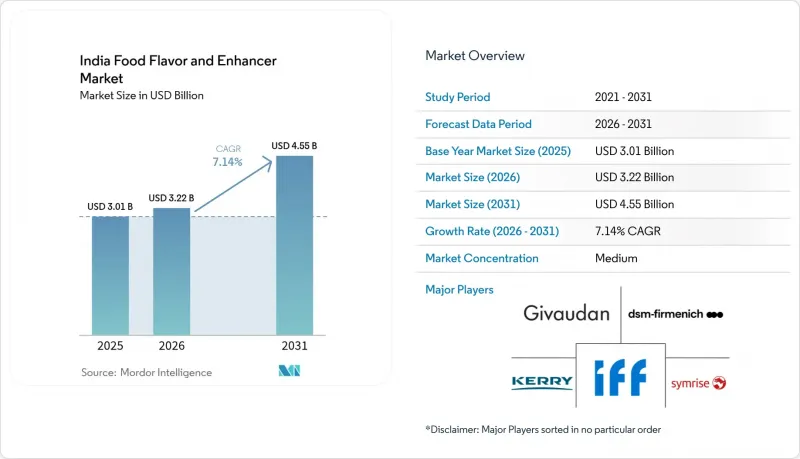
According to Mordor Intelligence, the Indian food flavors and flavor enhancers market size in 2026 is estimated at USD 3.22 billion, growing from 2025 value of USD 3.01 billion with 2031 projections showing USD 4.55 billion, growing at 7.14% CAGR over 2026-2031.
This report is Segmented by Type (Natural Flavors, Synthetic Flavor, Nature-Identical Flavors, Flavor Enhancers), Form (Liquid, Powder), Application (Beverages, Bakery and Confectionery, Dairy and Frozen Foods, Savory Snacks, Others), and Geography (North India, West India, East India, South India). The Market Forecasts are Provided in Terms of Value (USD).
India Food Flavors And Enhancers Market Trends and Insights
Rising Demand for Processed and Convenience Foods
In India, a surge in processed food consumption signals a shift in lifestyle, with time-strapped consumers now prioritizing convenience while still valuing authentic taste. As the domestic food market is set to grow by 47%, reaching a projected USD 1,274 billion by 2027, there's an unprecedented demand for flavor solutions that mimic traditional cooking methods on an industrial scale. This shift is especially advantageous for the ready-to-eat and ready-to-cook segments, where consistent flavor can distinguish premium products from their commodity counterparts. The trend gains momentum with e-commerce making inroads into rural markets, emphasizing the need for shelf-stable formulations that retain their sensory appeal over long distribution journeys. Urban millennials and Gen-Z are at the forefront of this evolution, craving products that offer restaurant-quality experiences at home. This demand paves the way for intricate flavor profiles, once reserved for fresh preparations, to find a place in the market.
Clean Label, Natural, and Organic Ingredient Trends
In India, 71.6% of consumers now prioritize products devoid of synthetic chemicals and additives. Furthermore, 53.7% of these consumers assert that clean label products confer enhanced health benefits. This shift in consumer preference is pushing manufacturers to not only reformulate their existing products but also to innovate new ones that align with these transparency demands, all while ensuring taste and functionality remain intact. However, the task is daunting: achieving the desired performance of natural flavor compounds often necessitates advanced extraction and stabilization technologies, traditionally associated with their synthetic counterparts. Enter biocatalysis: a game-changer that provides environmentally-friendly synthesis routes for natural flavoring compounds. This innovation adeptly reconciles the gap between the heightened demands of consumers and the scalability needs of industries. On the regulatory front, the FSSAI's push for stringent labeling and ingredient transparency bolsters this industry shift. Companies that can authentically showcase their natural sourcing and processing methods stand to gain a significant market edge.
High Costs and Supply Fluctuations
Flavor manufacturers face significant margin pressures due to raw material price volatility. Climatic disruptions and shifting cultivation patterns have caused dramatic price fluctuations in key spices. For example, turmeric production has declined by 15-20%, while demand continues to rise. Similarly, red chili prices are surging, driven by a 15% increase in export demand. These cost pressures make it difficult for manufacturers to pass on expenses to price-sensitive consumers. The situation is further complicated by China's entry into the spice extraction market, which heightens competition for Indian suppliers and threatens established pricing structures and supply chains. Additionally, cumin prices are impacted by weather disruptions, and global supply constraints are tightening the availability of black pepper. To address these challenges, manufacturers are adopting advanced hedging strategies and diversifying their sourcing networks. However, companies with limited financial resources face greater difficulties in managing these fluctuations, potentially leading to market consolidation as smaller players struggle with working capital needs and inventory management complexities.
Other drivers and restraints analyzed in the detailed report include:
- Technological Advancements in Flavor Development
- Government Initiatives Regarding Flavor Manufacturing and Utilization
- Proliferation of Counterfeit and Low-Quality Products
For complete list of drivers and restraints, kindly check the Table Of Contents.
Segment Analysis
In 2025, natural flavors commanded a dominant 35.05% share of India's food flavors and flavor enhancers market, buoyed by a clean-label trend. Meanwhile, flavor enhancers, driven by processors' quest for cost-effective taste intensity, recorded the swiftest growth at an 7.87% CAGR. The market size for natural flavors in India is set to rise from USD 1.06 billion in 2025 to an anticipated USD 1.55 billion by 2031. Manufacturers are leveraging enzymatically derived vanillin, citrus terpenes, and spice oleoresins, all aligning with FSSAI's "nature-derived" guidelines. This alignment allows them to command premium prices in functional drinks and gourmet sauces. Mid-tier snack producers are increasingly turning to nature-identical compounds, which help them navigate the delicate balance between cost and consumer perception, effectively blurring the lines between synthetic and natural. While the synthetic segment's share is dwindling, it remains steadfast in sugar-confectionery and powdered beverage bases, where high-temperature stability is paramount.
Flavor enhancers are witnessing growth, driven by rising demand for nucleotide- and yeast-based umami boosters. These enhancers not only reduce sodium content but also amplify flavor, making them especially popular in instant noodles and savory seasonings. As consumers adapt to low-salt diets, the market share for flavor enhancers in India's food flavors and flavor enhancers sector may surpass the projected 7.87% CAGR. Suppliers introducing label-friendly alternatives to monosodium glutamate-like tomato concentrate powders and fermented soy extracts-are resonating well with health-conscious consumers.
Complete Report Scope:
- By Type
- Natural Flavors
- Synthetic Flavor
- Nature-Identical Flavors
- Flavor Enhancers
- By Form
- Liquid
- Powder
- By Application
- Beverages
- Bakery and Confectionery
- Dairy and Frozen Foods
- Savory Snacks
- Others
- By Geography
- North India
- West India
- East India
- South India
List of Companies Covered in this Report:
- Givaudan SA
- DSM-Firmenich
- International Flavors & Fragrances (IFF)
- Symrise AG
- Kerry Group plc
- BASF SE
- Ajinomoto Co. Inc.
- Sensient Technologies
- Olam Food Ingredients (OFI)
- Keva Flavours
- Synthite Industries
- Flavaroma Flavours & Fragrances
- Flavours India Pvt. Ltd.
- Sonarome
- Symega Food Ingredients
- Mane SA
- Griffith Foods
- Universal Oleoresins & Flavours
- Vinayak Ingredients
- Cargill Inc.
Additional Benefits:
- The market estimate (ME) sheet in Excel format
- 3 months of analyst support
TABLE OF CONTENTS
1 INTRODUCTION
- 1.1 Study Assumptions & Market Definition
- 1.2 Scope of the Study
2 RESEARCH METHODOLOGY
3 EXECUTIVE SUMMARY
4 MARKET LANDSCAPE
- 4.1 Market Overview
- 4.2 Market Drivers
- 4.2.1 Rising demand for processed and convenience foods
- 4.2.2 Clean label, natural, and organic ingredient trends,
- 4.2.3 Technological advancements in Flavor Development
- 4.2.4 Government initiatives regarding Flavor Manufacturing and Utilisation
- 4.2.5 Rising investment in R&D and innovation labs
- 4.2.6 Demand for region-specific and ethnic flavors
- 4.3 Market Restraints
- 4.3.1 High costs and supply fluctuations
- 4.3.2 Proliferation of counterfeit and low-quality products
- 4.3.3 Sustainability and traceability pressures
- 4.3.4 Fragmented and unreliable supply chains
- 4.4 Supply Chain Analysis
- 4.5 Regulatory Outlook
- 4.6 Porter's Five Forces
- 4.6.1 Threat of New Entrants
- 4.6.2 Bargaining Power of Buyers/Consumers
- 4.6.3 Bargaining Power of Suppliers
- 4.6.4 Threat of Substitute Products
- 4.6.5 Intensity of Competitive Rivalry
5 MARKET SIZE AND GROWTH FORECAST
- 5.1 By Type
- 5.1.1 Natural Flavors
- 5.1.2 Synthetic Flavor
- 5.1.3 Nature-Identical Flavors
- 5.1.4 Flavor Enhancers
- 5.2 By Form
- 5.2.1 Liquid
- 5.2.2 Powder
- 5.3 By Application
- 5.3.1 Beverages
- 5.3.2 Bakery and Confectionery
- 5.3.3 Dairy and Frozen Foods
- 5.3.4 Savory Snacks
- 5.3.5 Others
- 5.4 By Geography
- 5.4.1 North India
- 5.4.2 West India
- 5.4.3 East India
- 5.4.4 South India
6 COMPETITIVE LANDSCAPE
- 6.1 Market Concentration
- 6.2 Strategic Moves
- 6.3 Market Ranking Analysis
- 6.4 Company Profiles (includes Global-level Overview, Market-level Overview, Core Segments, Financials (if available), Strategic Information, Market Rank/Share, Products & Services, Recent Developments)
- 6.4.1 Givaudan SA
- 6.4.2 DSM-Firmenich
- 6.4.3 International Flavors & Fragrances (IFF)
- 6.4.4 Symrise AG
- 6.4.5 Kerry Group plc
- 6.4.6 BASF SE
- 6.4.7 Ajinomoto Co. Inc.
- 6.4.8 Sensient Technologies
- 6.4.9 Olam Food Ingredients (OFI)
- 6.4.10 Keva Flavours
- 6.4.11 Synthite Industries
- 6.4.12 Flavaroma Flavours & Fragrances
- 6.4.13 Flavours India Pvt. Ltd.
- 6.4.14 Sonarome
- 6.4.15 Symega Food Ingredients
- 6.4.16 Mane SA
- 6.4.17 Griffith Foods
- 6.4.18 Universal Oleoresins & Flavours
- 6.4.19 Vinayak Ingredients
- 6.4.20 Cargill Inc.
7 MARKET OPPORTUNITIES AND FUTURE OUTLOOK

