PUBLISHER: Mordor Intelligence | PRODUCT CODE: 2097099

PUBLISHER: Mordor Intelligence | PRODUCT CODE: 2097099
Middle East Aviation - Market Share Analysis, Industry Trends & Statistics, Growth Forecasts (2026 - 2031)
According to Mordor Intelligence, the Middle East aviation market size is expected to grow from USD 28.64 billion in 2025 to USD 30.07 billion in 2026 and is forecasted to reach USD 37.93 billion by 2031 at a 4.75% CAGR over 2026-2031.
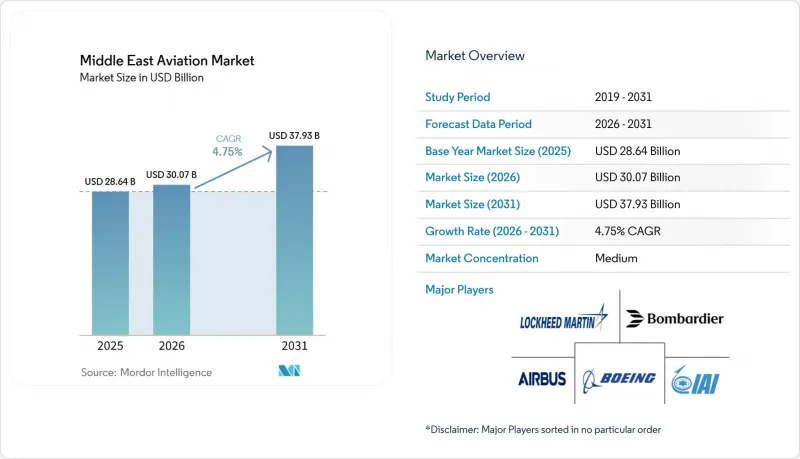
This report is Segmented by Type (Commercial Aviation, Military Aviation, General Aviation, Unmanned Aerial Systems, and More), Propulsion Technology (Turboprop, Turbofan, Piston Engine, Turboshaft, and More), Power Source (Conventional Fuel, SAF-Based, and Others), Fit (Linefit and Retrofit), and Geography (Saudi Arabia and More). The Market Forecasts are Provided in Terms of Value (USD).
Middle East Aviation Market Trends and Insights
Resilient Recovery in International Passenger Traffic Supporting Regional Demand
Load factors reached 80.8% in 2024, surpassing the 78.2% global average as international routes recovered above 2019 benchmarks. Hub carriers benefit from sixth-freedom flows that reroute travelers between Europe, Asia, and Africa. A unified GCC visa, set to begin in 2026, is expected to unlock 12 million additional leisure and business trips, easing the planning of multi-country itineraries. Revenue per passenger must still rise by 3-4% each year to match the 4.75% CAGR, as traffic momentum alone is insufficient. Geopolitical disruptions, such as Red Sea maritime incidents, temporarily divert cargo to air; however, the demand spike dissipates once sea lanes return to normal. Carriers therefore emphasize premium cabins and ancillary services to sustain yield expansion.
Fleet Renewal Strategies Focused on Fuel Efficiency and Emissions Optimization
Emirates bolstered its B777-9 backlog to 270 units in December 2025, aiming to achieve 20-25% fuel-burn savings over legacy widebodies. Etihad allocated USD 1 billion to retrofit A320 and B787 fleets, paring fuel use by 15% per seat-kilometer. These moves align with CORSIA's carbon-neutral growth requirement from 2027, ICAO. Regional reliance on conventional jet fuel, however, exposes operators to Brent crude volatility that averaged USD 95-105 per barrel in 2024. SAF costs two to four times as much as Jet A-1, so mandated blending targets and sovereign production incentives are pivotal to closing the price gap.
Elevated Geopolitical Risk Premiums Increasing Operational Insurance Burdens
War-risk premiums increased by 150-200% in 2024 after tensions in the Red Sea and between Iran and Israel led to detours, adding USD 200-400 per flight hour. Hull and liability policies span 12-18 months, compelling mid-size airlines to renegotiate rates twice as often. Insurers demand collateral equal to 20-30% of the hull value for older fleets, squeezing working capital for carriers such as Iraqi Airways and Mahan Air. Higher premiums translate into ticket surcharges, but price-sensitive leisure demand limits pass-through, compressing margins.
Other drivers and restraints analyzed in the detailed report include:
- Strategic Expansion of Sixth Freedom Hubs by Gulf Mega-Carriers
- Accelerated Adoption of Low-Cost Carrier Business Models
- Regional Shortage of Skilled Pilots and Certified Maintenance Personnel
For complete list of drivers and restraints, kindly check the Table Of Contents.
Segment Analysis
Commercial services accounted for 57.64% of 2025 revenue, supported by Gulf mega-carriers operating high-capacity widebodies. This represents the largest share of the Middle East aviation market. Growth moderates as mature long-haul flows face yield pressure from LCC encroachment and volatile fuel costs. Nevertheless, premium-cabin retrofits and cargo belly monetization sustain profitability.
Advanced air mobility (AAM), growing at an 8.45% CAGR, is redefining urban trips under 100 kilometers. Saudi Arabia's Hajj trial transported 12,000 pilgrims via EHang EH216-S eVTOLs at USD 80-100 for a 50-kilometer hop, confirming the commercial potential of the technology. NEOM's EUR 175 million (USD 204.52 million) stake in Volocopter and Archer's Saudi JV plan creates domestic manufacturing ecosystems. These initiatives elevate connected-city connectivity and diversify the future Middle East aviation market.
Turbofan engines accounted for 66.42% of the Middle East aviation market in 2025, thanks to Pratt & Whitney GTF and CFM LEAP platforms that cut fuel consumption by 15-20% compared with earlier models. This dominance anchors the Middle East aviation market share in propulsion. Rolls-Royce and Saudia will test hybrid-electric systems on 10 B787s by 2027, aiming for a 10-12% fuel savings on medium-range missions. Hybrid-electric technology's 7.21% CAGR is driven by retrofit economics and stricter carbon targets.
Turboprops still serve 22% of sub-100-seat fleets, especially in Oman's secondary airports. Turboshafts dominate offshore and medical helicopters, while turbojets persist in older business jets. Piston engines equip training aircraft across Saudi academies. Full-electric propulsion remains experimental, although the EH216-S taxi shows early niche feasibility. Certification standards unveiled by ICAO in 2024 mandate 10,000-hour endurance tests, which will delay the entry of hybrid-electric narrowbodies to 2028-2030.
Complete Report Scope:
- By Type
- Commercial Aviation
- Narrowbody
- Widebody
- Regional Jets
- Military Aviation
- Combat
- Transport
- Special Mission
- Helicopters
- General Aviation
- Business Jets
- Commercial Helicopters
- Unmanned Aerial Systems
- Civil and Commercial
- Defense and Government
- Advanced Air Mobility (AAM)
- eVTOL
- Urban Air Mobility (UAM)
- Commercial Aviation
- By Propulsion Technology
- Turboprop
- Turbofan
- Piston Engine
- Turboshaft
- Turbojet
- Hybrid-Electric
- Electric
- By Power Source
- Conventional Fuel
- SAF-Based
- Others
- By Fit
- Linefit
- Retrofit
- By Geography
- Saudi Arabia
- United Arab Emirates
- Qatar
- Israel
- Kuwait
- Oman
- Rest of Middle East
List of Companies Covered in this Report:
- Airbus SE
- The Boeing Company
- Embraer S.A.
- Avions de Transport Regional GIE
- General Dynamics Corporation
- Bombardier Inc.
- Dassault Aviation SA
- Textron Inc.
- Leonardo S.p.A.
- Turkish Aerospace Industries Inc.
- Israel Aerospace Industries Ltd.
- EDGE Group PJSC
- Baykar Makine Sanayi ve Ticaret A.S.
- Calidus, LLC
- Pilatus Aircraft Ltd.
- Cirrus Design Corporation
- Lockheed Martin Corporation
Additional Benefits:
- The market estimate (ME) sheet in Excel format
- 3 months of analyst support
TABLE OF CONTENTS
1 INTRODUCTION
- 1.1 Study Assumptions and Market Definition
- 1.2 Scope of the Study
2 RESEARCH METHODOLOGY
3 EXECUTIVE SUMMARY
4 MARKET LANDSCAPE
- 4.1 Market Overview
- 4.2 Market Drivers
- 4.2.1 Resilient recovery in international passenger traffic supporting regional demand
- 4.2.2 Fleet renewal strategies focused on fuel efficiency and emissions optimization
- 4.2.3 Strategic expansion of sixth-freedom hubs by Gulf mega-carriers
- 4.2.4 Accelerated adoption of low-cost carrier business models
- 4.2.5 State-backed investment in next-generation airport infrastructure
- 4.2.6 Air cargo growth driven by regional e-commerce and logistics integration
- 4.3 Market Restraints
- 4.3.1 Elevated geopolitical risk premiums increasing operational insurance burdens
- 4.3.2 Regional shortage of skilled pilots and certified maintenance personnel
- 4.3.3 Limited bilateral air liberalization beyond intra-GCC agreements
- 4.3.4 Jet fuel price volatility and restricted access to effective hedging instruments
- 4.4 Value Chain Analysis
- 4.5 Regulatory Landscape
- 4.6 Technological Outlook
- 4.7 Porter's Five Forces Analysis
- 4.7.1 Bargaining Power of Suppliers
- 4.7.2 Bargaining Power of Buyers
- 4.7.3 Threat of New Entrants
- 4.7.4 Threat of Substitutes
- 4.7.5 Intensity of Rivalry
5 MARKET SIZE AND GROWTH FORECASTS (VALUE)
- 5.1 By Type
- 5.1.1 Commercial Aviation
- 5.1.1.1 Narrowbody
- 5.1.1.2 Widebody
- 5.1.1.3 Regional Jets
- 5.1.2 Military Aviation
- 5.1.2.1 Combat
- 5.1.2.2 Transport
- 5.1.2.3 Special Mission
- 5.1.2.4 Helicopters
- 5.1.3 General Aviation
- 5.1.3.1 Business Jets
- 5.1.3.2 Commercial Helicopters
- 5.1.4 Unmanned Aerial Systems
- 5.1.4.1 Civil and Commercial
- 5.1.4.2 Defense and Government
- 5.1.5 Advanced Air Mobility (AAM)
- 5.1.5.1 eVTOL
- 5.1.5.2 Urban Air Mobility (UAM)
- 5.1.1 Commercial Aviation
- 5.2 By Propulsion Technology
- 5.2.1 Turboprop
- 5.2.2 Turbofan
- 5.2.3 Piston Engine
- 5.2.4 Turboshaft
- 5.2.5 Turbojet
- 5.2.6 Hybrid-Electric
- 5.2.7 Electric
- 5.3 By Power Source
- 5.3.1 Conventional Fuel
- 5.3.2 SAF-Based
- 5.3.3 Others
- 5.4 By Fit
- 5.4.1 Linefit
- 5.4.2 Retrofit
- 5.5 By Geography
- 5.5.1 Saudi Arabia
- 5.5.2 United Arab Emirates
- 5.5.3 Qatar
- 5.5.4 Israel
- 5.5.5 Kuwait
- 5.5.6 Oman
- 5.5.7 Rest of Middle East
6 COMPETITIVE LANDSCAPE
- 6.1 Market Concentration
- 6.2 Strategic Moves
- 6.3 Market Share Analysis
- 6.4 Company Profiles (includes Global-level Overview, Market-level Overview, Core Segments, Financials as available, Strategic Information, Market Rank/Share, Products and Services, and Recent Developments)
- 6.4.1 Airbus SE
- 6.4.2 The Boeing Company
- 6.4.3 Embraer S.A.
- 6.4.4 Avions de Transport Regional GIE
- 6.4.5 General Dynamics Corporation
- 6.4.6 Bombardier Inc.
- 6.4.7 Dassault Aviation SA
- 6.4.8 Textron Inc.
- 6.4.9 Leonardo S.p.A.
- 6.4.10 Turkish Aerospace Industries Inc.
- 6.4.11 Israel Aerospace Industries Ltd.
- 6.4.12 EDGE Group PJSC
- 6.4.13 Baykar Makine Sanayi ve Ticaret A.S.
- 6.4.14 Calidus, LLC
- 6.4.15 Pilatus Aircraft Ltd.
- 6.4.16 Cirrus Design Corporation
- 6.4.17 Lockheed Martin Corporation
7 MARKET OPPORTUNITIES AND FUTURE OUTLOOK
- 7.1 White-space and Unmet-need Assessment

