PUBLISHER: Mordor Intelligence | PRODUCT CODE: 2113458

PUBLISHER: Mordor Intelligence | PRODUCT CODE: 2113458
Europe Aviation - Market Share Analysis, Industry Trends & Statistics, Growth Forecasts (2026 - 2031)
According to Mordor Intelligence, the Europe aviation market size is expected to grow from USD 98.5 billion in 2025 to USD 106.52 billion in 2026 and is forecasted to reach USD 157.38 billion by 2031 at 8.12% CAGR over 2026-2031.
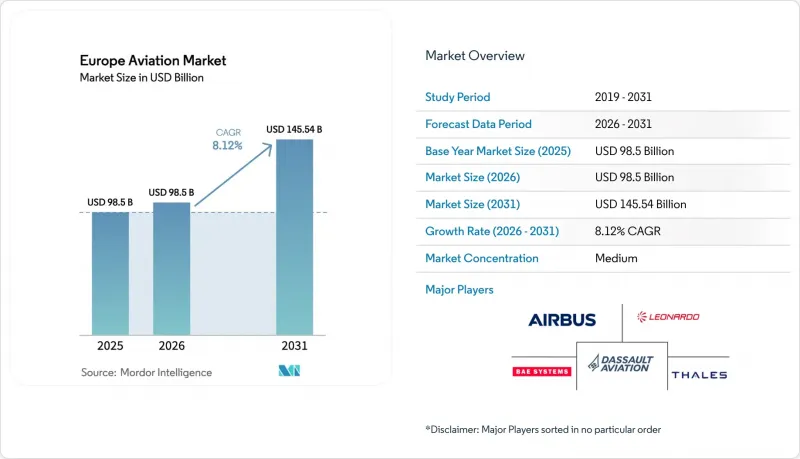
This report is Segmented by Type (Commercial Aviation, Military Aviation, General Aviation, and More), Propulsion Technology (Turboprop, Turbofan, Piston Engine, Turboshaft, and More), Power Source (Conventional Fuel, SAF-Based, Fuel Cell, and More), Fit (Linefit and Retrofit), and Geography (United Kingdom, Germany, France, Italy, Spain, and More). The Market Forecasts are Provided in Terms of Value (USD).
Europe Aviation Market Trends and Insights
Green-Tax Incentives Reshape Fleet Economics
European governments have increased carbon levies on short-haul flights, prompting airlines to adopt fuel-efficient aircraft and higher SAF blends. France lifted its domestic flight surcharge to EUR 30 (USD 35.06) per passenger in 2024, while Germany's revised ticket tax rewards operators that meet ICAO CO2 performance standards. The Netherlands introduced a new per-flight charge at Amsterdam Schiphol, linked to aircraft noise and emissions, prompting KLM to accelerate deliveries of the A320neo. Airlines operating legacy B737-800 and A320ceo fleets now face direct operating-cost penalties that compress the payback periods of new aircraft by up to 3 years. Low-cost carriers, whose unit economics hinge on fuel efficiency, are first movers in this transition. Nordic policymakers plan to implement a carbon border adjustment for aviation by 2027, further shifting the cost equation in favor of next-generation aircraft.
Air-Traffic Recovery Exceeds Pre-Pandemic Baseline
Eurocontrol data show that European flight volumes reached 102% of 2019 levels by August 2024, led by leisure demand on Mediterranean routes. Low-cost carriers (LCCs) increased capacity by 18% in 2024, adding service to secondary airports in Spain, Portugal, and Greece. Legacy airlines realigned their networks toward premium leisure travel, offsetting a 15% shortfall in corporate travel. Cargo tonnage increased by 6% year over year, driven by e-commerce and pharmaceutical shipments. Yet congestion persists at high-density airports, and Eurocontrol projects that 20 hubs will run out of peak-hour slots by 2027, leading to a shift in growth toward off-peak operations or regional fields.
Long Certification Cycle Delays Novel Propulsion Deployment
EASA issued only draft rules for electric and hydrogen propulsion in 2024, leaving OEMs unable to file final type-certificate applications until at least 2026. Heart Aerospace has postponed the ES-30's entry into service by two years due to evolving battery safety standards. ZeroAvia must run separate campaigns for 19- and 80-seat hydrogen retrofits, each spanning four years. Regulatory caution, shaped by lessons from the B737 MAX crisis, doubles the engineering workload for projects seeking dual FAA-EASA approval. Start-ups, therefore, face prolonged cash burn and dilution risk while awaiting certification milestones.
Other drivers and restraints analyzed in the detailed report include:
- Surge in E-Commerce-Driven Freighter Conversions
- Military Re-Armament Budgets Sustain Long-Run Demand
- Labor Shortages Constrain Operational Expansion
For complete list of drivers and restraints, kindly check the Table Of Contents.
Segment Analysis
Advanced Air Mobility (AAM) is forecasted to grow at a 9.45% CAGR as conditional eVTOL orders are converted into deliveries once EASA certification is achieved in 2026-2027. Commercial aviation accounted for 39.55% of the Europe aviation market in 2025, driven by 735 Airbus and 528 Boeing deliveries. However, widebody demand lags behind narrowbody growth as Asia-Pacific routes recover slowly.
Military aviation is experiencing a structural uptick due to higher NATO spending, with Germany and Poland expanding their F-35 orders, and Airbus delivering six A400M transports in 2024. Special mission aircraft, including ATR 72MP patrol variants, answer renewed surveillance needs on Europe's eastern flank. General aviation is stabilizing after a pandemic-era boom, with Dassault's Falcon line delivering 33 jets in 2024.
The AAM opportunity expands regional aviation capacity without requiring additional runway slots, though the lack of certified products hinders future revenue recognition. Commercial airlines are pursuing scope-clause relief to deploy 100-seat Embraer E2 jets on thin routes, as evidenced by 24 E2 deliveries in Europe in 2024. Helicopter demand splits between defense and civil rescue roles; Airbus supplied 25 H145Ms to Germany for special operations, while emergency medical services (EMS) operators extend contracts for fleet renewals. The Europe aviation market, therefore, balances mature commercial aircraft demand with burgeoning defense orders and an emerging eVTOL segment poised for exponential growth once certification hurdles are cleared.
Electric propulsion is expected to post the fastest gain, at a 10.38% CAGR, driven by improvements in battery density that make sub-500-kilometer routes commercially viable. Turbofan products maintained a 26.76% share in 2025, driven by 1,200 LEAP-powered deliveries worldwide, of which 35% served European operators. Pratt & Whitney's GTF durability issues grounded about 60 aircraft in Europe, nudging airlines toward CFM alternatives. Turboprops benefited from regional route growth; ATR delivered 41 aircraft in 2024, of which 28 went to European carriers. Hybrid-electric demonstrations by Rolls-Royce and Airbus promise 30% fuel savings, with megawatt-scale ground tests underway.
Battery-only eVTOL concepts dominate urban mobility prototypes, for instance, Vertical Aerospace's eight-rotor VX4 emphasizes low noise to clear EASA limits. Turboshaft engines, primarily used in helicopters, remain steady, with Safran shipping 450 units in 2024. Turbojet use is confined to niche military trainers. Electric advances hinge on solid-state batteries that may lift energy density to 400 Wh/kg by 2028, unlocking regional ranges of up to 1,000 kilometers. Until then, hybrid architectures bridge fuel-burn cuts and range constraints.
Complete Report Scope:
- By Type
- Commercial Aviation
- Narrowbody
- Widebody
- Regional Jets
- Military Aviation
- Combat
- Transport
- Special Missions
- Helicopters
- General Aviation
- Business Jets
- Commercial Helicopters
- Unmanned Aerial Systems
- Civil and Commercial
- Defense and Government
- Advanced Air Mobility (AAM)
- eVTOL
- Urban Air Mobility (UAM)
- Commercial Aviation
- By Propulsion Technology
- Turboprop
- Turbofan
- Piston Engine
- Turboshaft
- Turbojet
- Hybrid-Electric
- Electric
- By Power Source
- Conventional Fuel
- SAF-Based
- Fuel Cell
- Battery Powered
- Solar Powered
- By Fit
- Linefit
- Retrofit
- By Geography
- United Kingdom
- Germany
- France
- Italy
- Spain
- Rest of Europe
List of Companies Covered in this Report:
- Airbus SE
- The Boeing Company
- Leonardo S.p.A.
- Dassault Aviation
- Saab AB
- Pilatus Aircraft Ltd.
- Bombardier Inc.
- Textron Aviation Inc.
- Embraer S.A.
- Lockheed Martin Corporation
- Daher SA
- Avions de Transport Regional (ATR)
- Thales Group
- Rheinmetall AG
- BAE Systems plc
- Parrot Drones SAS
- Quantum-Systems GmbH
- Helsing SE
- Volocopter GmbH
- Vertical Aerospace Group Ltd.
Additional Benefits:
- The market estimate (ME) sheet in Excel format
- 3 months of analyst support
TABLE OF CONTENTS
1 INTRODUCTION
- 1.1 Study Assumptions and Market Definition
- 1.2 Scope of the Study
2 RESEARCH METHODOLOGY
3 EXECUTIVE SUMMARY
4 MARKET LANDSCAPE
- 4.1 Market Overview
- 4.2 Market Drivers
- 4.2.1 Green-tax incentives for fleet renewal
- 4.2.2 Air-traffic recovery post-COVID
- 4.2.3 Surge in e-commerce-driven freighter conversions
- 4.2.4 Military re-armament budgets (Ukraine war spill-over)
- 4.2.5 Hydrogen-ready propulsion R&D consortia (Clean Aviation JU)
- 4.2.6 SESAR-led U-space integration accelerating eVTOL deployment across Europe
- 4.3 Market Restraints
- 4.3.1 Long certification cycle for novel propulsion
- 4.3.2 Persistent pilot/engineer labour shortages
- 4.3.3 Volatile SAF pricing
- 4.3.4 ATC capacity bottlenecks at core hubs
- 4.4 Market Trends
- 4.5 Value Chain Analysis
- 4.6 Regulatory Landscape
- 4.7 Technological Outlook
- 4.8 Porter's Five Forces Analysis
- 4.8.1 Bargaining Power of Buyers
- 4.8.2 Bargaining Power of Suppliers
- 4.8.3 Threat of New Entrants
- 4.8.4 Threat of Substitutes
- 4.8.5 Intensity of Competitive Rivalry
5 MARKET SIZE AND GROWTH FORECASTS (VALUE)
- 5.1 By Type
- 5.1.1 Commercial Aviation
- 5.1.1.1 Narrowbody
- 5.1.1.2 Widebody
- 5.1.1.3 Regional Jets
- 5.1.2 Military Aviation
- 5.1.2.1 Combat
- 5.1.2.2 Transport
- 5.1.2.3 Special Missions
- 5.1.2.4 Helicopters
- 5.1.3 General Aviation
- 5.1.3.1 Business Jets
- 5.1.3.2 Commercial Helicopters
- 5.1.4 Unmanned Aerial Systems
- 5.1.4.1 Civil and Commercial
- 5.1.4.2 Defense and Government
- 5.1.5 Advanced Air Mobility (AAM)
- 5.1.5.1 eVTOL
- 5.1.5.2 Urban Air Mobility (UAM)
- 5.1.1 Commercial Aviation
- 5.2 By Propulsion Technology
- 5.2.1 Turboprop
- 5.2.2 Turbofan
- 5.2.3 Piston Engine
- 5.2.4 Turboshaft
- 5.2.5 Turbojet
- 5.2.6 Hybrid-Electric
- 5.2.7 Electric
- 5.3 By Power Source
- 5.3.1 Conventional Fuel
- 5.3.2 SAF-Based
- 5.3.3 Fuel Cell
- 5.3.4 Battery Powered
- 5.3.5 Solar Powered
- 5.4 By Fit
- 5.4.1 Linefit
- 5.4.2 Retrofit
- 5.5 By Geography
- 5.5.1 United Kingdom
- 5.5.2 Germany
- 5.5.3 France
- 5.5.4 Italy
- 5.5.5 Spain
- 5.5.6 Rest of Europe
6 COMPETITIVE LANDSCAPE
- 6.1 Market Concentration
- 6.2 Strategic Moves
- 6.3 Market Share Analysis
- 6.4 Company Profiles (includes Global-level Overview, Market-level Overview, Core Segments, Financials as available, Strategic Information, Market Rank/Share, Products and Services, and Recent Developments)
- 6.4.1 Airbus SE
- 6.4.2 The Boeing Company
- 6.4.3 Leonardo S.p.A.
- 6.4.4 Dassault Aviation
- 6.4.5 Saab AB
- 6.4.6 Pilatus Aircraft Ltd.
- 6.4.7 Bombardier Inc.
- 6.4.8 Textron Aviation Inc.
- 6.4.9 Embraer S.A.
- 6.4.10 Lockheed Martin Corporation
- 6.4.11 Daher SA
- 6.4.12 Avions de Transport Regional (ATR)
- 6.4.13 Thales Group
- 6.4.14 Rheinmetall AG
- 6.4.15 BAE Systems plc
- 6.4.16 Parrot Drones SAS
- 6.4.17 Quantum-Systems GmbH
- 6.4.18 Helsing SE
- 6.4.19 Volocopter GmbH
- 6.4.20 Vertical Aerospace Group Ltd.
7 MARKET OPPORTUNITIES AND FUTURE OUTLOOK
- 7.1 White-space and Unmet-Need Assessment

