
PUBLISHER: Mordor Intelligence | PRODUCT CODE: 2097115

PUBLISHER: Mordor Intelligence | PRODUCT CODE: 2097115
Philippines Hospitality - Market Share Analysis, Industry Trends & Statistics, Growth Forecasts (2026 - 2031)
According to Mordor Intelligence, the Philippines hospitality market size was valued at USD 7.84 billion in 2025 and is estimated to grow from USD 8.41 billion in 2026 to reach USD 11.90 billion by 2031, at a CAGR of 7.21% during the forecast period (2026-2031).
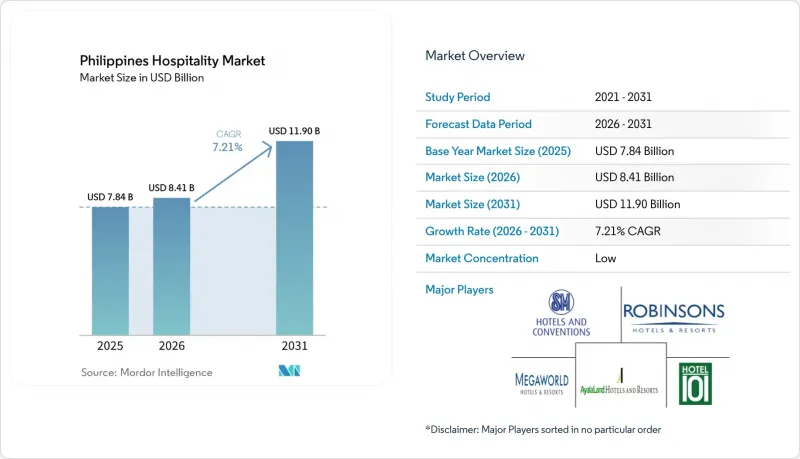
This report is Segmented by Type (Chain Hotels, and Independent Hotels), Accommodation Type (Luxury, Mid & Upper-Midscale, Budget and Economy, and More), Booking Channel (Direct Digital, Otas, Corporate/MICE and More), and Geography (Western Visayas, Mimaropa, Central Visayas, Caraga, and Others). The Market Forecasts are Provided in Terms of Value (USD).
Philippines Hospitality Market Trends and Insights
Government Tourism Campaigns and Infrastructure Investments
The government's USD 26.5 billion (PHP 1.56 trillion) infrastructure outlay in 2026, including USD 3.35 billion (PHP 197.3 billion) for the transport department, strengthens aviation gateways and regional links that directly support hotel demand in tier-1 and tier-2 destinations. The New NAIA Infra Corp concession, valued at USD 2.9 billion (PHP 170.6 billion), grows capacity for Manila's main gateway to 62 million passengers annually and processed a record 52.02 million passengers in 2025, improving throughput for inbound and domestic travelers. Flagship projects like the Panay-Guimaras-Negros Bridge at USD 3.32 billion, and the Samal Island-Davao City Connector Bridge at USD 0.41 billion, cut inter-island travel times and unlock resort zones for development and scaling. Road works under the Tourism Road Infrastructure Program reached 882.281 km by mid-2024, improving last-mile access to eco and heritage attractions with measurable benefits for provincial hotel occupancy. Navigation and air-traffic upgrades at NAIA, Kalibo, and Laoag further improve reliability, which supports itinerary planning and enhances traveler confidence during peak seasons. These coordinated investments lower friction in an archipelago setting, which drives higher average length of stay and broader dispersion of visitors beyond Metro Manila.
Expanded International Air Connectivity
Passenger volumes rose at both gateway and regional airports due to operational improvements and private capital in aviation assets that widen the funnel to leisure islands and business hubs. Manila's concession program generated USD 1 billion in remittances in its first year and backed terminal upgrades that improve on-time performance and throughput during peak holidays. Arrivals data show 15.6 million total arrivals in 2025, including 6.7 million foreign travelers, which reinforces long-haul and regional connectivity across core markets. Capacity builds include the expansion of Bohol-Panglao International Airport, which improves access to prime dive and beach circuits in Central Visayas. The Bulacan greenfield gateway backed by long-term financing will decongest Manila's airspace and provide redundancy that benefits airlines and hotel operators as routes scale. Parallel airport projects in Palawan and Siargao under the flagship pipeline position eco destinations to absorb demand, which helps diversify the hospitality industry in the Philippines across islands.
High Vulnerability to Natural Disasters
The country experiences frequent tropical cyclones that peak in the July to October window, which creates systemic disruption risks for travel planning and hotel operations in coastal areas. Official damage statistics underscore the economic costs of these events and the need for resilient design in hospitality assets across high-risk provinces. Disaster mitigation and recovery outlays are embedded in national planning, yet event severity and uneven enforcement of building codes can leave property-level vulnerabilities. Operators in island destinations reinforce roofs, foundations, and power systems to protect continuity during adverse weather, which increases development and operating costs relative to inland peers. Temperature and sea-level trends add medium-term risks that factor into site selection and insurance policies for coastal resorts. These conditions require contingency plans and diversified demand bases to stabilize performance in the Philippines hospitality market.
Other drivers and restraints analyzed in the detailed report include:
- Growth in Domestic Travel Demand
- Surge in MICE and Business Travel
- Insufficient Infrastructure in Secondary Destinations
For complete list of drivers and restraints, kindly check the Table Of Contents.
Segment Analysis
Independent hotels command 63.52% of the Philippines hospitality market share in 2025, while chain hotels are projected to grow at a 10.12% CAGR through 2031 as brand penetration and institutional capital increase. The consolidation strategy of large groups accelerates momentum, with SM Hotels forming a multi-property partnership with Radisson for new flags as part of its expansion cycle. Robinsons Hotels' opening of the ultra-luxury NUSTAR Hotel in Cebu in 2025 adds 223 rooms and scales a portfolio that already spans dozens of properties in key cities. Centralized revenue management and loyalty platforms allow chains to outperform on distribution and repeat stays, creating advantages in corporate and high-season leisure segments in the Philippines hospitality market. Independents remain competitive where authentic experiences and bespoke service differentiate, including eco and heritage assets that are less suited to standardized brand norms.
Chain operators leverage asset-light growth via management and franchise models that speed entry into provincial capitals and resort corridors without heavy balance-sheet risk. Megaworld's 8,500-room footprint and the 1,530-room Grand Westside Hotel demonstrate scale at a time when large properties capture MICE and integrated-resort demand. Sustainability certifications such as IFC EDGE Zero Carbon at Ayala Land Hotels lower utility costs and align with corporate procurement criteria for business travel. Independent hotels often face succession and professionalization challenges that create selective acquisition opportunities for chains and investors attentive to culture and property DNA in the Philippines hospitality industry. The interplay between brand scale and local authenticity will define competitive positioning as supply grows against improving connectivity.
Mid and upper-midscale hotels held the largest segment at 36.25% in 2025, while luxury properties are projected to grow fastest at a 9.52% CAGR as high-net-worth travelers and MICE delegates increase their share of nights and spend. Integrated-resort operators report strong occupancy from premium gaming and entertainment patrons, which raises pricing power for adjacent luxury and upper-upscale inventory in the Philippines hospitality market. The Mandarin at Ayala Triangle Gardens, set for a 2026 opening, targets embassy and corporate accounts with premium rates that match location and service positioning. Midscale hotels anchor domestic business trips and family travel in regional centers, with steady occupancy that diversifies cash flows during seasonal lulls. Utility cost inflation and OTA commissions pressure budget and economy margins, which push operators toward direct channels and cost-efficiency measures.
Service apartments benefit from corporate relocations and project-based stays with multinational accounts, which support long-stay ADR and reduce distribution costs through direct contracts. Rate differentials across tiers persist, with luxury ADRs in Metro Manila materially above midscale averages, which yields higher RevPAR despite lower average occupancy. The mid and upper-midscale cluster continues to dominate in provincial capitals, where location and reliable service are more important than tier upgrades for core demand segments in the Philippines hospitality industry. Luxury resorts in Palawan and similar destinations will rely on utility and transport upgrades to reach full potential as flight times shorten and power and fiber networks improve. Across tiers, sustainability standards and efficiency retrofits will improve margins and appeal to corporate buyers with ESG mandates.
Complete Report Scope:
- By Type
- Chain Hotels
- Independent Hotels
- By Accommodation Type
- Luxury
- Mid & Upper-Midscale Hotels
- Budget & Economy
- Service Apartments
- By Booking Channel
- Direct Digital
- OTAs
- Corporate/MICE
- Wholesale & Traditional Agents
- By Region (Philippines)
- Western Visayas
- MIMAROPA
- Central Visayas
- Caraga
- Others
List of Companies Covered in this Report:
- SM Hotels and Conventions Corp.
- Robinsons Hotels & Resorts
- AyalaLand Hotels & Resorts Corp.
- Megaworld Hotels & Resorts
- DoubleDragon
- Travellers Intl Hotel Group
- Okada Manila
- City of Dreams Manila
- Jpark Island Resort & Waterpark
- Shangri-La Hotels & Resorts
- Marriott International
- Hilton Worldwide
- IHG Hotels & Resorts
- Accor Hotels
- Red Planet Hotels
- The Ascott Ltd.
- Filinvest Hospitality
- Discovery Hospitality Corp.
- Cebu Landmasters Hospitality
- Berjaya Hotels
Additional Benefits:
- The market estimate (ME) sheet in Excel format
- 3 months of analyst support
TABLE OF CONTENTS
1 Introduction
- 1.1 Study Assumptions & Market Definition
- 1.2 Scope of the Study
2 Research Methodology
3 Executive Summary
4 Market Landscape
- 4.1 Market Overview
- 4.2 Market Drivers
- 4.2.1 Government tourism campaigns & infrastructure investments
- 4.2.2 Expanded international air connectivity
- 4.2.3 Growth in domestic travel demand
- 4.2.4 Surge in MICE and business travel
- 4.2.5 Rising interest in eco- and adventure tourism
- 4.2.6 Visa facilitation and tax-refund programs
- 4.3 Market Restraints
- 4.3.1 High vulnerability to natural disasters
- 4.3.2 Insufficient infrastructure in secondary destinations
- 4.3.3 Skilled labor shortages in hospitality
- 4.3.4 Overcrowding & environmental degradation at hotspots
- 4.4 Value / Supply-Chain Analysis
- 4.5 Regulatory Landscape
- 4.6 Technological Outlook
- 4.7 Porter's Five Forces Analysis
- 4.7.1 Threat of New Entrants
- 4.7.2 Bargaining Power of Suppliers
- 4.7.3 Bargaining Power of Buyers
- 4.7.4 Threat of Substitutes
- 4.7.5 Industry Rivalry
5 Market Size & Growth Forecasts (Value, USD)
- 5.1 By Type
- 5.1.1 Chain Hotels
- 5.1.2 Independent Hotels
- 5.2 By Accommodation Type
- 5.2.1 Luxury
- 5.2.2 Mid & Upper-Midscale Hotels
- 5.2.3 Budget & Economy
- 5.2.4 Service Apartments
- 5.3 By Booking Channel
- 5.3.1 Direct Digital
- 5.3.2 OTAs
- 5.3.3 Corporate/MICE
- 5.3.4 Wholesale & Traditional Agents
- 5.4 By Region (Philippines)
- 5.4.1 Western Visayas
- 5.4.2 MIMAROPA
- 5.4.3 Central Visayas
- 5.4.4 Caraga
- 5.4.5 Others
6 Competitive Landscape
- 6.1 Market Concentration
- 6.2 Strategic Moves
- 6.3 Market Share Analysis
- 6.4 Company Profiles (includes Global level Overview, Market level overview, Core Segments, Financials as available, Strategic Information, Market Rank/Share for key companies, Products & Services, and Recent Developments)
- 6.4.1 SM Hotels and Conventions Corp.
- 6.4.2 Robinsons Hotels & Resorts
- 6.4.3 AyalaLand Hotels & Resorts Corp.
- 6.4.4 Megaworld Hotels & Resorts
- 6.4.5 DoubleDragon
- 6.4.6 Travellers Intl Hotel Group
- 6.4.7 Okada Manila
- 6.4.8 City of Dreams Manila
- 6.4.9 Jpark Island Resort & Waterpark
- 6.4.10 Shangri-La Hotels & Resorts
- 6.4.11 Marriott International
- 6.4.12 Hilton Worldwide
- 6.4.13 IHG Hotels & Resorts
- 6.4.14 Accor Hotels
- 6.4.15 Red Planet Hotels
- 6.4.16 The Ascott Ltd.
- 6.4.17 Filinvest Hospitality
- 6.4.18 Discovery Hospitality Corp.
- 6.4.19 Cebu Landmasters Hospitality
- 6.4.20 Berjaya Hotels
7 Market Opportunities & Future Outlook
- 7.1 Expansion of event and MICE tourism facilities and services
- 7.2 Adoption of smart hospitality solutions for personalized experiences

