PUBLISHER: Mordor Intelligence | PRODUCT CODE: 2115038

PUBLISHER: Mordor Intelligence | PRODUCT CODE: 2115038
Malaysia Hospitality - Market Share Analysis, Industry Trends & Statistics, Growth Forecasts (2026 - 2031)
According to Mordor Intelligence, the Malaysia hospitality market size was valued at USD 49.28 billion in 2025 and is estimated to grow from USD 53.11 billion in 2026 to reach USD 77.20 billion by 2031, at a CAGR of 7.76% during the forecast period (2026-2031).
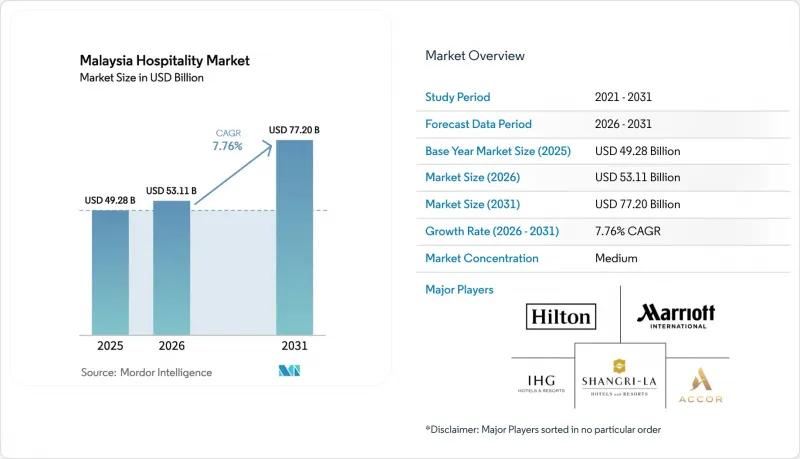
This report is Segmented by Type (Chain Hotels, and Independent Hotels), Accommodation Class (Luxury, Mid & Upper-Mid-Scale, Budget & Economy, and Service Apartments), Booking Channel (Direct Digital, Otas, Corporate/MICE, and Wholesale & Traditional Agents), and Geography (Central, Northern, Southern, East Coast, East Malaysia). Market Forecasts are Provided in Value (USD).
Malaysia Hospitality Market Trends and Insights
Post-COVID "Visit Malaysia 2026" Tourism Push Delivers Fiscal Commitment and Visa Liberalization
Visit Malaysia 2026 is supported by USD 135.7 million (MYR 550.0 million) in promotional funding and USD 27.1 million (MYR 110.0 million) for infrastructure, which signals fiscal commitment to demand recovery and destination marketing. The campaign commenced operations at Kuala Lumpur International Airport and key entry points nationwide on January 1, 2026, which marks an operational inflection for coordinated arrivals handling and event activation. The visa exemption program for Chinese nationals has been extended by five years, while Indian nationals can avail it until December 31, 2026. Eligible Chinese nationals may now stay in Malaysia for up to 90 days, previously 30 days. The launch also aligns with a calendar of nationwide cultural and festive events that push room-night demand into shoulder periods and distribute travel beyond a few hubs within the Malaysia hospitality market. This policy clarity lowers perceived risk for hotel investments in secondary corridors that also benefit from transport upgrades, which helps the Malaysia hospitality market attract capital for new builds and conversions.
Accelerated Luxury Pipeline in Kuala Lumpur and Penang Reshapes Revenue-Per-Available-Room Benchmarks
Kuala Lumpur's pipeline includes 1,970 luxury rooms within a 6,209-room under-construction base, which adds depth to the Golden Triangle and supports premium rate ceilings in the Malaysia hospitality market. Park Hyatt Kuala Lumpur opened in August 2025, within Merdeka 118 and reinforced the city's positioning for high-net-worth travellers and global corporate accounts. An additional five-star supply led by Waldorf Astoria Kuala Lumpur and Conrad Kuala Lumpur is set to widen choice and strengthen brand-led pricing power as the luxury tier scales. Luxury rate traction was already evident as ADR reached USD 183.52 (MYR 743.78) in August 2024, which supported RevPAR at USD 146.18 (MYR 592.45), during peak months. Penang's pipeline and mixed-use luxury entries complement Kuala Lumpur and extend premium appeal into the Northern region, which is supported by new executive apartments and branded residences that lengthen stays.
Other drivers and restraints analyzed in the detailed report include:
- OTA Dominance Boosting Room-Night Conversion While Eroding Operator Margins
- Infrastructure Roll-Outs Unlock Secondary Cities and Reduce Travel Friction
- Labour-Cost Inflation After 2024 Minimum-Wage Hike Compresses Budget-Segment Operating Margins
- Slow Visa Processing for Emerging Markets Creates Friction Despite Liberalization Gains
For complete list of drivers and restraints, kindly check the Table Of Contents.
Segment Analysis
Independent hotels held 63.32% of Malaysia's hospitality market share in 2025, while chain hotels are projected to grow at a 10.75% CAGR through 2031 as brand systems and loyalty scale distribution. The expansion of flags across Kuala Lumpur, Penang, and Johor improves access to corporate and MICE accounts that prize standardized service and rate predictability in the Malaysia hospitality market. Marriott's milestone of 50 properties in September 2024 shows how a broad portfolio and loyalty program deepen weekday base business across cities. Hilton's Southeast Asia signings underscore appetite for luxury and lifestyle keys that lift rate ceilings and drive brand-led demand. Independents defend niche positions through heritage assets and local immersion, but platform fees and wage cost inflation increase the appeal of conversions or soft-brand affiliations in the Malaysia hospitality market.
As chains grow within the Malaysia hospitality market, standardized procurement and revenue management unlock cost and yield benefits that are hard to match individually. Soft brands and collections offer a middle path that preserves identity while accessing global distribution and loyalty. IHG's platform exemplifies how development-focused pathways enable owners to reflag and upgrade operations to contemporary standards. Over the forecast period, institutional capital remains attracted to asset-light models and branded operating platforms, which support the chain segment's share gains in the Malaysia hospitality market. Independents that sharpen positioning and modernize distribution can maintain performance, especially in leisure-first destinations where character and location drive choice.
Complete Report Scope:
- By Type
- Chain Hotels
- Independent Hotels
- By Accommodation Class
- Luxury
- Mid & Upper-Mid-scale
- Budget & Economy
- Service Apartments
- By Booking Channel
- Direct Digital
- OTAs
- Corporate / MICE
- Wholesale & Traditional Agents
- By Geographic Region
- Central (Kuala Lumpur, Selangor, Putrajaya)
- Northern (Penang, Kedah, Perlis, Perak)
- Southern (Johor, Melaka, Negeri Sembilan)
- East Coast (Pahang, Terengganu, Kelantan)
- East Malaysia (Sabah, Sarawak, Labuan)
List of Companies Covered in this Report:
- Marriott International
- Hilton Worldwide
- Accor
- InterContinental Hotels Group (IHG)
- Shangri-La Hotels and Resorts
- Hyatt Hotels Corporation
- Radisson Hotel Group
- Wyndham Hotels & Resorts
- Minor Hotels (Anantara, Avani)
- Banyan Tree Holdings
- YTL Hotels
- Berjaya Hotels & Resorts
- Sunway Hotels & Resorts
- Genting Malaysia (Resorts World)
- TA Global (Aviator, Swiss-Garden)
- Tune Hotels
- OYO Malaysia
- GSH Corporation (Hotel Jen, Sutera)
- Plenitude Berhad (The Nomad, Mercure Penang)
- Ormond Group (The Chow Kit, MoMo's)
Additional Benefits:
- The market estimate (ME) sheet in Excel format
- 3 months of analyst support
TABLE OF CONTENTS
1 Introduction
- 1.1 Study Assumptions & Market Definition
- 1.2 Scope of the Study
2 Research Methodology
3 Executive Summary
4 Market Landscape
- 4.1 Market Overview
- 4.2 Market Drivers
- 4.2.1 Post-COVID "Visit Malaysia 2026" tourism push
- 4.2.2 Accelerated luxury pipeline in Kuala Lumpur & Penang
- 4.2.3 OTA dominance boosting room-night conversion
- 4.2.4 Infrastructure roll-outs (RTS Link, ECRL) unlocking secondary cities
- 4.2.5 Niche ESG-certified resorts capturing premium ADR (under-the-radar)
- 4.2.6 E-sports-themed hotels tapping millennial demand (under-the-radar)
- 4.3 Market Restraints
- 4.3.1 Labour-cost inflation after 2024 minimum-wage hike
- 4.3.2 Slow visa processing for emerging markets
- 4.3.3 Strain on urban utilities from rapid hotel densification (under-the-radar)
- 4.3.4 High OTA commission squeeze on independents' margins (under-the-radar)
- 4.4 Value / Supply-Chain Analysis
- 4.5 Regulatory Landscape
- 4.6 Technological Outlook
- 4.7 Porter's Five Forces
- 4.7.1 Threat of New Entrants
- 4.7.2 Bargaining Power of Suppliers
- 4.7.3 Bargaining Power of Buyers
- 4.7.4 Threat of Substitutes
- 4.7.5 Competitive Rivalry
5 Market Size & Growth Forecasts (Value, MYR)
- 5.1 By Type
- 5.1.1 Chain Hotels
- 5.1.2 Independent Hotels
- 5.2 By Accommodation Class
- 5.2.1 Luxury
- 5.2.2 Mid & Upper-Mid-scale
- 5.2.3 Budget & Economy
- 5.2.4 Service Apartments
- 5.3 By Booking Channel
- 5.3.1 Direct Digital
- 5.3.2 OTAs
- 5.3.3 Corporate / MICE
- 5.3.4 Wholesale & Traditional Agents
- 5.4 By Geographic Region
- 5.4.1 Central (Kuala Lumpur, Selangor, Putrajaya)
- 5.4.2 Northern (Penang, Kedah, Perlis, Perak)
- 5.4.3 Southern (Johor, Melaka, Negeri Sembilan)
- 5.4.4 East Coast (Pahang, Terengganu, Kelantan)
- 5.4.5 East Malaysia (Sabah, Sarawak, Labuan)
6 Competitive Landscape
- 6.1 Market Concentration
- 6.2 Strategic Moves
- 6.3 Market Share Analysis
- 6.4 Company Profiles (includes Global level Overview, Market level overview, Core Segments, Financials as available, Strategic Information, Market Rank/Share for key companies, Products & Services, and Recent Developments)
- 6.4.1 Marriott International
- 6.4.2 Hilton Worldwide
- 6.4.3 Accor
- 6.4.4 InterContinental Hotels Group (IHG)
- 6.4.5 Shangri-La Hotels and Resorts
- 6.4.6 Hyatt Hotels Corporation
- 6.4.7 Radisson Hotel Group
- 6.4.8 Wyndham Hotels & Resorts
- 6.4.9 Minor Hotels (Anantara, Avani)
- 6.4.10 Banyan Tree Holdings
- 6.4.11 YTL Hotels
- 6.4.12 Berjaya Hotels & Resorts
- 6.4.13 Sunway Hotels & Resorts
- 6.4.14 Genting Malaysia (Resorts World)
- 6.4.15 TA Global (Aviator, Swiss-Garden)
- 6.4.16 Tune Hotels
- 6.4.17 OYO Malaysia
- 6.4.18 GSH Corporation (Hotel Jen, Sutera)
- 6.4.19 Plenitude Berhad (The Nomad, Mercure Penang)
- 6.4.20 Ormond Group (The Chow Kit, MoMo's)
7 Market Opportunities & Future Outlook
- 7.1 Mixed-use transit-oriented hotel projects along RTS Link corridor
- 7.2 Purpose-built wellness retreats leveraging Malaysia's medical-tourism hub status

