PUBLISHER: Mordor Intelligence | PRODUCT CODE: 2100638

PUBLISHER: Mordor Intelligence | PRODUCT CODE: 2100638
Thailand Hospitality - Market Share Analysis, Industry Trends & Statistics, Growth Forecasts (2026 - 2031)
According to Mordor Intelligence, the Thailand hospitality market size is expected to grow from USD 22.68 billion in 2025 to USD 24.53 billion in 2026 and is forecast to reach USD 36.26 billion by 2031 at 8.13% CAGR over 2026-2031.
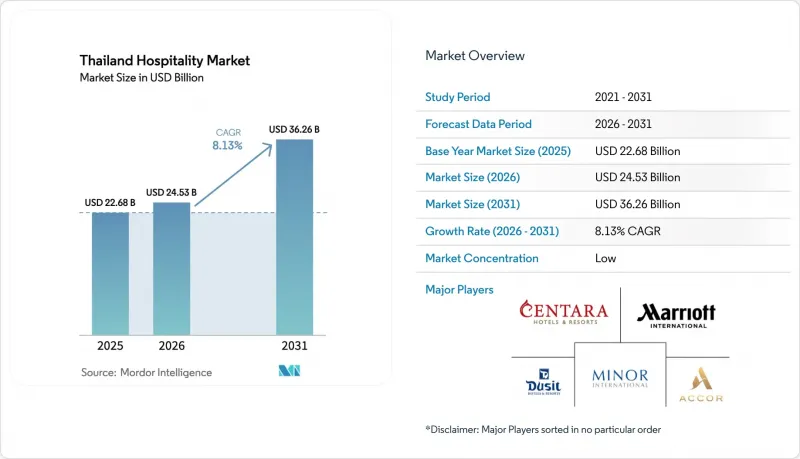
This report is Segmented by Type (Chain Hotels, and Independent Hotels), by Accommodation Class (Luxury, Mid & Upper-Mid-Scale, Budget & Economy, and More), by Booking Channel (Direct Digital, Otas, Corporate/MICE, and More), and Geography (Bangkok & Central Plains, Northern Thailand, Northeastern Thailand, Eastern Thailand, and More). The Market Forecasts are Provided in Terms of Value (USD).
Thailand Hospitality Market Trends and Insights
Surge in long-haul arrivals from Russia and India
Thailand's recovery in foreign arrivals in 2024 and continuing momentum in 2025 strengthen the Thailand hospitality market as long-haul capacity returns and flight networks broaden. The country recorded 35.54 million foreign tourist arrivals in 2024, which supports higher room-night demand across city and beach destinations and encourages operators to sustain yield-focused pricing strategies during peak periods. Route renewals and longer-haul services into Bangkok and Phuket improve seat availability, while broader Asia-Pacific network expansion aids Thailand's inbound traffic recovery in the medium term Large operators cite stronger performance in European source markets in early 2025, signaling resilient long-haul demand at family-friendly beach properties favored by value-seeking travelers. This pattern supports balanced seasonality, with Russians and Europeans helping fill the high winter season in Southern Thailand, while regional travelers and Indians sustain city occupancy around retail and cultural attractions. The result is a more diversified demand mix that mitigates volatility and underpins networked growth plans of major brands that are expanding through management agreements and franchise deals.
Domestic tourism via "We Travel Together"
Revived domestic subsidies in 2025 improved secondary destination performance and unfolded a useful demand buffer for the Thailand hospitality market during shoulder months. The Tourism Authority of Thailand's program architecture focuses on accommodation and dining subsidies delivered through digital channels, helping smaller cities capture incremental trips and weekend getaways that lift occupancy and food and beverage revenue. The policy aligns with a larger pattern of domestic travel normalization through 2024 and 2025 as mobility and household confidence recover, with program design nudging the discovery of lesser-visited provinces. Coordinated promotion with regional airlines and intercity transport can lift multi-city itineraries and reduce frictions for longer domestic loops, reinforcing network effects. The impact is more pronounced for independent mid-scale properties that package rooms with dining credits and local experiences tailored to Thai travelers. By spreading demand beyond a few hubs, subsidies also enable a more durable revenue base that can smooth seasonal swings for smaller hotels reliant on domestic business.
Chronic skilled-labour shortages and payroll inflation
A tight labor market continues to constrain service levels and stretch payroll budgets for operators across the Thailand hospitality market. Sector wage indices point to sustained upward pressure in accommodation and food services during 2025, elevating unit costs in a period of still-normalizing demand. International evidence on wage concentration confirms that hotel and restaurant workers in upper-middle-income economies remain clustered in the lower earnings quintiles, which complicates recruitment for skill-intensive roles and encourages out-migration from the sector. Operators respond by redesigning processes to cope with leaner staffing, but that approach has limits for premium service properties where guest expectations remain high. Pressure is more pronounced in city hotels that rely on higher daily throughput of front-office, housekeeping, and food service teams. For listed Thai hotel groups, margin narratives in 2025 point to increased room cost ratios and lower gross profit margins in cases where rate gains have not fully offset wage inflation.
Other drivers and restraints analyzed in the detailed report include:
- Luxury ADR inflation outpacing CPI
- Accelerated hotel-REIT transactions
- Elevated utility tariffs compressing margins
For complete list of drivers and restraints, kindly check the Table Of Contents.
Segment Analysis
Independent hotels held 57.65% of the Thailand hospitality market by type in 2025. A tight labor market continues to constrain service levels and stretch payroll budgets for operators across the Thailand hospitality market. Sector wage indices point to sustained upward pressure in accommodation and food services during 2025, elevating unit costs in a period of still-normalizing demand. International evidence on wage concentration confirms that hotel and restaurant workers in upper-middle-income economies remain clustered in the lower earnings quintiles, which complicates recruitment for skill-intensive roles and encourages out-migration from the sector. Operators respond by redesigning processes to cope with leaner staffing, but that approach has limits for premium service properties where guest expectations remain high. Pressure is more pronounced in city hotels that rely on higher daily throughput of front-office, housekeeping, and food service teams. For listed Thai hotel groups, margin narratives in 2025 point to increased room cost ratios and lower gross profit margins in cases where rate gains have not fully offset wage inflation.
Complete Report Scope:
- By Type (Value)
- Chain Hotels
- Independent Hotels
- By Accommodation Class (Value)
- Luxury
- Mid & Upper-Mid-scale
- Budget & Economy
- Service Apartments
- By Booking Channel (Value)
- Direct Digital
- OTAs
- Corporate / MICE
- Wholesale & Traditional Agents
- By Geographic Region (Value)
- Bangkok & Central Plains
- Northern Thailand
- Northeastern Thailand
- Eastern Thailand
- Southern Thailand
List of Companies Covered in this Report:
- Minor International (MINT)
- Centara Hotels & Resorts (CENTEL)
- Accor Group
- Marriott International
- Hilton Worldwide Holdings
- InterContinental Hotels Group (IHG)
- Dusit Thani Public Co.
- Asset World Corporation (AWC)
- ONYX Hospitality Group
- Banyan Tree Holdings
- Wyndham Hotels & Resorts
- Best Western Hotels & Resorts
- Shangri-La Hotels & Resorts
- Four Seasons Hotels & Resorts
- Mandarin Oriental Hotel Group
- Radisson Hotel Group
- Melia Hotels International
- S Hotels & Resorts (Singha Estate)
- Kempinski Hotels
- Outrigger Hospitality Group
- Hyatt Hotels Corporation
- Capella Hotel Group
Additional Benefits:
- The market estimate (ME) sheet in Excel format
- 3 months of analyst support
TABLE OF CONTENTS
1 Introduction
- 1.1 Study Assumptions & Market Definition
- 1.2 Scope of the Study
2 Research Methodology
3 Executive Summary
4 Market Landscape
- 4.1 Market Overview
- 4.2 Market Drivers
- 4.2.1 Surge in long-haul arrivals as Russian & Indian air-lift capacity doubles post-2025
- 4.2.2 Domestic tourism boom via government
- 4.2.3 Luxury ADR inflation outpacing CPI by >6 ppts since 2022
- 4.2.4 Accelerated hotel-REIT transactions boosting asset-light expansion
- 4.2.5 Niche lifestyle positioning (wellness, plant-based, halal) winning Gen-Z wallets
- 4.2.6 Digital nomad visas extending average length-of-stay beyond 30 days
- 4.3 Market Restraints
- 4.3.1 Chronic skilled-labour shortages driving 15-20 % payroll inflation
- 4.3.2 Elevated utility tariffs squeezing GOP margins, esp. independent hotels
- 4.3.3 Short-term rental oversupply in Bangkok & Phuket depressing RevPAR
- 4.3.4 High dependence on Chinese arrivals
- 4.4 Value / Supply-Chain Analysis
- 4.5 Regulatory Landscape
- 4.6 Technological Outlook
- 4.7 Porter's Five Forces
- 4.7.1 Threat of New Entrants
- 4.7.2 Bargaining Power of Suppliers
- 4.7.3 Bargaining Power of Buyers
- 4.7.4 Threat of Substitutes
- 4.7.5 Competitive Rivalry
5 Market Size & Growth Forecasts
- 5.1 By Type (Value)
- 5.1.1 Chain Hotels
- 5.1.2 Independent Hotels
- 5.2 By Accommodation Class (Value)
- 5.2.1 Luxury
- 5.2.2 Mid & Upper-Mid-scale
- 5.2.3 Budget & Economy
- 5.2.4 Service Apartments
- 5.3 By Booking Channel (Value)
- 5.3.1 Direct Digital
- 5.3.2 OTAs
- 5.3.3 Corporate / MICE
- 5.3.4 Wholesale & Traditional Agents
- 5.4 By Geographic Region (Value)
- 5.4.1 Bangkok & Central Plains
- 5.4.2 Northern Thailand
- 5.4.3 Northeastern Thailand
- 5.4.4 Eastern Thailand
- 5.4.5 Southern Thailand
6 Competitive Landscape
- 6.1 Market Concentration
- 6.2 Strategic Moves
- 6.3 Market Share Analysis
- 6.4 Company Profiles {(includes Global level Overview, Market level overview, Core Segments, Financials as available, Strategic Information, Market Rank/Share for key companies, Products & Services, and Recent Developments)}
- 6.4.1 Minor International (MINT)
- 6.4.2 Centara Hotels & Resorts (CENTEL)
- 6.4.3 Accor Group
- 6.4.4 Marriott International
- 6.4.5 Hilton Worldwide Holdings
- 6.4.6 InterContinental Hotels Group (IHG)
- 6.4.7 Dusit Thani Public Co.
- 6.4.8 Asset World Corporation (AWC)
- 6.4.9 ONYX Hospitality Group
- 6.4.10 Banyan Tree Holdings
- 6.4.11 Wyndham Hotels & Resorts
- 6.4.12 Best Western Hotels & Resorts
- 6.4.13 Shangri-La Hotels & Resorts
- 6.4.14 Four Seasons Hotels & Resorts
- 6.4.15 Mandarin Oriental Hotel Group
- 6.4.16 Radisson Hotel Group
- 6.4.17 Melia Hotels International
- 6.4.18 S Hotels & Resorts (Singha Estate)
- 6.4.19 Kempinski Hotels
- 6.4.20 Outrigger Hospitality Group
- 6.4.21 Hyatt Hotels Corporation
- 6.4.22 Capella Hotel Group
7 Market Opportunities & Future Outlook
- 7.1 Wellness-integrated resort development in secondary coastal provinces
- 7.2 AI-driven dynamic pricing & revenue-optimisation solutions for independent mid-scale hotels

