PUBLISHER: Mordor Intelligence | PRODUCT CODE: 2098473

PUBLISHER: Mordor Intelligence | PRODUCT CODE: 2098473
Indonesia Pet Veterinary Diets - Market Share Analysis, Industry Trends & Statistics, Growth Forecasts (2026 - 2031)
According to Mordor Intelligence, the Indonesia pet veterinary diets market was anticipated to increase from USD 1.20 billion in 2025 to USD 1.30 billion in 2026 and reach USD 1.80 billion by 2031, growing at a CAGR of 7.40% over 2026-2031.
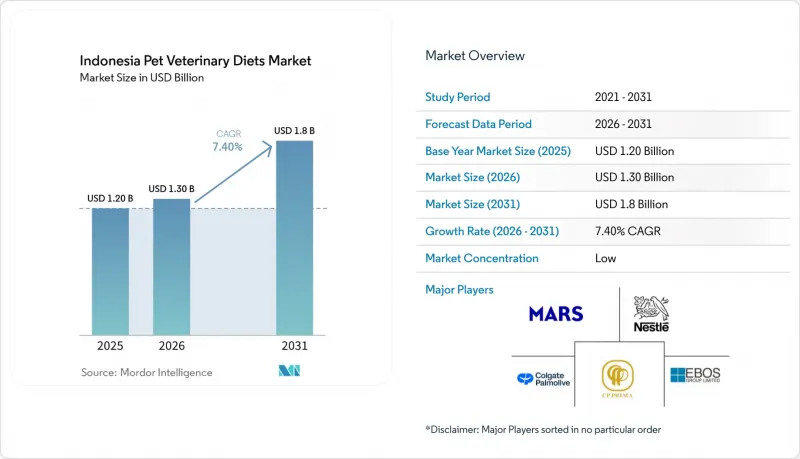
This report is Segmented by Sub Product (Diabetes, Digestive Sensitivity, Oral Care Diets, Renal, and More), by Pet Type (Cats, Dogs, and Other Pets), and by Distribution Channel (Convenience Stores, Online Channel, and More). The Market Forecasts are Provided in Terms of Value (USD) and Volume (Metric Tons).
Indonesia Pet Veterinary Diets Market Trends and Insights
Rising Pet Humanization and Preventive Care Spending
The Indonesia pet veterinary diets market is benefiting from a clear shift in how urban households view companion animal care. Therapeutic diets are no longer treated solely as emergency purchases after a diagnosis. They are increasingly part of routine spending tied to digestive stability, weight management, renal support, and urinary health. This is most visible in Greater Jakarta, Surabaya, and Bandung, where pet owners are more willing to pay for products that appear aligned with long-term wellness. The result is a stronger demand for nutritionally positioned products and a greater willingness to follow a prescribed feeding plan once a veterinarian or trusted retailer introduces the product.
Veterinarian-Endorsed Nutrition for Chronic Pet Conditions
The Indonesia pet veterinary diet market still relies heavily on veterinary recommendations, especially for chronic conditions that require ongoing feeding discipline. Renal, urinary, and digestive conditions remain the strongest triggers for a therapeutic diet purchase because owners are more likely to accept a premium when the product is tied to a diagnosed need. Nestle Purina's expansion of Pro Plan Veterinary Diets for digestive and urinary conditions at Indonesia International Pet Expo (IIPE) 2025 showed that manufacturers continue to treat the clinic-linked channel as a serious growth route in Indonesia. Adoption will remain uneven across the country because urban markets have denser care networks and stronger follow-up behavior than smaller cities. That pattern keeps Java ahead in early therapeutic diet uptake and gives companies a reason to keep investing in clinician education, sampling, and clinic-facing product portfolios.
Price Sensitivity Among Mass-Market Pet Owners
The Indonesia pet veterinary diets market still faces a real affordability ceiling outside premium urban clusters. Many households continue to compare therapeutic diets against standard commercial food and may not see enough immediate value to justify the higher spend. This is especially relevant in tier 2 and tier 3 cities, where price discipline tends to be stronger, and replacement with lower-cost alternatives is easier. Premiumization is present, but it is not uniform across income groups or regions. Companies that fail to offer smaller packs, clearer clinical value, or more accessible entry points may find that demand in the Indonesia pet veterinary diets market grows more slowly than anticipated.
Other drivers and restraints analyzed in the detailed report include:
- Expansion of E-Commerce and Modern Retail Access
- Premiumization of Therapeutic Pet Diets
- Limited Availability of Specialized Veterinary Diets Outside Major Cities
For complete list of drivers and restraints, kindly check the Table Of Contents.
Segment Analysis
Diabetes dominated the Indonesia pet veterinary diets market in 2025, accounting for 18.4% of the market share. It is also the fastest-growing segment, projected to expand at a CAGR of 11.2% from 2026 to 2031. This dominance is primarily due to the increasing prevalence of diabetes and obesity-related metabolic disorders among companion animals, particularly dogs and cats. Factors such as changing lifestyles, reduced physical activity, and rising pet obesity rates contribute to this trend. Additionally, growing awareness among pet owners about the importance of disease-specific nutritional management has driven demand for specialized diabetic veterinary diets. These diets are designed to regulate blood glucose levels, support weight management, and enhance overall health outcomes in diabetic pets.
The sub-product view of the Indonesia pet veterinary diets market shows the greatest maturity in renal and urinary formulations, while digestive sensitivity remains a practical entry category. These segments are well aligned with conditions that owners and veterinarians are more likely to recognize and manage through daily feeding. Digestive sensitivity products are also important because digestive complaints often prompt owners to seek specialized feeding earlier than other health concerns. That makes digestive care a useful bridge between routine nutrition and prescription-style diets.
Complete Report Scope:
- By Sub Product
- Diabetes
- Renal
- Urinary Tract Disease
- Digestive Sensitivity
- Oral Care Diets
- Derma Diets
- Obesity Diets
- Other Veterinary Diets
- By Pet Type
- Cats
- Dogs
- Other Pets
- By Distribution Channel
- Convenience Stores
- Online Channel
- Specialty Stores
- Supermarkets and Hypermarkets
- Other Channels
List of Companies Covered in this Report:
- Mars, Incorporated
- Nestle S.A.
- Colgate-Palmolive (The Hill's Pet Nutrition)
- PT Central Proteina Prima Tbk
- Farmina Pet Foods
- EBOS Group Limited
- ADM
- Perfect Companion Group Co. Ltd
- Vafo Praha s.r.o.
- Schell and Kampeter, Inc.
- PLB International Inc.
- WellPet LLC
- Spectrum Brands Holdings, Inc.
- Adabi Consumer Industries Sdn Bhd
- Charoen Pokphand Group Company Limited
Additional Benefits:
- The market estimate (ME) sheet in Excel format
- 3 months of analyst support
TABLE OF CONTENTS
1 Introduction
- 1.1 Study Assumption and Market Definition
- 1.2 Scope of the Study
2 Research Methodology
3 Executive Summary
4 Key Industry Trends
- 4.1 Pet Population
- 4.1.1 Cats
- 4.1.2 Dogs
- 4.1.3 Other Pets
- 4.2 Pet Expenditure
- 4.3 Consumer Trends
5 Supply and Production Dynamics
- 5.1 Trade Analysis
- 5.2 Ingredient Trends
- 5.3 Value Chain and Distribution Channel Analysis
- 5.4 Regulatory Framework
- 5.5 Market Overview
- 5.6 Market Drivers
- 5.6.1 Rising Pet Humanization and Preventive Care Spending
- 5.6.2 Veterinarian-Endorsed Nutrition for Chronic Pet Conditions
- 5.6.3 Expansion of E-Commerce and Modern Retail Access
- 5.6.4 Premiumization of Therapeutic Pet Diets
- 5.6.5 Higher Awareness of Breed-Specific and Condition-Specific Diets
- 5.6.6 Halal Compliance and Ingredient Transparency
- 5.7 Market Restraints
- 5.7.1 Price Sensitivity Among Mass-Market Pet Owners
- 5.7.2 Limited Availability of Specialized Veterinary Diets Outside Major Cities
- 5.7.3 Limited Veterinary Prescription Culture for Companion Animals
- 5.7.4 Higher Product Compliance and Import Dependence Costs
6 Market Size and Growth Forecasts (Value and Volume)
- 6.1 By Sub Product
- 6.1.1 Diabetes
- 6.1.2 Renal
- 6.1.3 Urinary Tract Disease
- 6.1.4 Digestive Sensitivity
- 6.1.5 Oral Care Diets
- 6.1.6 Derma Diets
- 6.1.7 Obesity Diets
- 6.1.8 Other Veterinary Diets
- 6.2 By Pet Type
- 6.2.1 Cats
- 6.2.2 Dogs
- 6.2.3 Other Pets
- 6.3 By Distribution Channel
- 6.3.1 Convenience Stores
- 6.3.2 Online Channel
- 6.3.3 Specialty Stores
- 6.3.4 Supermarkets and Hypermarkets
- 6.3.5 Other Channels
7 Competitive Landscape
- 7.1 Market Concentration
- 7.2 Strategic Moves
- 7.3 Market Share Analysis
- 7.4 Company Profiles (Includes Global Level Overview, Market Level Overview, Core Segments, Financials as Available, Strategic Information, Market Rank/Share for Key Companies, Products and Services, and Recent Developments)
- 7.4.1 Mars, Incorporated
- 7.4.2 Nestle S.A.
- 7.4.3 Colgate-Palmolive (The Hill's Pet Nutrition)
- 7.4.4 PT Central Proteina Prima Tbk
- 7.4.5 Farmina Pet Foods
- 7.4.6 EBOS Group Limited
- 7.4.7 ADM
- 7.4.8 Perfect Companion Group Co. Ltd
- 7.4.9 Vafo Praha s.r.o.
- 7.4.10 Schell and Kampeter, Inc.
- 7.4.11 PLB International Inc.
- 7.4.12 WellPet LLC
- 7.4.13 Spectrum Brands Holdings, Inc.
- 7.4.14 Adabi Consumer Industries Sdn Bhd
- 7.4.15 Charoen Pokphand Group Company Limited
8 Key Strategic Questions for Stakeholders

