PUBLISHER: Mordor Intelligence | PRODUCT CODE: 2099924

PUBLISHER: Mordor Intelligence | PRODUCT CODE: 2099924
Malaysia Pet Veterinary Diet - Market Share Analysis, Industry Trends & Statistics, Growth Forecasts (2026 - 2031)
According to Mordor Intelligence, the Malaysia pet veterinary diet market size is projected to expand from USD 59.61 million in 2025 and USD 64.57 million in 2026 to USD 97.45 million by 2031, registering a CAGR of 8.58% between 2026 and 2031.
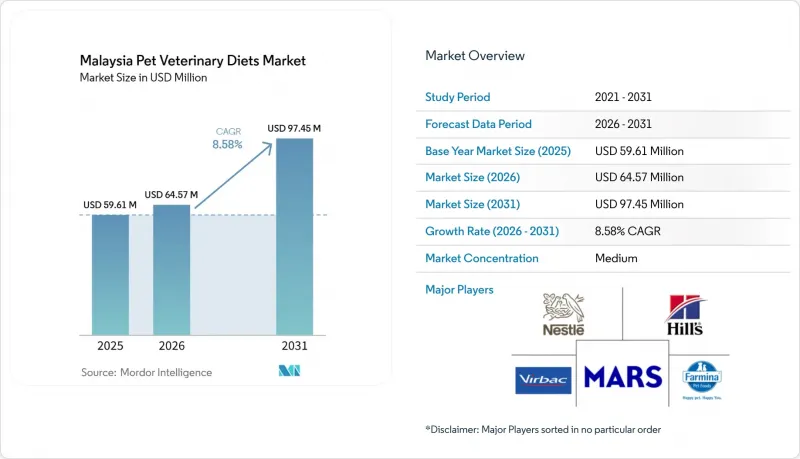
This report is Segmented by Sub Product (Diabetes, Renal, Urinary Tract Disease, Digestive Sensitivity, Oral Care, Derma, and More), by Pet Type (Cats, Dogs, and Other Pets), and by Distribution Channel (Convenience Stores, Online Channel, Specialty Stores, Supermarkets and Hypermarkets, and Other Channels). The Market Forecasts are Provided in Terms of Value (USD) and Volume (Metric Tons).
Malaysia Pet Veterinary Diet Market Trends and Insights
Rising Cat Ownership and Premiumization of Therapeutic Nutrition
Growing cat ownership in Malaysia is expanding the addressable market for veterinary therapeutic diets, with cats accounting for an increasing share of companion animals in urban households due to their suitability for apartment living and relatively lower maintenance requirements. As the feline population grows and ages, the incidence of chronic conditions requiring long-term nutritional management also increases. Chronic kidney disease (CKD), one of the most common age-related feline diseases, affects up to 40% of cats over the age of 10 and up to 80% of cats over the age of 15. International Cat Care also reported in 2024 that 20% to 50% of cats over age 15 have some degree of CKD, reinforcing the commonness of long-term nutritional management in older feline populations. Because CKD is a lifelong condition that relies on sustained dietary intervention alongside veterinary care, affected pets typically remain on therapeutic nutrition for extended periods. This shifts purchasing decisions toward clinically formulated, premium veterinary diets with proven renal support benefits, increasing both product adoption and spending per pet. Consequently, the Malaysia pet veterinary diet market benefits from sustained demand for feline therapeutic nutrition, particularly within renal care and other long-term disease management categories.
Higher Veterinary Diagnosis Rates for Chronic Companion Animal Conditions
The Malaysia pet veterinary diet market grows when chronic conditions are identified earlier and when veterinary clinics are more trusted. Universiti Putra Malaysia and Aniware Limited signed an AI imaging collaboration in May 2025 that enables rapid disease detection at the University Veterinary Hospital in Serdang, supporting AI-assisted diagnostic workflows and potentially enabling earlier clinical decision-making for chronic companion animal diseases. A 2024 Malaysian case study published in Pertanika Journal of Tropical Agricultural Science documented feline idiopathic cystitis in a local context, supporting the clinical relevance of urinary diet management in Malaysia rather than in imported veterinary literature. The 2025 iCatCare consensus guidelines on lower urinary tract diseases in cats also support more consistent diet-led case management across veterinary practice. As diagnostic capability improves, prescription therapeutic diets continue to be primarily dispensed through veterinary clinics, where veterinarians guide long-term nutritional management and repeat purchasing. This strengthens incumbent brands because diagnosis-led demand can only convert into sales when approved therapeutic products are already available in the market.
High Unit Prices Relative to Standard Pet Food
The Malaysia pet veterinary diet industry faces immediate resistance from premium pricing because renal, urinary, and digestive formulas cost much more than standard pet food. The price gap becomes even more important when the owner also needs to pay for consultation and diagnostic work before the first therapeutic purchase. This creates a drop-off both before diagnosis and after prescription, especially in households that may try supplements or premium general nutrition first. Imported supply deepens the problem because most leading therapeutic brands still reach the market through regulated foreign product pipelines rather than through large-scale local manufacturing. Even when the clinical need is clear, the shift into prescription feeding can therefore be delayed by budget pressure rather than by a weak medical rationale. In the Malaysia pet veterinary diet market, pricing remains the most direct barrier between diagnosis and sustained adherence.
Other drivers and restraints analyzed in the detailed report include:
- E-Commerce Expansion for Prescription and Functional Pet Nutrition
- Growth of Preventive Pet Healthcare and Early Diet Intervention
- Prescription Dependency and Limited Consumer Awareness in Secondary Cities
For complete list of drivers and restraints, kindly check the Table Of Contents.
Segment Analysis
Digestive sensitivity captured 24.1% of the Malaysia pet veterinary diet market share in 2025, making it the largest product category in current demand. The segment highlights the increasing need for nutritional management of gastrointestinal disorders, many of which require long-term dietary intervention rather than short-term pharmaceutical solutions. In October 2024, a study titled "Macronutrients Comparison of Commercial Cat Foods in Malaysia," published in the Sarhad Journal of Agriculture, identified significant differences in nutrient composition among commercial cat foods in Malaysia. This study emphasizes the growing focus on diet quality and nutritional formulation within the country's pet food market. As veterinarians prioritize gastrointestinal health, digestibility, and nutrient utilization, the demand for therapeutic digestive-support diets is anticipated to remain robust. Renal diets represent another key clinical category, as chronic kidney disease necessitates prolonged dietary management and high owner compliance, leading to extended prescription cycles. Additionally, diets targeting obesity, dermatological health, oral care, and diabetes are expanding the role of veterinary nutrition from disease treatment to structured, long-term health management.
Urinary tract disease is the fastest product segment, and the Malaysia pet veterinary diet market size for this category is projected to expand at a 10.1% CAGR during 2026-2031. Demand is being supported by growing veterinary recognition that nutritional management plays a central role in controlling feline lower urinary tract disease (FLUTD), one of the most frequently encountered feline health conditions. Clinical guidance increasingly recommends dietary strategies that promote urine dilution and higher water intake, driving adoption of therapeutic urinary formulas. The segment also benefits from the rising share of indoor cats, a population commonly associated with urinary health risks such as obesity, reduced activity levels, and stress-related urinary disorders. Looking ahead, the increasing prevalence of age-related comorbidities is anticipated to drive the development of integrated veterinary diets that target urinary, renal, and metabolic health within a single formulation.
Complete Report Scope:
- By Sub Product
- Diabetes
- Renal
- Urinary Tract Disease
- Digestive Sensitivity
- Oral Care Diets
- Derma Diets
- Obesity Diets
- Other Veterinary Diets
- By Pets
- Cats
- Dogs
- Other Pets
- By Distribution Channel
- Convenience Stores
- Online Channel
- Specialty Stores
- Supermarkets/ Hypermarkets
- Other Channels
List of Companies Covered in this Report:
- Mars, Incorporated
- Hill's Pet Nutrition, Inc. (Colgate-Palmolive Company)
- Nestle Purina PetCare (Nestle S.A.)
- Virbac S.A.
- Farmina Pet Foods Holding B.V.
- Monge & C. S.p.A.
- Affinity Petcare, S.A. (Agrolimen Group)
- Dechra Pharmaceuticals PLC
- Vetoquinol S.A.
- Ceva Sante Animale
- Diamond Pet Foods, Inc.
- Wellness Pet Company, Inc.
- Spectrum Brands Holdings, Inc.
- Blue Buffalo Company, Ltd. (General Mills, Inc.)
- Dr. Clauder's GmbH & Co. KG
Additional Benefits:
- The market estimate (ME) sheet in Excel format
- 3 months of analyst support
TABLE OF CONTENTS
1 INTRODUCTION
- 1.1 Study Assumptions and Market Definition
- 1.2 Scope of the Study
- 1.3 Research Methodology
2 REPORT OFFERS
3 EXECUTIVE SUMMARY AND KEY FINDINGS
4 KEY INDUSTRY TRENDS
- 4.1 Pet Population
- 4.1.1 Cats
- 4.1.2 Dogs
- 4.1.3 Other Pets
- 4.2 Pet Expenditure
- 4.3 Consumer Trends
5 SUPPLY AND PRODUCTION DYNAMICS
- 5.1 Trade Analysis
- 5.2 Ingredient Trends
- 5.3 Value Chain and Distribution Channel Analysis
- 5.4 Regulatory Framework
- 5.5 Market Drivers
- 5.5.1 Rising cat ownership and premiumization of therapeutic nutrition
- 5.5.2 Higher veterinary diagnosis rates for chronic companion animal conditions
- 5.5.3 E-commerce expansion for prescription and functional pet nutrition
- 5.5.4 Expansion of urban multi-pet households and health-managed feeding
- 5.5.5 Growth of preventive pet healthcare and early diet intervention
- 5.5.6 Broader availability of clinic-linked and retail therapeutic diet assortments
- 5.6 Market Restraints
- 5.6.1 High unit prices relative to standard pet food
- 5.6.2 Prescription dependency and limited consumer awareness in secondary cities
- 5.6.3 Import dependence and product registration lead times
- 5.6.4 Limited shelf space and channel fragmentation outside major urban centers
- 5.7 Regulatory Landscape
- 5.8 Technological Outlook
- 5.9 Product Innovation and Therapeutic Differentiation
- 5.10 Porter's Five Forces Analysis
- 5.10.1 Threat of New Entrants
- 5.10.2 Bargaining Power of Suppliers
- 5.10.3 Bargaining Power of Buyers
- 5.10.4 Threat of Substitutes
- 5.10.5 Intensity of Competitive Rivalry
6 MARKET SIZE AND GROWTH FORECASTS (VALUE AND VOLUME)
- 6.1 By Sub Product
- 6.1.1 Diabetes
- 6.1.2 Renal
- 6.1.3 Urinary Tract Disease
- 6.1.4 Digestive Sensitivity
- 6.1.5 Oral Care Diets
- 6.1.6 Derma Diets
- 6.1.7 Obesity Diets
- 6.1.8 Other Veterinary Diets
- 6.2 By Pets
- 6.2.1 Cats
- 6.2.2 Dogs
- 6.2.3 Other Pets
- 6.3 By Distribution Channel
- 6.3.1 Convenience Stores
- 6.3.2 Online Channel
- 6.3.3 Specialty Stores
- 6.3.4 Supermarkets/ Hypermarkets
- 6.3.5 Other Channels
7 COMPETITIVE LANDSCAPE
- 7.1 Market Concentration
- 7.2 Strategic Moves
- 7.3 Market Share Analysis
- 7.4 Company Profiles (Includes Global Level Overview, Market Level Overview, Core Segments, Financials as Available, Strategic Information, Market Rank/Share for Key Companies, Products and Services, and Recent Developments)
- 7.4.1 Mars, Incorporated
- 7.4.2 Hill's Pet Nutrition, Inc. (Colgate-Palmolive Company)
- 7.4.3 Nestle Purina PetCare (Nestle S.A.)
- 7.4.4 Virbac S.A.
- 7.4.5 Farmina Pet Foods Holding B.V.
- 7.4.6 Monge & C. S.p.A.
- 7.4.7 Affinity Petcare, S.A. (Agrolimen Group)
- 7.4.8 Dechra Pharmaceuticals PLC
- 7.4.9 Vetoquinol S.A.
- 7.4.10 Ceva Sante Animale
- 7.4.11 Diamond Pet Foods, Inc.
- 7.4.12 Wellness Pet Company, Inc.
- 7.4.13 Spectrum Brands Holdings, Inc.
- 7.4.14 Blue Buffalo Company, Ltd. (General Mills, Inc.)
- 7.4.15 Dr. Clauder's GmbH & Co. KG
8 KEY STRATEGIC QUESTIONS FOR PET FOOD CEOS

