PUBLISHER: Mordor Intelligence | PRODUCT CODE: 2099082

PUBLISHER: Mordor Intelligence | PRODUCT CODE: 2099082
United States Healthcare Logistics - Market Share Analysis, Industry Trends & Statistics, Growth Forecasts (2026 - 2031)
According to Mordor Intelligence, the United States healthcare logistics market size was valued at USD 251.36 billion in 2025 and is estimated to grow from USD 266.49 billion in 2026 to reach USD 352.03 billion by 2031, at a CAGR of 5.73% during the forecast period (2026-2031).
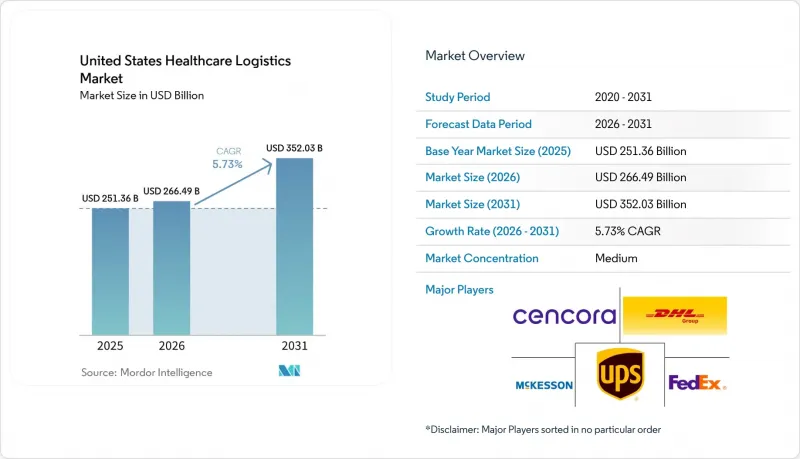
Growth is being shaped by specialty pharmaceuticals, cell and gene therapies, and decentralized care delivery, which are shifting spending toward cold chain capacity, last-mile execution, and stronger chain-of-custody controls across the market. This report is Segmented by Logistics Function (Transportation, Warehousing & Distribution, and More), by Temperature Type (Temperature Controlled, Non-Temperature Controlled), by Product Type (Pharmaceuticals, and More), by Destination (Domestic, International), by End User (Pharmaceutical Manufacturers, and More), and by Geography. The Market Forecasts are Provided in Terms of Value (USD).
United States Healthcare Logistics Market Trends and Insights
Growth of Direct-to-Patient Specialty Pharmacy Fulfillment
Direct-to-patient fulfillment has moved from an emerging channel to a mainstream operating model for specialty pharmaceuticals. A larger therapy mix now carries handling, reimbursement, and patient support needs that do not fit well with traditional wholesale distribution. Payers and pharmacy benefit managers are redirecting more high-cost biologics, GLP-1 products, and oncology treatments toward mail-order and hub-and-spoke fulfillment. That shift requires logistics providers to manage temperature assurance, delivery scheduling, adherence support, and nurse coordination in one operating flow. Providers that cannot combine delivery with service visibility are losing ground in the United States healthcare logistics market to integrated specialty pharmacy and purpose-built direct-to-patient platforms.
Expansion of Cell and Gene Therapy Cold Chain Lanes
FDA-regulated cellular and gene therapy products are now established commercial products, and that is changing lane design, packaging, and exception management in the United States healthcare logistics market. Each autologous treatment follows a chain-of-identity flow from collection to manufacturing to cryogenic shipment to final infusion, so the logistics process becomes part of the treatment pathway. This structure requires cryogenic handling at or below -150 °C for some therapies, energy-redundant storage, and auditable chain-of-custody records. Manufacturing investment is filling future logistics pipelines, especially near established biopharma clusters in the Northeast and Pennsylvania. The high capital threshold is concentrating this part of the United States healthcare logistics market among operators that already run validated cryogenic networks.
Driver Shortages in Time-Critical Road Freight
The road freight market entered 2026 with a tighter driver base, which is a meaningful constraint on the United States healthcare logistics market. The shortage states that a rule change affecting non-domiciled commercial driver eligibility removed 50,000 drivers from active service in the near term. It also states that the broader truck driver shortfall stood at around 82,000 drivers, leaving healthcare freight exposed because road transport still handles the bulk of pharmaceutical replenishment and last-mile movement. That pressure is particularly serious for organs, blood products, cell therapies, and urgent pharmaceutical deliveries, as those shipments offer little or no transit flexibility. Carriers that can still provide healthcare-grade service are gaining pricing power as reefer and time-critical capacity tighten.
Other drivers and restraints analyzed in the detailed report include:
- Rising Serialization, Track-and-Trace, and Chain-of-Custody Demands
- Growth of Hospital-at-Home and Home Infusion Delivery Models
- High Cost of Ultra-Low Temperature Infrastructure
For complete list of drivers and restraints, kindly check the Table Of Contents.
Segment Analysis
Transportation held 54.50% of the United States healthcare logistics market share in 2025, while warehousing and distribution is forecast to advance at 7.49% CAGR through 2031. That leading share reflects the central role of road, air, and intermodal movement in pharmaceutical distribution, where timing and compliant handling remain critical service requirements. Air freight serves the premium end of the network because cryogenic therapies and urgent biologics depend on validated lanes and tightly managed handoffs. Road networks still carry the volume base of the United States healthcare logistics industry because they connect manufacturers, distributors, hospitals, pharmacies, and regional distribution points at national scale. This keeps transportation at the center of contract value even as the service mix becomes more specialized.
Warehousing and distribution is growing faster because manufacturers are moving toward outsourced models that combine storage, fulfillment, and temperature management under one provider. That change is tied to the rise of distributed care because home-based therapy and acute-care-at-home programs need inventory positioned closer to patients and care teams. The value-added layer is also expanding as providers take on kitting, labeling, cold packing, and reverse logistics alongside core storage. Providers with GDP and cGMP compliant sites are holding a structural advantage because regulated pharmaceutical products cannot easily be moved through non-certified environments. Over time, this is shifting competitive positioning within the United States healthcare logistics market from basic transport reach toward integrated warehousing capability and validated operating discipline.
Non-temperature-controlled logistics accounted for 82.14% of the United States healthcare logistics market size in 2025, while temperature-controlled logistics are projected to grow at 7.63% CAGR through 2031. Ambient flows remain dominant because a large volume of pharmaceuticals, devices, and healthcare supplies can move without active temperature control. This wide ambient base supports national scale and cost efficiency, making it essential for routine replenishment and broad healthcare distribution. Even so, the mix is slowly shifting because new therapies are placing greater weight on refrigerated, frozen, and deep-frozen handling. That is moving investment toward monitoring, qualified packaging, and tighter exception management in the United States healthcare logistics market.
The chilled 2 °C to 8 °C range serves much of the refrigerated pharmaceutical base, while frozen ranges support mRNA vaccines and selected biologics, and deeper frozen ranges support advanced therapy flows. Also, refrigerant regulations are affecting construction economics for new cold storage facilities in 2026, adding another planning variable to network expansion. At the same time, validated cold-chain capacity continues to command a premium because the service is harder to replicate, more capital-intensive, and more compliance-sensitive. This also states that cold-chain rates can run 150% to 200% above ambient alternatives, which shows how sharply pricing separates the two service tiers. That widening gap suggests that temperature-controlled capacity will remain one of the strongest value pools in the United States healthcare logistics industry.
Complete Report Scope:
- By Logistics Function
- Transportation
- Road
- Air
- Sea and Inland Waterways
- Rail
- Warehousing and Distribution
- Value-added Services and Others
- Transportation
- By Temperature Type
- Temperature Controlled
- Chilled (0-5 °C)
- Frozen (-18-0 °C)
- Ambient
- Deep-Frozen / Ultra-Low (less than -20 °C)
- Non-Temperature Controlled
- Temperature Controlled
- By Product Type
- Pharmaceuticals
- Prescription and Specialty Drugs
- OTC Drugs
- Biopharmaceuticals (Biologics and Biosimilars)
- Vaccines
- Clinical Trial Materials
- Cell and Gene Therapies
- Medical Devices
- Veterinary Medicine
- Blood, Plasma and Blood Components
- Diagnostic and Laboratory Products
- Organs and Human Tissues
- Others
- Pharmaceuticals
- By Destination
- Domestics
- International
- By End User
- Pharmaceutical Manufacturers
- Biopharmaceutical Manufacturers
- Hospitals and Clinics
- Hospitals and Retail Pharmacies
- Healthcare Distributors and Wholesalers
- Others
- By Region
- Northeast
- Southeast
- Midwest
- Southwest
- West
List of Companies Covered in this Report:
- United Parcel Service of America, Inc. (UPS)
- DHL Group
- FedEx
- McKesson Corporation
- Cencora
- Cardinal Health
- Kuehne+Nagel
- GEODIS
- CMA CGM Group (Including CEVA Logistics)
- Lineage, Inc.
- Americold
- DSV A/S (Including DB Schenker)
- Nippon Express Holdings
- Ryder System, Inc.
- C.H. Robinson Worldwide, Inc.
- Expeditors International of Washington, Inc.
- AIT Worldwide Logistics, Inc.
- World Courier
- Medline Industries
- Owens and Minor
- Henry Schein
Additional Benefits:
- The market estimate (ME) sheet in Excel format
- 3 months of analyst support
TABLE OF CONTENTS
1 Introduction
- 1.1 Study Assumptions and Market Definition
- 1.2 Scope of the Study
2 Research Methodology
3 Executive Summary
4 Market Landscape
- 4.1 Market Overview and Role of Logistics in Healthcare
- 4.2 Healthcare Spending Trends
- 4.3 Market Drivers
- 4.3.1 Growth of Direct-to-Patient Specialty Pharmacy Fulfillment
- 4.3.2 Expansion of Cell and Gene Therapy Cold Chain Lanes
- 4.3.3 Rising Serialization, Track-and-Trace, and Chain-of-Custody Demands
- 4.3.4 Adoption of Predictive Control Towers and IoT Monitoring
- 4.3.5 Growth of Hospital-at-Home and Home Infusion Delivery Models
- 4.3.6 Sustainability Pressure on Temperature-Controlled Packaging and Transport
- 4.4 Market Restraints
- 4.4.1 Driver Shortages in Time-Critical Road Freight
- 4.4.2 High Cost of Ultra-Low Temperature Infrastructure
- 4.4.3 Refrigeration Failure and Excursion Liability Risk
- 4.4.4 Fragmented Compliance Across Multi-State and Cross-Border Flows
- 4.5 Regulatory Framework
- 4.6 Value Chain and Distribution Channel Architecture Analysis
- 4.7 Technology Innovations Outlook
- 4.8 Porter's Five Forces Analysis
- 4.8.1 Threat of New Entrants
- 4.8.2 Bargaining Power of Suppliers
- 4.8.3 Bargaining Power of Buyers
- 4.8.4 Threat of Substitutes
- 4.8.5 Rivalry Among Competitors
- 4.9 Evolution of Healthcare Logistics Requirements
- 4.10 Impact of Geo-Political Events on Supply Chain Shifts
5 Market Size and Growth Forecasts (Value, 2026-2031)
- 5.1 By Logistics Function
- 5.1.1 Transportation
- 5.1.1.1 Road
- 5.1.1.2 Air
- 5.1.1.3 Sea and Inland Waterways
- 5.1.1.4 Rail
- 5.1.2 Warehousing and Distribution
- 5.1.3 Value-added Services and Others
- 5.1.1 Transportation
- 5.2 By Temperature Type
- 5.2.1 Temperature Controlled
- 5.2.1.1 Chilled (0-5 °C)
- 5.2.1.2 Frozen (-18-0 °C)
- 5.2.1.3 Ambient
- 5.2.1.4 Deep-Frozen / Ultra-Low (less than -20 °C)
- 5.2.2 Non-Temperature Controlled
- 5.2.1 Temperature Controlled
- 5.3 By Product Type
- 5.3.1 Pharmaceuticals
- 5.3.1.1 Prescription and Specialty Drugs
- 5.3.1.2 OTC Drugs
- 5.3.2 Biopharmaceuticals (Biologics and Biosimilars)
- 5.3.3 Vaccines
- 5.3.4 Clinical Trial Materials
- 5.3.5 Cell and Gene Therapies
- 5.3.6 Medical Devices
- 5.3.7 Veterinary Medicine
- 5.3.8 Blood, Plasma and Blood Components
- 5.3.9 Diagnostic and Laboratory Products
- 5.3.10 Organs and Human Tissues
- 5.3.11 Others
- 5.3.1 Pharmaceuticals
- 5.4 By Destination
- 5.4.1 Domestics
- 5.4.2 International
- 5.5 By End User
- 5.5.1 Pharmaceutical Manufacturers
- 5.5.2 Biopharmaceutical Manufacturers
- 5.5.3 Hospitals and Clinics
- 5.5.4 Hospitals and Retail Pharmacies
- 5.5.5 Healthcare Distributors and Wholesalers
- 5.5.6 Others
- 5.6 By Region
- 5.6.1 Northeast
- 5.6.2 Southeast
- 5.6.3 Midwest
- 5.6.4 Southwest
- 5.6.5 West
6 Competitive Landscape
- 6.1 Market Concentration
- 6.2 Key Strategic Moves
- 6.3 Market Share Analysis
- 6.4 Company Profiles (Includes Global Level Overview, Market Level Overview, Core Segments, Financials as Available, Strategic Information, Market Rank/Share for Key Companies, Products and Services, and Recent Developments)
- 6.4.1 United Parcel Service of America, Inc. (UPS)
- 6.4.2 DHL Group
- 6.4.3 FedEx
- 6.4.4 McKesson Corporation
- 6.4.5 Cencora
- 6.4.6 Cardinal Health
- 6.4.7 Kuehne+Nagel
- 6.4.8 GEODIS
- 6.4.9 CMA CGM Group (Including CEVA Logistics)
- 6.4.10 Lineage, Inc.
- 6.4.11 Americold
- 6.4.12 DSV A/S (Including DB Schenker)
- 6.4.13 Nippon Express Holdings
- 6.4.14 Ryder System, Inc.
- 6.4.15 C.H. Robinson Worldwide, Inc.
- 6.4.16 Expeditors International of Washington, Inc.
- 6.4.17 AIT Worldwide Logistics, Inc.
- 6.4.18 World Courier
- 6.4.19 Medline Industries
- 6.4.20 Owens and Minor
- 6.4.21 Henry Schein
7 Market Opportunities and Future Outlook
- 7.1 White-space and Unmet-Need Assessment

