PUBLISHER: Mordor Intelligence | PRODUCT CODE: 2099464

PUBLISHER: Mordor Intelligence | PRODUCT CODE: 2099464
Germany Healthcare Logistics - Market Share Analysis, Industry Trends & Statistics, Growth Forecasts (2026 - 2031)
According to Mordor Intelligence, the Germany healthcare logistics market size is expected to increase from USD 26.97 billion in 2025 to USD 28.63 billion in 2026 and reach USD 38.10 billion by 2031, growing at a CAGR of 5.88% over 2026-2031.
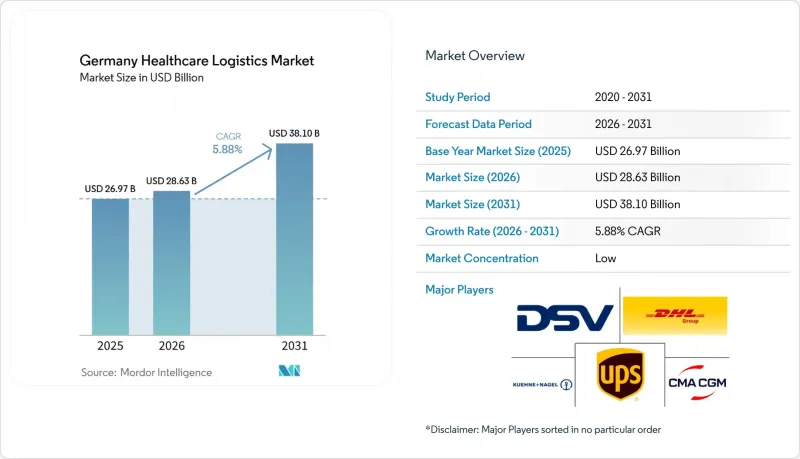
The Germany healthcare logistics market is supported by Germany's role as a central European pharmaceutical distribution base, where GDP-compliant warehousing, air cargo handling, and road connectivity support both domestic supply and cross-border drug flows across the European Union. This report is Segmented by Logistics Function (Transportation, Warehousing and Distribution, and More), by Temperature Type (Temperature Controlled, and More), by Product Type (Pharmaceuticals, and More), by Destination (Domestic, International), by End User (Pharma Manufacturers, and More), and by Region (NRW, Bavaria, and Rest). The Market Forecasts are Provided in Terms of Value (USD).
Germany Healthcare Logistics Market Trends and Insights
Germany As a Central European Pharmaceutical Distribution Hub
Germany's location and transport density continue to support its role as a central European pharmaceutical distribution platform. The Germany healthcare logistics market benefits from GDP-compliant air cargo infrastructure at Frankfurt and from road links that connect western, southern, and central European trade routes. Frankfurt Cargo Hub's Pharma@FRA setup requires continuous temperature monitoring, dedicated handling procedures, and support for sensitive pharmaceutical products, which strengthens Germany's role in high-value healthcare distribution. This operating model matters more as pharmaceutical flows shift from standard ambient products toward biologics and advanced therapies that need tighter process control. The result is a higher compliance threshold for new entrants and a stronger position for operators that already run certified sites, validated processes, and integrated transport links. The Germany healthcare logistics market therefore gains not only from geography, but also from the fact that compliance capability is now part of core network design.
Rising Direct-to-Patient and Home Delivery Models
Direct-to-patient delivery is becoming an increasingly important part of pharmaceutical fulfillment in Germany as prescription access, home-based treatment, and patient convenience gain greater weight in care delivery. The Germany healthcare logistics market is responding by moving closer to hybrid fulfillment models that can support both institutional distribution and patient-level dispatch in the same network. That shift is operationally demanding because hospital replenishment and home delivery require different pack formats, different controls, and different proof-of-delivery standards. GDP handling requirements still apply when medicinal products move outside classic wholesale channels, which means compliance cannot be relaxed simply because the shipment is smaller or consumer-facing. Providers that can combine batch-level traceability, tamper-evident packaging, and time-sensitive last-mile execution are better placed to secure pharmacy and specialty care contracts. The Germany healthcare logistics market is therefore seeing home delivery as an extension of regulated pharmaceutical fulfillment rather than as a simple parcel service.
High Energy Costs for Refrigerated Warehousing and Transport
Refrigerated warehousing and transport continue to face cost pressure from elevated energy use and the need for continuous temperature control. The Germany healthcare logistics market feels this pressure most strongly in cold storage operations, where power use is built into the service model and cannot be reduced without equipment upgrades. Smaller specialist operators are more exposed because they often have narrower asset bases and less room to fund large cooling retrofits. Compliance and refrigerant rules also make facility upgrades more expensive and slower to execute, which can delay efficiency gains in parts of the network. This pushes the market toward larger operators that can absorb utility volatility and finance validated infrastructure renewal over a longer planning period. The result is short-term margin pressure and, over time, gradual consolidation pressure in temperature-controlled nodes.
Other drivers and restraints analyzed in the detailed report include:
- Increasing Cell and Gene Therapy Trial Logistics
- Higher Premium Tolerance for GDP-Compliant Temperature Assurance
- Shortage of GDP-Trained Drivers and Cold Chain Labor
For complete list of drivers and restraints, kindly check the Table Of Contents.
Segment Analysis
Transportation accounted for 47.78% of the Germany healthcare logistics market share in 2026, making it the largest function in the market. Road freight remained the core mode within this segment because hospitals, wholesalers, and pharmacies need dense last-mile and regional replenishment coverage. Air freight still represented a smaller share, but investment intensity remained high because time-sensitive biologics and specialty shipments depend on faster international connections. Kuehne+Nagel added Frankfurt to its Inspire aircraft rotation in June 2026, creating a direct Chicago-Frankfurt link that targets sensitive pharmaceutical flows between 2 major production and distribution hubs. Sea, inland waterways, and rail kept more selective roles in bulk API movements and intermodal domestic distribution, while warehousing and distribution remained the second-largest functional category in the Germany healthcare logistics market.
Value-added services and others are forecast to grow at a 7.64% CAGR from 2026 to 2031, making it the fastest-growing function in the German healthcare logistics market. This expansion reflects the broader outsourcing of serialization, kitting, relabeling, clinical trial support, and patient-specific cold-chain packaging to specialized logistics partners. LOXXESS Pharma's Rosengarten-Nenndorf site near Hamburg, scheduled to start in Q3 2026, includes automated cube-storage robotic picking systems and was presented as the first such system with pharmaceutical GDP approval in Germany. The commercial effect is clear, because validated automation can raise throughput and accuracy while also strengthening audit readiness. In this part of the Germany healthcare logistics industry, service depth is becoming more valuable than simple warehouse footprint because pharmaceutical customers are shifting regulated support tasks outside their own facilities.
Non-temperature-controlled logistics held 88.28% of the Germany healthcare logistics market share in 2025, which kept it as the largest temperature segment in the market. That reflects the large volume of ambient pharmaceuticals, medical devices, and diagnostic products that still move through German healthcare supply chains. Even so, this lead is gradually narrowing as the product mix shifts toward biologics, specialty medicines, and other temperature-sensitive products. Chilled, standard refrigerated, and deep-frozen lanes each matter, but the sharpest capability gap sits in ultra-low-temperature handling for advanced therapies. Movianto expanded its Neunkirchen pharmaceutical refrigeration site from 7,200 to 8,000 pallet positions at 2 °C to 8 °C in May 2025, which shows continued investment in regulated cold chain capacity. The company is also building a new site in Wiesloch-Walldorf, Baden-Wurttemberg, to introduce frozen goods logistics in Germany, extending the cold chain offer beyond standard refrigerated handling.
Temperature-controlled logistics is forecast to grow at a 7.46% CAGR from 2026 to 2031, outpacing the overall Germany healthcare logistics market and gaining strategic weight. GDP guidelines for medicinal products, along with vehicle qualification and temperature monitoring requirements, shape how this capacity can be expanded and validated in practice. The Germany healthcare logistics market is therefore seeing temperature-controlled growth as a mix of infrastructure expansion, stricter monitoring, and more specialized shipment profiles. This is also one of the clearest areas where premium service capability is separating healthcare-focused providers from standard freight operators.
Complete Report Scope:
- By Logistics Function
- Transportation
- Road
- Air
- Sea and Inland Waterways
- Rail
- Warehousing and Distribution
- Value-added Services and Others
- Transportation
- By Temperature Type
- Temperature Controlled
- Chilled (0-5 °C)
- Frozen (-18-0 °C)
- Ambient
- Deep-Frozen / Ultra-Low (less than -20 °C)
- Non-Temperature Controlled
- Temperature Controlled
- By Product Type
- Pharmaceuticals
- Prescription and Specialty Drugs
- OTC Drugs
- Biopharmaceuticals (Biologics and Biosimilars)
- Vaccines
- Clinical Trial Materials
- Cell and Gene Therapies
- Medical Devices
- Veterinary Medicine
- Blood, Plasma and Blood Components
- Diagnostic and Laboratory Products
- Organs and Human Tissues
- Others
- Pharmaceuticals
- By Destination
- Domestics
- International
- By End User
- Pharmaceutical Manufacturers
- Biopharmaceutical Manufacturers
- Hospitals and Clinics
- Hospitals and Retail Pharmacies
- Healthcare Distributors and Wholesalers
- Others
- By Region
- North Rhine-Westphalia
- Bavaria (Bayern)
- Baden-Wurttemberg
- Rest of States
List of Companies Covered in this Report:
- DHL Group
- Kuehne+Nagel
- United Parcel Service of America, Inc. (UPS)
- DSV A/S (Including DB Schenker)
- CMA CGM Group (Including CEVA Logistics)
- GEODIS
- Movianto
- Trans-o-Flex
- DACHSER SE
- FedEx
- Rhenus Group
- FIEGE
- Hellmann Worldwide Logistics
- LOXXESS Pharma
- SK Pharma Logistics GmbH
- Frigo-Trans
- Biotech and Pharma Logistics GmbH
- PHOENIX Pharmahandel
- Alliance Healthcare Deutschland GmbH
- Noweda Logistik
- Pharmaserv Logistics GmbH
Additional Benefits:
- The market estimate (ME) sheet in Excel format
- 3 months of analyst support
TABLE OF CONTENTS
1 Introduction
- 1.1 Study Assumptions and Market Definition
- 1.2 Scope of the Study
2 Research Methodology
3 Executive Summary
4 Market Landscape
- 4.1 Market Overview and Role of Logistics in Healthcare
- 4.2 Healthcare Spending Trends
- 4.3 Market Drivers
- 4.3.1 Germany as a Central European Pharmaceutical Distribution Hub
- 4.3.2 Rising Direct-to-Patient and Home Delivery Models
- 4.3.3 Increasing Cell and Gene Therapy Trial Logistics
- 4.3.4 Higher Premium Tolerance for GDP-Compliant Temperature Assurance
- 4.3.5 Increasing Ultra-Low-Temperature Readiness for Advanced Therapies
- 4.3.6 Expansion of Biopharma Manufacturing in Southern Germany
- 4.4 Market Restraints
- 4.4.1 High Energy Costs for Refrigerated Warehousing and Transport
- 4.4.2 Shortage of GDP-Trained Drivers and Cold Chain Labor
- 4.4.3 Uneven Infrastructure Depth Across Smaller Federal States
- 4.4.4 Margin Pressure From Cross-Border and Regional Specialist Carriers
- 4.5 Regulatory Framework
- 4.6 Value Chain and Distribution Channel Architecture Analysis
- 4.7 Technology Innovations Outlook
- 4.8 Porter's Five Forces Analysis
- 4.8.1 Threat of New Entrants
- 4.8.2 Bargaining Power of Suppliers
- 4.8.3 Bargaining Power of Buyers
- 4.8.4 Threat of Substitutes
- 4.8.5 Rivalry Among Competitors
- 4.9 Evolution of Healthcare Logistics Requirements
- 4.10 Impact of Geo-Political Events on Supply Chain Shifts
5 Market Size and Growth Forecasts
- 5.1 By Logistics Function
- 5.1.1 Transportation
- 5.1.1.1 Road
- 5.1.1.2 Air
- 5.1.1.3 Sea and Inland Waterways
- 5.1.1.4 Rail
- 5.1.2 Warehousing and Distribution
- 5.1.3 Value-added Services and Others
- 5.1.1 Transportation
- 5.2 By Temperature Type
- 5.2.1 Temperature Controlled
- 5.2.1.1 Chilled (0-5 °C)
- 5.2.1.2 Frozen (-18-0 °C)
- 5.2.1.3 Ambient
- 5.2.1.4 Deep-Frozen / Ultra-Low (less than -20 °C)
- 5.2.2 Non-Temperature Controlled
- 5.2.1 Temperature Controlled
- 5.3 By Product Type
- 5.3.1 Pharmaceuticals
- 5.3.1.1 Prescription and Specialty Drugs
- 5.3.1.2 OTC Drugs
- 5.3.2 Biopharmaceuticals (Biologics and Biosimilars)
- 5.3.3 Vaccines
- 5.3.4 Clinical Trial Materials
- 5.3.5 Cell and Gene Therapies
- 5.3.6 Medical Devices
- 5.3.7 Veterinary Medicine
- 5.3.8 Blood, Plasma and Blood Components
- 5.3.9 Diagnostic and Laboratory Products
- 5.3.10 Organs and Human Tissues
- 5.3.11 Others
- 5.3.1 Pharmaceuticals
- 5.4 By Destination
- 5.4.1 Domestics
- 5.4.2 International
- 5.5 By End User
- 5.5.1 Pharmaceutical Manufacturers
- 5.5.2 Biopharmaceutical Manufacturers
- 5.5.3 Hospitals and Clinics
- 5.5.4 Hospitals and Retail Pharmacies
- 5.5.5 Healthcare Distributors and Wholesalers
- 5.5.6 Others
- 5.6 By Region
- 5.6.1 North Rhine-Westphalia
- 5.6.2 Bavaria (Bayern)
- 5.6.3 Baden-Wurttemberg
- 5.6.4 Rest of States
6 Competitive Landscape
- 6.1 Market Concentration
- 6.2 Key Strategic Moves
- 6.3 Market Share Analysis
- 6.4 Company Profiles (Includes Global Level Overview, Market Level Overview, Core Segments, Financials as Available, Strategic Information, Market Rank/Share for Key Companies, Products and Services, and Recent Developments)
- 6.4.1 DHL Group
- 6.4.2 Kuehne+Nagel
- 6.4.3 United Parcel Service of America, Inc. (UPS)
- 6.4.4 DSV A/S (Including DB Schenker)
- 6.4.5 CMA CGM Group (Including CEVA Logistics)
- 6.4.6 GEODIS
- 6.4.7 Movianto
- 6.4.8 Trans-o-Flex
- 6.4.9 DACHSER SE
- 6.4.10 FedEx
- 6.4.11 Rhenus Group
- 6.4.12 FIEGE
- 6.4.13 Hellmann Worldwide Logistics
- 6.4.14 LOXXESS Pharma
- 6.4.15 SK Pharma Logistics GmbH
- 6.4.16 Frigo-Trans
- 6.4.17 Biotech and Pharma Logistics GmbH
- 6.4.18 PHOENIX Pharmahandel
- 6.4.19 Alliance Healthcare Deutschland GmbH
- 6.4.20 Noweda Logistik
- 6.4.21 Pharmaserv Logistics GmbH
7 Market Opportunities and Future Outlook
- 7.1 White-space and Unmet-Need Assessment

