PUBLISHER: Mordor Intelligence | PRODUCT CODE: 2099458

PUBLISHER: Mordor Intelligence | PRODUCT CODE: 2099458
China Healthcare Logistics - Market Share Analysis, Industry Trends & Statistics, Growth Forecasts (2026 - 2031)
According to Mordor Intelligence, the China healthcare logistics market size is expected to increase from USD 92.43 billion in 2025 to USD 96.97 billion in 2026, and reach USD 121.88 billion by 2031, growing at a CAGR of 4.68% from 2026 to 2031.
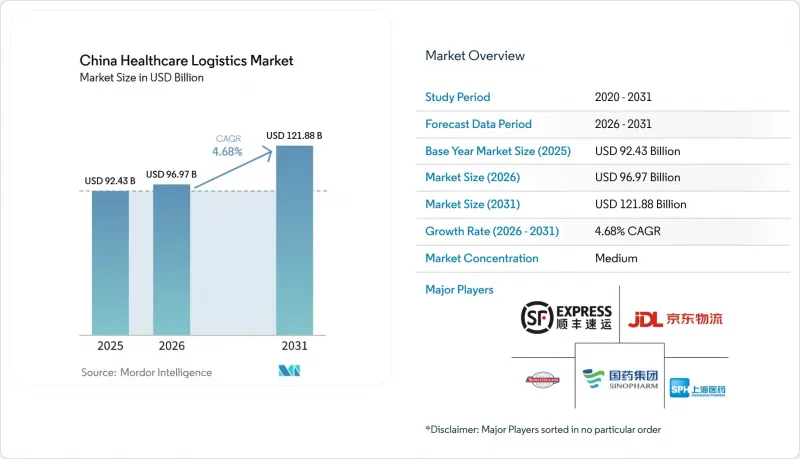
This report is Segmented by Logistics Function (Transportation, Warehousing, Value-Added Services), by Temperature Type (Controlled, Non-Controlled), by Product Type (Pharmaceuticals, and More), by Destination (Domestic, International), by End User (Pharma Manufacturers, Hospitals, Pharmacies, Others), and by Region (North, East, Central, South, and More). The Market Forecasts are Provided in Value (USD).
China Healthcare Logistics Market Trends and Insights
Expansion of Biopharmaceutical and Vaccine Distribution Networks
Industry and policy bodies are directing funding toward pharmaceutical cold chain expansion beyond large urban hubs, which is widening the addressable service base of the China healthcare logistics market. The county and township rollout matters because vaccine flows and temperature-sensitive drug volumes need qualified storage and transport at each handoff. The same pattern supports a stronger demand for distribution models that can handle more sensitive products with tighter documentation needs. As more innovative therapies reach patients through structured supply chains, logistics demand becomes longer-lasting rather than episodic. This is raising the value of operators that can combine cold chain capacity, audit readiness, and broad geographic coverage in the China healthcare logistics market.
Shift Toward Out-of-Hospital Drug Consumption
Retail pharmacy reform is changing where prescription medicines are dispensed, and that is reshaping delivery economics in the China healthcare logistics market. Hospital-oriented distribution usually concentrates volume into fewer stops, while retail and patient-facing fulfillment spreads the same volume across many more delivery points. That shift increases the need for route planning, smaller cold chain shipments, and better proof of delivery. It also favors logistics providers that can link transport with patient support, medication access, and follow-up coordination. The result is a broader service mix in the China healthcare logistics market, with more value shifting toward consumer-facing fulfillment rather than solely institutional distribution.
Centralized Procurement Pressure on Logistics Margins
Centralized drug procurement is putting pressure on revenue models tied closely to product value in the China healthcare logistics market. Moreover, procurement reform can raise concentration among leading suppliers while leaving smaller participants more exposed. That matters for logistics because volume commitments may rise even while pricing room narrows. Operators with a narrow service mix are more vulnerable when large contract volumes are accompanied by low margin tolerance. This creates a split in the China healthcare logistics market between bulk distributors that depend on scale and providers that can earn more from specialized handling or bundled services.
Other drivers and restraints analyzed in the detailed report include:
- Rapid Digitization of Temperature Monitoring and Traceability
- Multimodal Capacity Expansion Across Trunk and Last-Mile Routes
- High Compliance Cost for End-To-End Temperature Integrity
For complete list of drivers and restraints, kindly check the Table Of Contents.
Segment Analysis
Transportation held 51.52% of the China healthcare logistics market share in 2025, which confirms that national product movement remains the core service layer. The segment benefits from China's extensive pharmaceutical distribution network and the need to connect manufacturing centers with hospitals, pharmacies, and clinics over long distances. Cold chain vehicles also expanded faster than the broader pharmaceutical fleet in 2025, which shows where transport investment is being directed. That trend keeps transportation at the center of the China healthcare logistics industry even as service complexity rises.
Value-added services and others are projected to grow at a 6.44% CAGR through 2031, making it the fastest-expanding logistics function. These services include higher-touch workflows such as coordinated fulfillment, compliance support, and processing activities that sit above basic transport. JD Logistics' automation deployment in Beijing shows how providers are lifting throughput and serving more downstream pharmacies without matching volume growth with the same level of added floor space. As a result, the China healthcare logistics market is gradually shifting more value toward service layers that improve speed, visibility, and compliance rather than movement alone.
Non-temperature-controlled logistics held 78.53% of the China healthcare logistics market size in 2025, reflecting the large volume of ambient pharmaceuticals, devices, and healthcare supplies moving through the network. That volume dominance keeps ambient handling important for scale in the China healthcare logistics market. The traceability standard has raised documentation expectations for cold chain shipments across storage and transport activities. The difference shows that value is moving toward shipments that need stricter thermal control and better traceability.
Temperature-controlled logistics, however, is forecast to grow at a 6.58% CAGR through 2031, and this part of the China healthcare logistics market size is expanding faster than the overall average.The current regulatory direction is also pushing operators to maintain better systems, qualified equipment, and cleaner records across controlled logistics. This supports providers that can manage multiple temperature bands within a single network rather than relying on separate, specialized handoffs. As more sensitive therapies move through the system, controlled logistics should command a larger strategic role within the China healthcare logistics industry.
Complete Report Scope:
- By Logistics Function
- Transportation
- Road
- Air
- Sea and Inland Waterways
- Rail
- Warehousing and Distribution
- Value-added Services and Others
- Transportation
- By Temperature Type
- Temperature Controlled
- Chilled (0-5 °C)
- Frozen (-18-0 °C)
- Ambient
- Deep-Frozen / Ultra-Low (less than -20 °C)
- Non-Temperature Controlled
- Temperature Controlled
- By Product Type
- Pharmaceuticals
- Prescription and Specialty Drugs
- OTC Drugs
- Biopharmaceuticals (Biologics and Biosimilars)
- Vaccines
- Clinical Trial Materials
- Cell and Gene Therapies
- Medical Devices
- Veterinary Medicine
- Blood, Plasma and Blood Components
- Diagnostic and Laboratory Products
- Organs and Human Tissues
- Others
- Pharmaceuticals
- By Destination
- Domestics
- International
- By End User
- Pharmaceutical Manufacturers
- Biopharmaceutical Manufacturers
- Hospitals and Clinics
- Hospitals and Retail Pharmacies
- Healthcare Distributors and Wholesalers
- Others
- By Region
- North
- Northeast
- East
- Central
- South
- Southwest
- Northwest
List of Companies Covered in this Report:
- Sinopharm Logistics Co., Ltd.
- Shanghai Pharmaceuticals Logistics
- JD Logistics
- SF Express (KEX-SF)
- Sinotrans Limited
- China Post
- DHL Group
- United Parcel Service of America, Inc. (UPS)
- Kuehne+Nagel
- CMA CGM Group (Including CEVA Logistics)
- GEODIS
- Nippon Express Holdings
- ZTO Express
- STO Express
- YTO Express
- Yunda Holding
- Best Inc.
- CR Pharmaceutical Commercial Logistics
- Jointown Pharmaceutical Group Logistics
- Guangzhou Pharmaceutical Holdings Logistics
- CN Logistics International Holdings
Additional Benefits:
- The market estimate (ME) sheet in Excel format
- 3 months of analyst support
TABLE OF CONTENTS
1 Introduction
- 1.1 Study Assumptions and Market Definition
- 1.2 Scope of the Study
2 Research Methodology
3 Executive Summary
4 Market Landscape
- 4.1 Market Overview and Role of Logistics in Healthcare
- 4.2 Healthcare Spending Trends
- 4.3 Market Drivers
- 4.3.1 Expansion of Biopharmaceutical and Vaccine Distribution Networks
- 4.3.2 Shift Toward Out-of-Hospital Drug Consumption
- 4.3.3 Rapid Digitization of Temperature Monitoring and Traceability
- 4.3.4 Multimodal Capacity Expansion Across Trunk and Last-Mile Routes
- 4.3.5 Growth in Clinical Trial and Specialty Therapy Logistics
- 4.3.6 Rising Demand for Ultra-Low Temperature and Deep-Frozen Handling
- 4.4 Market Restraints
- 4.4.1 Centralized Procurement Pressure on Logistics Margins
- 4.4.2 Regional Gaps in Cold Chain Validation Standards
- 4.4.3 High Compliance Cost for End-to-End Temperature Integrity
- 4.4.4 Fragmented Service Quality Across Lower-Tier Cities
- 4.5 Regulatory Framework
- 4.6 Value Chain and Distribution Channel Architecture Analysis
- 4.7 Technology Innovations Outlook
- 4.8 Porter's Five Forces Analysis
- 4.8.1 Threat of New Entrants
- 4.8.2 Bargaining Power of Suppliers
- 4.8.3 Bargaining Power of Buyers
- 4.8.4 Threat of Substitutes
- 4.8.5 Rivalry Among Competitors
- 4.9 Evolution of Healthcare Logistics Requirements
- 4.10 Impact of Geo-Political Events on Supply Chain Shifts
5 Market Size and Growth Forecasts
- 5.1 By Logistics Function
- 5.1.1 Transportation
- 5.1.1.1 Road
- 5.1.1.2 Air
- 5.1.1.3 Sea and Inland Waterways
- 5.1.1.4 Rail
- 5.1.2 Warehousing and Distribution
- 5.1.3 Value-added Services and Others
- 5.1.1 Transportation
- 5.2 By Temperature Type
- 5.2.1 Temperature Controlled
- 5.2.1.1 Chilled (0-5 °C)
- 5.2.1.2 Frozen (-18-0 °C)
- 5.2.1.3 Ambient
- 5.2.1.4 Deep-Frozen / Ultra-Low (less than -20 °C)
- 5.2.2 Non-Temperature Controlled
- 5.2.1 Temperature Controlled
- 5.3 By Product Type
- 5.3.1 Pharmaceuticals
- 5.3.1.1 Prescription and Specialty Drugs
- 5.3.1.2 OTC Drugs
- 5.3.2 Biopharmaceuticals (Biologics and Biosimilars)
- 5.3.3 Vaccines
- 5.3.4 Clinical Trial Materials
- 5.3.5 Cell and Gene Therapies
- 5.3.6 Medical Devices
- 5.3.7 Veterinary Medicine
- 5.3.8 Blood, Plasma and Blood Components
- 5.3.9 Diagnostic and Laboratory Products
- 5.3.10 Organs and Human Tissues
- 5.3.11 Others
- 5.3.1 Pharmaceuticals
- 5.4 By Destination
- 5.4.1 Domestics
- 5.4.2 International
- 5.5 By End User
- 5.5.1 Pharmaceutical Manufacturers
- 5.5.2 Biopharmaceutical Manufacturers
- 5.5.3 Hospitals and Clinics
- 5.5.4 Hospitals and Retail Pharmacies
- 5.5.5 Healthcare Distributors and Wholesalers
- 5.5.6 Others
- 5.6 By Region
- 5.6.1 North
- 5.6.2 Northeast
- 5.6.3 East
- 5.6.4 Central
- 5.6.5 South
- 5.6.6 Southwest
- 5.6.7 Northwest
6 Competitive Landscape
- 6.1 Market Concentration
- 6.2 Key Strategic Moves
- 6.3 Market Share Analysis
- 6.4 Company Profiles (Includes Global Level Overview, Market Level Overview, Core Segments, Financials as Available, Strategic Information, Market Rank/Share for Key Companies, Products and Services, and Recent Developments)
- 6.4.1 Sinopharm Logistics Co., Ltd.
- 6.4.2 Shanghai Pharmaceuticals Logistics
- 6.4.3 JD Logistics
- 6.4.4 SF Express (KEX-SF)
- 6.4.5 Sinotrans Limited
- 6.4.6 China Post
- 6.4.7 DHL Group
- 6.4.8 United Parcel Service of America, Inc. (UPS)
- 6.4.9 Kuehne+Nagel
- 6.4.10 CMA CGM Group (Including CEVA Logistics)
- 6.4.11 GEODIS
- 6.4.12 Nippon Express Holdings
- 6.4.13 ZTO Express
- 6.4.14 STO Express
- 6.4.15 YTO Express
- 6.4.16 Yunda Holding
- 6.4.17 Best Inc.
- 6.4.18 CR Pharmaceutical Commercial Logistics
- 6.4.19 Jointown Pharmaceutical Group Logistics
- 6.4.20 Guangzhou Pharmaceutical Holdings Logistics
- 6.4.21 CN Logistics International Holdings
7 Market Opportunities and Future Outlook
- 7.1 White-space and Unmet-Need Assessment

