PUBLISHER: Mordor Intelligence | PRODUCT CODE: 2099103

PUBLISHER: Mordor Intelligence | PRODUCT CODE: 2099103
GCC CRM Marketing Services Market - Market Share Analysis, Industry Trends & Statistics, Growth Forecasts (2026 - 2031)
According to Mordor Intelligence, the GCC CRM marketing services market size is expected to increase from USD 1.01 billion in 2025 to USD 1.13 billion in 2026 and reach USD 1.98 billion by 2031, growing at a CAGR of 11.91% over 2026-2031.
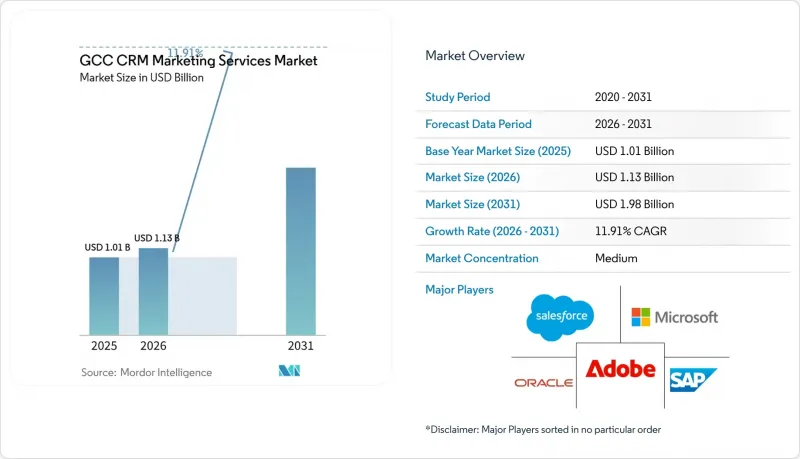
This report is Segmented by Service Type (CRM Strategy and Consulting, CRM Implementation and Integration, and More), Enterprise Size (Large Enterprises, and Small and Medium Enterprises), Service Application (Customer Acquisition, Personalization Services, and More), End-User Industry (Healthcare and Life Sciences, and More), and Geography. The Market Forecasts are Provided in Terms of Value (USD).
GCC CRM Marketing Services Market Trends and Insights
Vision 2030 and Government-Led Digital Transformation
Saudi Arabia remains the clearest policy-driven demand center within the GCC CRM marketing services market because public transformation goals are translating into direct enterprise technology spending. Salesforce committed USD 500 million at LEAP 2025, including Hyperforce in the Kingdom through AWS, a Riyadh regional headquarters, and AI skilling for 30,000 Saudi citizens. Microsoft also confirmed that its Saudi Arabia East datacenter region would accept customer cloud workloads starting in Q4 2026, strengthening the local base for Dynamics 365 and Azure AI deployments. This means CRM adoption is becoming more closely tied to participation in government-linked supply chains, regulated sectors, and state-backed digital programs across the GCC. The same pattern is visible in the UAE, where Abu Dhabi's digital agenda is pushing private suppliers toward tighter service integration and higher customer engagement standards. As a result, the GCC CRM marketing services market is being supported by policy pressure as much as by ordinary software replacement demand.
Expansion of Cloud Infrastructure and Sovereign Cloud Readiness
The GCC CRM marketing services market is benefiting from a more practical path to local hosting, which has long been a decisive factor for regulated buyers. In November 2025, e& and AWS commercially launched the UAE Sovereign Launchpad, and the offer was aligned with the UAE Cybersecurity Council's National Cloud Security Policy for non-classified workloads. Microsoft's Saudi Arabia East region and Pegasystems' Saudi-hosted cloud stack are adding further in-country deployment options for enterprises that previously relied on infrastructure outside the Kingdom. That matters because CRM procurement in the GCC now starts with residency and security questions, not after the platform shortlist is already complete. It also raises the value of service firms that can configure hybrid and sovereign cloud environments without slowing project delivery. This is one of the clearest reasons the GCC CRM marketing services market continues to widen beyond software licensing and into integration-heavy service work.
Data Residency, Privacy, and Cross-Border Compliance Complexity
Compliance remains one of the most persistent restraints on the GCC CRM marketing services market, especially for multinational firms that manage customer data across several jurisdictions. Microsoft's own guidance on deployments in the UAE and Saudi deployment makes clear that data residency obligations can shape how Azure services are selected and where workloads can be placed. This increases implementation time because architecture choices, storage design, and integration logic must be tested against local regulatory expectations before a rollout can proceed. It also favors larger implementation partners that already understand sovereign cloud design and cross-border operating constraints. For smaller buyers, the issue is not just cost, because the real burden often comes from slower project sequencing and narrower platform flexibility. That keeps compliance work near the center of the GCC CRM marketing services market even when demand conditions remain strong.
Other drivers and restraints analyzed in the detailed report include:
- AI-Driven Personalization and Automation in Customer Engagement
- Rising Demand for Arabic-First Omnichannel Journeys
- Legacy Integration and Migration Friction
For complete list of drivers and restraints, kindly check the Table Of Contents.
Segment Analysis
CRM Implementation and Integration held 56.21% of GCC CRM marketing services market share in 2025, which confirms that the region is still in a heavy buildout phase rather than a purely mature support phase. Large buyers continue to spend first on architecture setup because CRM programs in the GCC often involve consolidating customer data, redesigning processes, migrating to the cloud, and mapping to local compliance requirements simultaneously. The work is rarely limited to a single platform, as many deployments also require links to ERP systems, call center tools, digital channels, and analytics layers. Salesforce's Saudi expansion and Microsoft's Saudi datacenter rollout both reinforce this implementation cycle by expanding the number of enterprises that can move forward with locally compliant projects. The leading position in implementation work also reflects the fact that many organizations are still defining, for the first time, long-term customer data structures, service workflows, and AI operating rules.
The GCC CRM marketing services market size for CRM Managed Services is projected to expand at a 13.96% CAGR from 2026 to 2031, indicating that buyers increasingly want ongoing operational support after the initial deployment stage. This shift is logical because AI-enabled CRM platforms need constant tuning, permissions management, workflow maintenance, and service quality monitoring after launch. Strategy and consulting work are moving in parallel, as enterprises seek clearer guidance on platform choice, localization needs, and residency design before committing major budgets. Migration and modernization services are also gaining importance because older on-premises setups and fragmented databases are harder to keep aligned with newer compliance and automation goals. Training and support remain relevant as well, since large programs in the GCC CRM marketing services industry often involve new user groups, role-specific adoption needs, and recurring enablement across growing teams.
Large enterprises accounted for 71.49% of the GCC CRM marketing services market in 2025, reflecting the scale and complexity of their transformation programs. Their projects usually span multiple business units, multilingual channels, and several connected systems, so contract values rise quickly even before managed support is added. Banks, telecom operators, government-linked entities, and diversified groups have been the main anchors of this spending because they face the highest expectations for service continuity, security, and control over customer data. Microsoft's local cloud expansion in Saudi Arabia and its larger AI infrastructure commitment in the UAE deepen the operating base for these enterprise-scale deployments. Large buyers also shape service economics by demanding longer implementation windows, stricter service levels, and more detailed performance reporting after deployment.
Small and medium enterprises are projected to expand at a 14.31% CAGR from 2026 to 2031, making them the fastest-rising customer group in the GCC CRM marketing services market. Growth in this tier is being supported by lower-cost cloud options, phased deployment models, and broader awareness that customer engagement tools are no longer the domain of large corporations. Public SME development programs in markets such as Saudi Arabia and Kuwait are helping more firms move from informal sales tracking toward structured CRM usage. This group often prefers simpler deployment paths, outsourced administration, and faster time-to-value, which increases demand for packaged implementations and managed service offerings. The result is a broader client base for the GCC CRM marketing services industry, even though the revenue center still sits with large enterprises. Over time, this SME wave is likely to reward providers that can deliver local hosting, Arabic support, and affordable service bundles without adding heavy customization costs.
Complete Report Scope:
- By Service Type
- CRM Strategy and Consulting
- CRM Implementation and Integration
- CRM Migration and Modernization
- CRM Managed Services
- CRM Training and Support
- By Enterprise Size
- Large Enterprises
- Small and Medium Enterprises
- By Service Application
- Customer Acquisition
- Customer Retention and Loyalty
- Campaign Management Services
- Marketing Automation Services
- Customer Analytics and Insights
- Omnichannel Customer Engagement
- Personalization Services
- By End-user Industry
- Banking, Financial Services, and Insurance (BFSI)
- Healthcare and Life Sciences
- Information Technology and Telecom
- Retail and E-commerce
- Industrial Manufacturing
- Government and Public Administration
- Other End-user Industries
- By Geography
- Saudi Arabia
- United Arab Emirates
- Qatar
- Kuwait
- Oman
- Bahrain
List of Companies Covered in this Report:
- Salesforce, Inc.
- Microsoft Corporation
- Oracle Corporation
- SAP SE
- Adobe Inc.
- HubSpot, Inc.
- Zoho Corporation Pvt. Ltd.
- Freshworks Inc.
- Pipedrive Inc.
- SugarCRM Inc.
- monday.com Ltd.
- Creatio Inc.
- Zendesk, Inc.
- Infor, Inc.
- Pegasystems Inc.
- Insightly, Inc.
- Keap, LLC
- Nimble Inc.
- Bitrix24 Ltd.
- Amdocs Limited
Additional Benefits:
- The market estimate (ME) sheet in Excel format
- 3 months of analyst support
TABLE OF CONTENTS
1 INTRODUCTION
- 1.1 Study Assumptions and Market Definition
- 1.2 Scope of the Study
2 RESEARCH METHODOLOGY
3 EXECUTIVE SUMMARY
4 MARKET LANDSCAPE
- 4.1 Market Overview
- 4.2 Market Drivers
- 4.2.1 Vision 2030 and Government-Led Digital Transformation
- 4.2.2 Expansion of Cloud Infrastructure and Sovereign Cloud Readiness
- 4.2.3 AI-Driven Personalization and Automation in Customer Engagement
- 4.2.4 Rising Demand for Arabic-First Omnichannel Journeys
- 4.2.5 CRM Linked to E-Commerce and Retail Modernization
- 4.2.6 Rising Cross-Selling in Banking, Hospitality, and Telecom
- 4.3 Market Restraints
- 4.3.1 Data Residency, Privacy, and Cross-Border Compliance Complexity
- 4.3.2 Legacy Integration and Migration Friction
- 4.3.3 Skilled Talent Shortage for CRM Architecture and Administration
- 4.3.4 High Implementation and Change-Management Costs for SMEs
- 4.4 Industry Value Chain Analysis
- 4.5 Impact of Macroeconomic Factors on the Market
- 4.6 Regulatory Landscape
- 4.7 Technological Outlook
- 4.8 Porter's Five Forces and Analysis
- 4.8.1 Bargaining Power of Suppliers
- 4.8.2 Bargaining Power of Buyers
- 4.8.3 Threat of New Entrants
- 4.8.4 Threat of Substitutes
- 4.8.5 Industry Rivalry
5 MARKET SIZE AND GROWTH FORECASTS (VALUE)
- 5.1 By Service Type
- 5.1.1 CRM Strategy and Consulting
- 5.1.2 CRM Implementation and Integration
- 5.1.3 CRM Migration and Modernization
- 5.1.4 CRM Managed Services
- 5.1.5 CRM Training and Support
- 5.2 By Enterprise Size
- 5.2.1 Large Enterprises
- 5.2.2 Small and Medium Enterprises
- 5.3 By Service Application
- 5.3.1 Customer Acquisition
- 5.3.2 Customer Retention and Loyalty
- 5.3.3 Campaign Management Services
- 5.3.4 Marketing Automation Services
- 5.3.5 Customer Analytics and Insights
- 5.3.6 Omnichannel Customer Engagement
- 5.3.7 Personalization Services
- 5.4 By End-user Industry
- 5.4.1 Banking, Financial Services, and Insurance (BFSI)
- 5.4.2 Healthcare and Life Sciences
- 5.4.3 Information Technology and Telecom
- 5.4.4 Retail and E-commerce
- 5.4.5 Industrial Manufacturing
- 5.4.6 Government and Public Administration
- 5.4.7 Other End-user Industries
- 5.5 By Geography
- 5.5.1 Saudi Arabia
- 5.5.2 United Arab Emirates
- 5.5.3 Qatar
- 5.5.4 Kuwait
- 5.5.5 Oman
- 5.5.6 Bahrain
6 COMPETITIVE LANDSCAPE
- 6.1 Market Concentration
- 6.2 Strategic Moves
- 6.3 Market Share Analysis
- 6.4 Company Profiles (includes Global Level Overview, Market Level Overview, Core Segments, Financials as available, Strategic Information, Market Rank/Share, Products and Services, Recent Developments)
- 6.4.1 Salesforce, Inc.
- 6.4.2 Microsoft Corporation
- 6.4.3 Oracle Corporation
- 6.4.4 SAP SE
- 6.4.5 Adobe Inc.
- 6.4.6 HubSpot, Inc.
- 6.4.7 Zoho Corporation Pvt. Ltd.
- 6.4.8 Freshworks Inc.
- 6.4.9 Pipedrive Inc.
- 6.4.10 SugarCRM Inc.
- 6.4.11 monday.com Ltd.
- 6.4.12 Creatio Inc.
- 6.4.13 Zendesk, Inc.
- 6.4.14 Infor, Inc.
- 6.4.15 Pegasystems Inc.
- 6.4.16 Insightly, Inc.
- 6.4.17 Keap, LLC
- 6.4.18 Nimble Inc.
- 6.4.19 Bitrix24 Ltd.
- 6.4.20 Amdocs Limited
7 MARKET OPPORTUNITIES AND FUTURE OUTLOOK
- 7.1 White-Space and Unmet-Need Assessment

