PUBLISHER: Mordor Intelligence | PRODUCT CODE: 2099207

PUBLISHER: Mordor Intelligence | PRODUCT CODE: 2099207
North America Architectural Services - Market Share Analysis, Industry Trends & Statistics, Growth Forecasts (2026 - 2031)
According to Mordor Intelligence, the North America architectural services market size is projected to expand from USD 69.04 billion in 2025 and USD 72.95 billion in 2026 to USD 95.12 billion by 2031, registering a CAGR of 5.45% between 2026 to 2031.The North American architectural market is supported by renovation and adaptive reuse work, which keeps billings active even when speculative commercial construction remains slow.
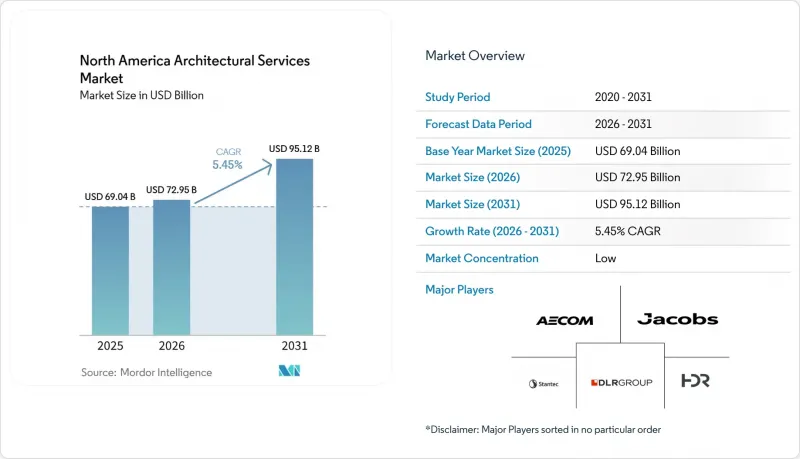
This report is Segmented by Service Type (Architectural Design, Documentation & Delivery, Interior Architecture, Urban Design & Master Planning, Others), Project Type (New Construction, Renovation), End-Use (Residential, Commercial, Infrastructure-Linked), Investment Source (Public, Private), and Country (United States, Canada, Mexico). Forecasts are in Value (USD).
North America Architectural Services Market Trends and Insights
Large-Scale Renovation and Adaptive Reuse Demand
Renovation held 55% of project-type revenue in 2025, keeping the North American architectural market anchored in work tied to existing buildings rather than new starts. The North American architectural market continues to benefit from adaptive reuse, as office-to-residential conversions require structural revisions, envelope work, building systems redesign, and code compliance, which raise design complexity. Gensler stated that the national office-to-residential conversion pipeline reached 90,300 units, and New York City alone was targeting 9.5 million square feet of conversions in 2026. These projects also extend design involvement across permitting, value engineering, and phased execution, which supports a longer fee duration than that required for routine new-build projects. This makes adaptive reuse an important stabilizer for the North American architectural market, as private developers remain selective about greenfield office investment.
Data Center and Mission-Critical Facility Expansion
Infrastructure-linked Buildings is projected to grow at a 7.8% CAGR through 2031, and a large part of that momentum comes from data center and mission-critical demand within the North America architectural market. This work is attractive because clients need high-performance layouts, power and cooling coordination, fast delivery schedules, and reliable documentation during both greenfield and retrofit projects. The North America architectural market is seeing this demand reduce exposure to slower-moving office development, since mission-critical projects are tied more closely to corporate capital plans and essential infrastructure needs. Retrofit activity is also important, because operators are upgrading existing facilities for new computing loads while waiting for larger capacity additions to come online. As a result, firms with strong documentation workflows and coordination depth are in a better position to capture this part of the North America architectural market than firms centered on conventional commercial design.
Skilled Labor Shortages Across Design Teams
The North America architectural market continues to face a staffing constraint, even though the number of licensed U.S. architects improved in 2025. NCARB stated that the number of U.S. architects rose by 6% in 2025, yet the age mix remained uneven, with a small share of younger architects and a larger group nearing retirement. AIA and Deltek reported in June 2025 that 24% of architecture firms were understaffed, with sharper strain among institutional specialists and firms in the South. The North America architectural market feels this most in healthcare and mission-critical work, where senior technical talent is harder to replace, and client expectations are less forgiving. This means firms may win opportunities in the North America architectural market but still face limits in how fast they can turn backlog into revenue.
Other drivers and restraints analyzed in the detailed report include:
- Reshoring-Led Industrial and Logistics Development
- Healthcare and Life-Sciences Campus Growth
- Interest-Rate Sensitivity Delaying Commercial Pipelines
For complete list of drivers and restraints, kindly check the Table Of Contents.
Segment Analysis
Architectural Design Services held the largest share at 32% in 2025, while Architectural Documentation and Delivery Services is projected to grow at a 7.4% CAGR through 2031. That mix shows how the North America architectural market still earns its largest fee pool from concept and design leadership, even as documentation work starts to change more quickly. Design services remain central in healthcare, mission-critical, and complex institutional projects, because early-stage planning carries the greatest influence over program, performance, and compliance. In the North America architectural market, this keeps design leadership as the main profit center for firms with deeper sector expertise and stronger client relationships. It also explains why clients continue to value firms that can translate strategic requirements into workable design packages early in the project cycle.
Architectural Documentation and Delivery Services is the fastest-growing service type at 7.4%, and that is changing competitive behavior across the North America architectural market. OFA Group launched the commercial version of its QikBIM AI platform in June 2026, showing how permit-level BIM documentation can be produced much faster than before. Interior Architecture and Space Planning continues to benefit from workplace repositioning and healthcare interior upgrades, while Urban Design and Master Planning remains supported by transit-led urban redevelopment in the North America architectural market. The practical divide is becoming clearer, because firms that hold strong digital assets and coordinated model libraries can defend scope better than firms that sell documentation as a basic throughput service.
Renovation held 55% of the North America architectural market share in 2025, which shows how much current demand still comes from existing building stock rather than entirely new assets. The North America architectural market is benefiting from years of deferred maintenance, changing occupancy needs, and code compliance requirements that push owners toward reuse and upgrades. Adaptive reuse remains especially important because obsolete office assets can be repositioned into housing or mixed-use formats when location quality remains attractive. Gensler stated that office-to-residential conversions reached 90,300 units nationally, supporting a steady flow of redesign, systems overhauls, and permitting work. In the North America architectural industry, firms that combine structural review, MEP retrofit planning, and regulatory coordination are better placed than firms focused only on routine renovation documentation.
New Construction is projected to grow at a 7.1% CAGR through 2031, indicating where the next cycle of the North American architectural market is building. This demand is coming from industrial parks, data center campuses, healthcare expansions, and transit-related facilities that require purpose-built layouts from the outset. The North America architectural market is therefore seeing a shift where renovation provides current scale, while new construction offers a stronger growth path in the most technical and capital-intensive project classes. Firms that can move between adaptive reuse and new-build delivery will be better positioned than firms that depend too heavily on a single project format. That balance matters because the North America architectural market still moves unevenly across end uses, funding channels, and client types.
Complete Report Scope:
- By Service Type
- Architectural Design Services
- Architectural Documentation and Delivery Services
- Interior Architecture and Space Planning Services
- Urban Design and Master Planning Services
- Others
- By Project Type
- New Construction
- Renovation
- By End-Use
- Residential
- Commercial
- Office
- Retail
- Institutional
- Industrial and Logistics
- Others
- Infrastructure-linked Buildings
- By Investment Source
- Public
- Private
- By Country
- United States
- Canada
- Mexico
List of Companies Covered in this Report:
- AECOM
- Jacobs Solutions Inc.
- Gensler
- Perkins and Will
- HOK
- Stantec Inc.
- HDR, Inc.
- Skidmore, Owings and Merrill LLP
- NBBJ
- DLR Group
- CallisonRTKL Inc.
- Corgan Associates, Inc.
- Populous
- Page Southerland Page, Inc.
- ZGF Architects LLP
- HKS, Inc.
- CannonDesign
- Perkins Eastman
- BKV Group
- WSP Global Inc.
Additional Benefits:
- The market estimate (ME) sheet in Excel format
- 3 months of analyst support
TABLE OF CONTENTS
1 Introduction
- 1.1 Study Assumptions & Market Definition
- 1.2 Scope of the Study
2 Research Methodology
3 Executive Summary
4 Market Landscape
- 4.1 Market Overview
- 4.2 Market Drivers
- 4.2.1 Large-Scale Renovation and Adaptive Reuse Demand
- 4.2.2 Data Center and Mission-Critical Facility Expansion
- 4.2.3 Reshoring-Led Industrial and Logistics Development
- 4.2.4 Healthcare and Life-Sciences Campus Growth
- 4.2.5 Public Infrastructure Rebuild and Transit Modernization
- 4.2.6 ESG and Carbon-Disclosure Requirements Increasing Design Scope
- 4.3 Market Restraints
- 4.3.1 Skilled Labor Shortages Across Design Teams
- 4.3.2 Interest-Rate Sensitivity Delaying Commercial Pipelines
- 4.3.3 Permitting and Zoning Complexity in Major Metro Areas
- 4.3.4 Professional Fee Pressure from Competitive Bidding
- 4.4 Value / Supply-Chain Analysis
- 4.5 Regulatory Landscape
- 4.6 Technological Outlook
- 4.7 Industry Attractiveness - Porter's Five Forces Analysis
- 4.7.1 Threat of New Entrants
- 4.7.2 Bargaining Power of Buyers
- 4.7.3 Bargaining Power of Suppliers
- 4.7.4 Threat of Substitute Products
- 4.7.5 Intensity of Competitive Rivalry
- 4.8 Pricing Analysis
- 4.9 Key Upcoming and Ongoing Projects
5 Market Size & Growth Forecasts (Value, in USD)
- 5.1 By Service Type
- 5.1.1 Architectural Design Services
- 5.1.2 Architectural Documentation and Delivery Services
- 5.1.3 Interior Architecture and Space Planning Services
- 5.1.4 Urban Design and Master Planning Services
- 5.1.5 Others
- 5.2 By Project Type
- 5.2.1 New Construction
- 5.2.2 Renovation
- 5.3 By End-Use
- 5.3.1 Residential
- 5.3.2 Commercial
- 5.3.2.1 Office
- 5.3.2.2 Retail
- 5.3.2.3 Institutional
- 5.3.2.4 Industrial and Logistics
- 5.3.2.5 Others
- 5.3.3 Infrastructure-linked Buildings
- 5.4 By Investment Source
- 5.4.1 Public
- 5.4.2 Private
- 5.5 By Country
- 5.5.1 United States
- 5.5.2 Canada
- 5.5.3 Mexico
6 Competitive Landscape
- 6.1 Market Concentration
- 6.2 Strategic Moves
- 6.3 Company Profiles (includes Global level Overview, Market level overview, Core Segments, Financials as available, Strategic Information, Market Rank/Share for key companies, Products & Services, and Recent Developments)
- 6.3.1 AECOM
- 6.3.2 Jacobs Solutions Inc.
- 6.3.3 Gensler
- 6.3.4 Perkins and Will
- 6.3.5 HOK
- 6.3.6 Stantec Inc.
- 6.3.7 HDR, Inc.
- 6.3.8 Skidmore, Owings and Merrill LLP
- 6.3.9 NBBJ
- 6.3.10 DLR Group
- 6.3.11 CallisonRTKL Inc.
- 6.3.12 Corgan Associates, Inc.
- 6.3.13 Populous
- 6.3.14 Page Southerland Page, Inc.
- 6.3.15 ZGF Architects LLP
- 6.3.16 HKS, Inc.
- 6.3.17 CannonDesign
- 6.3.18 Perkins Eastman
- 6.3.19 BKV Group
- 6.3.20 WSP Global Inc.
7 Market Opportunities & Future Outlook
- 7.1 White-space & Unmet-Need Assessment

