PUBLISHER: Mordor Intelligence | PRODUCT CODE: 2099213

PUBLISHER: Mordor Intelligence | PRODUCT CODE: 2099213
India Architectural Services - Market Share Analysis, Industry Trends & Statistics, Growth Forecasts (2026 - 2031)
According to Mordor Intelligence, the India architectural services market size is projected to be USD 14.22 billion in 2025, USD 15.37 billion in 2026, and reach USD 23.30 billion by 2031, growing at a CAGR of 8.66% from 2026 to 2031.
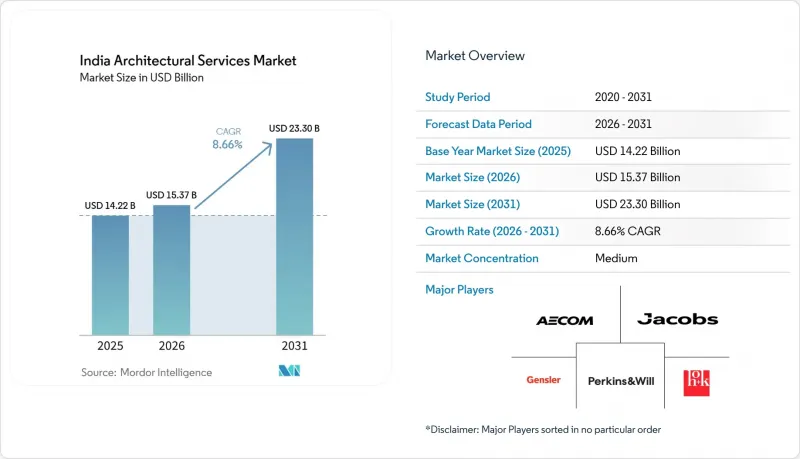
This report is Segmented by Service Type (Architectural Design, Documentation, Interior Architecture, Urban Design, Others), Project Type (New Construction, Renovation), End-Use (Residential, Commercial, Infrastructure-Linked Buildings), Investment Source (Public, Private), and Geography (North, South, West, East, Central India). Forecasts are in Value (USD).
India Architectural Services Market Trends and Insights
Infrastructure-Led Urban Expansion Anchors Greenfield Demand
Public capital expenditure remains the strongest structural support for the India architectural services market. Budget 2026-27 kept central capital expenditure at 3.1% of GDP, which sustained a broad pipeline across transport, housing, and civic infrastructure. PMAY-U dashboards showed that 9.9 million homes had been grounded by June 2026, which kept housing drawings, approvals, and site-level design supervision active across states. The World Bank also said that India still has more than half of its future urban infrastructure left to build, which gives firms a longer project runway than a normal real estate cycle would provide. This mix keeps greenfield design demand spread across affordable housing, civic facilities, and mixed-use urban districts. It also favors firms that can meet technical qualification filters and government compliance requirements before price becomes the deciding factor.
Commercial Real Estate Recovery Recalibrates Program Complexity
Commercial activity is supporting the India architectural services market through a more specialized type of project demand. India now hosts more than 2,117 GCCs, employs over 2.3 million professionals in that base, and generates nearly USD 100 billion in related revenue, underscoring the need for custom workplace planning and interior delivery. That matters because newer mandates are no longer simple office fit-outs and now require stricter standards for collaboration spaces, sustainability, employee experience, and branded workplace identity. Interio by Godrej's projects business has already executed more than 1,000 projects across 100 million sq ft and is targeting 500 GCC sites by 2027, which shows the scale of the design and fit-out pipeline. As a result, the faster growth in interior architecture and space planning reflects program complexity as much as it reflects pure project volume. The India architectural services market is therefore benefiting from a commercial cycle in which design depth matters more than standard floorplate delivery.
Approval and Land-Acquisition Delays Compress Fee Realization
Approval bottlenecks continue to slow billing cycles in the India architectural services market. Cabinet Secretary Somanathan said that land acquisition accounted for 35% of issues raised across major infrastructure projects under the PRAGATI framework, underscoring how early-stage delays carry over into project execution. Business Standard also reported disruptions to approvals affecting project schedules and profitability in MMR and Bengaluru during 2025. For architecture firms, the main issue is not only a slower project launch, but also a slower pace of work. The deeper problem is that teams remain engaged during design freeze periods even as the freeze is pushed back. This weakens cash flow visibility and makes it harder for firms to scale specialist staff at the same pace as opportunities.
Other drivers and restraints analyzed in the detailed report include:
- Industrial Park and Logistics Hub Development Opens Mid-Tier Project Pipeline
- Metro Rail, Airport, and Transit-Oriented Development Multiplies Design Scopes
- Price Pressure in a Fragmented Design Market Suppresses Mid-Market Margins
For complete list of drivers and restraints, kindly check the Table Of Contents.
Segment Analysis
Architectural Design Services held 37% of the India architectural services market in 2025, while Interior Architecture and Space Planning Services are set to grow at 10.1% CAGR through 2031. This keeps design services in the lead because every new build and most retrofit projects still begin with core architectural planning, client briefing, and statutory documentation. At the same time, faster growth in interior architecture reflects the rising role of GCC campuses, branded workplaces, premium housing, and specialized fit-outs. India's GCC base has crossed 2,117 entities, with more than 2.3 million professionals, keeping demand strong for customized interiors and space optimization. Interio by Godrej has already executed more than 1,000 projects across 100 million sq ft and is targeting 500 GCC sites by 2027, which shows the commercial depth of this service line.
The second layer of change is happening in documentation and delivery capability, where digital coordination is becoming a competitive filter rather than a back-office function. The National BIM Policy, published in March 2025, signals that public-sector eligibility will increasingly depend on documentation quality, model coordination, and workflow discipline. That benefits firms that can move beyond concept design and deliver structured technical packages for large institutional or infrastructure jobs. Urban Design and Master Planning Services are also gaining ground as more projects shift toward long-horizon district development rather than stand-alone buildings. The Bhubaneswar Development Authority's agreement with Surbana Jurong for a new city master plan with an INR 8,179 crore (USD 951 million) outlay shows how master planning work can convert into multi-year delivery engagement rather than a one-time advisory role.
New Construction accounted for 76% of the India architectural services market size in 2025, which reflects the scale of greenfield housing, infrastructure, and commercial development underway. Renovation, however, is projected to grow faster at 9.6% CAGR through 2031, which points to a more durable opportunity than a simple cyclical rebound. A large share of India's older office and commercial stock now needs energy upgrades, space reconfiguration, and compliance-driven modernization. That work is often more design-intensive because it requires phasing, occupied-site coordination, and detailed systems integration inside existing structures. The fee outcome is usually stronger than in standard new-build assignments because problem-solving intensity is higher and drawing revisions are more frequent.
This part of the India architectural services industry is also being supported by heritage reuse and by stalled projects returning to execution. The completion of the restoration of a 113-year-old Nizam-era landmark in Hyderabad during 2026 reflects a category of technically demanding adaptive reuse work that requires careful planning, specialist detailing, and institutional coordination. The 2025 Supreme Court ruling that cleared environmental approvals for 493 stalled residential projects in MMR and Pune also released a practical pipeline of redrawings, compliance resubmissions, and revised construction document packages. That kind of work rarely draws the same visibility as new launches, yet it creates steady demand for firms with regulatory knowledge and retrofit skill. Renovation therefore adds balance to the India architectural services market because it is tied to code upgrades and asset repositioning as much as to new capital cycles.
Complete Report Scope:
- By Service Type
- Architectural Design Services
- Architectural Documentation and Delivery Services
- Interior Architecture and Space Planning Services
- Urban Design and Master Planning Services
- Others
- By Project Type
- New Construction
- Renovation
- By End-Use
- Residential
- Commercial
- Office
- Retail
- Institutional
- Industrial and Logistics
- Others
- Infrastructure-linked Buildings
- By Investment Source
- Public
- Private
- By Geography
- North India
- South India
- West India
- East India
- Central India
List of Companies Covered in this Report:
- AECOM
- Jacobs Solutions Inc.
- Gensler
- Perkins and Will
- HOK
- Stantec Inc.
- Arcadis NV
- HDR, Inc.
- Skidmore, Owings and Merrill LLP
- Foster + Partners LLP
- L & T Construction
- Tata Projects Limited
- Shapoorji Pallonji Group
- RSP Design Consultants (India) Pvt. Ltd.
- CP Kukreja Architects
- Hafeez Contractor
- Morphogenesis
- Design Consortium
- BDP India
- Architect Hafeez Contractor
Additional Benefits:
- The market estimate (ME) sheet in Excel format
- 3 months of analyst support
TABLE OF CONTENTS
1 Introduction
- 1.1 Study Assumptions & Market Definition
- 1.2 Scope of the Study
2 Research Methodology
3 Executive Summary
4 Market Landscape
- 4.1 Market Overview
- 4.2 Market Drivers
- 4.2.1 Infrastructure-Led Urban Expansion
- 4.2.2 Commercial Real Estate Recovery
- 4.2.3 Industrial Park and Logistics Hub Development
- 4.2.4 Metro Rail, Airport, and Transit-Oriented Development
- 4.2.5 Data Center and GCC Campus Expansion
- 4.2.6 Green Building and Sustainability Demand
- 4.3 Market Restraints
- 4.3.1 Approval and Land-Acquisition Delays
- 4.3.2 Price Pressure in a Fragmented Design Market Suppresses Mid-Market Margins
- 4.3.3 Skilled Talent Shortage in BIM and Sustainable Design
- 4.3.4 Fee Compression from Design-Build and EPC-Led Procurement
- 4.4 Value / Supply-Chain Analysis
- 4.5 Regulatory Landscape
- 4.6 Technological Outlook
- 4.7 Industry Attractiveness - Porter's Five Forces Analysis
- 4.7.1 Threat of New Entrants
- 4.7.2 Bargaining Power of Buyers
- 4.7.3 Bargaining Power of Suppliers
- 4.7.4 Threat of Substitute Products
- 4.7.5 Intensity of Competitive Rivalry
- 4.8 Pricing Analysis
- 4.9 Key Upcoming and Ongoing Projects
5 Market Size & Growth Forecasts (Value, in USD)
- 5.1 By Service Type
- 5.1.1 Architectural Design Services
- 5.1.2 Architectural Documentation and Delivery Services
- 5.1.3 Interior Architecture and Space Planning Services
- 5.1.4 Urban Design and Master Planning Services
- 5.1.5 Others
- 5.2 By Project Type
- 5.2.1 New Construction
- 5.2.2 Renovation
- 5.3 By End-Use
- 5.3.1 Residential
- 5.3.2 Commercial
- 5.3.2.1 Office
- 5.3.2.2 Retail
- 5.3.2.3 Institutional
- 5.3.2.4 Industrial and Logistics
- 5.3.2.5 Others
- 5.3.3 Infrastructure-linked Buildings
- 5.4 By Investment Source
- 5.4.1 Public
- 5.4.2 Private
- 5.5 By Geography
- 5.5.1 North India
- 5.5.2 South India
- 5.5.3 West India
- 5.5.4 East India
- 5.5.5 Central India
6 Competitive Landscape
- 6.1 Market Concentration
- 6.2 Strategic Moves
- 6.3 Market Share Analysis
- 6.4 Company Profiles (includes Global level Overview, Market level overview, Core Segments, Financials as available, Strategic Information, Market Rank/Share for key companies, Products & Services, and Recent Developments)
- 6.4.1 AECOM
- 6.4.2 Jacobs Solutions Inc.
- 6.4.3 Gensler
- 6.4.4 Perkins and Will
- 6.4.5 HOK
- 6.4.6 Stantec Inc.
- 6.4.7 Arcadis NV
- 6.4.8 HDR, Inc.
- 6.4.9 Skidmore, Owings and Merrill LLP
- 6.4.10 Foster + Partners LLP
- 6.4.11 L & T Construction
- 6.4.12 Tata Projects Limited
- 6.4.13 Shapoorji Pallonji Group
- 6.4.14 RSP Design Consultants (India) Pvt. Ltd.
- 6.4.15 CP Kukreja Architects
- 6.4.16 Hafeez Contractor
- 6.4.17 Morphogenesis
- 6.4.18 Design Consortium
- 6.4.19 BDP India
- 6.4.20 Architect Hafeez Contractor
7 Market Opportunities & Future Outlook
- 7.1 White-space & Unmet-Need Assessment

