PUBLISHER: Mordor Intelligence | PRODUCT CODE: 2125706

PUBLISHER: Mordor Intelligence | PRODUCT CODE: 2125706
MENA Architectural Services - Market Share Analysis, Industry Trends & Statistics, Growth Forecasts (2026 - 2031)
According to Mordor Intelligence, MENA architectural services market size in 2026 is estimated at USD 21.43 billion, growing from 2025 value of USD 20.40 billion with 2031 projections showing USD 27.46 billion, growing at 5.07% CAGR over 2026-2031.
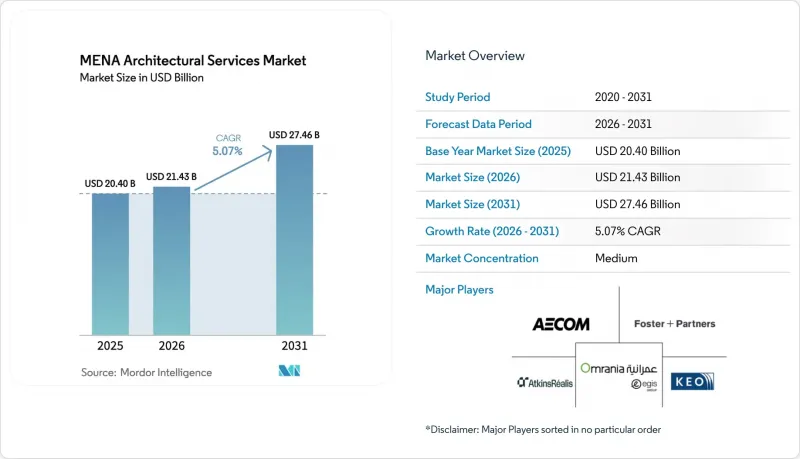
This report is Segmented by Service Type (Architectural Design and Drafting, and More), End-User Sector (Commercial, Institutional and Public, Residential, Healthcare, Industrial, and Other Specialized Facilities), Delivery Model (Design-Bid-Build, Design-Build, Integrated Project Delivery, Public-Private Partnership), and Geography. The Market Forecasts are Provided in Terms of Value (USD).
MENA Architectural Services Market Trends and Insights
Government-led Giga Projects Pipeline
The region's USD 3.7 trillion construction pipeline is the single largest demand engine for the MENA architectural services market. Saudi Arabia's USD 500 billion NEOM program alone has reshaped service requirements, with Bechtel and Parsons managing the new King Salman International Airport that targets 120 million passengers a year. Project scope adjustments, such as reducing The Line's initial scale to 2.4 kilometers by 2030, have not curbed the need for complex urban-planning, landscape, and integrated-delivery expertise. Parallel mega-airports in Dubai and Doha extend opportunities across aviation-terminal architecture. These multibillion-dollar undertakings elevate risk-management, digital-coordination, and sustainability skills from optional to essential as governments mandate transparent cost and schedule controls. International firms that embed local joint-venture structures and digital-twin workflows are best positioned to secure repeat commissions.
Rising Demand for Sustainable and Green Buildings
Green-building codes are maturing quickly, compelling the MENA architectural services market to integrate lifecycle energy modeling and low-carbon materials into the baseline scope. The UAE's Estidama, Dubai Green Building Regulations, and LEED uptake, covering 5,255 regional projects totaling 1.5 billion ft2, set a regional benchmark. Saudi Arabia's Mostadam rating system, optimized for local climate, is gaining traction as a culturally resonant alternative to LEED. Market surveys show only 11% of firms currently deliver portfolios exceeding 60% green projects, yet that share is expected to rise to 26% by 2024 as clients seek demonstrable energy savings. Flagship projects such as Dubai's LEED-Platinum DEWA Solar Innovation Centre highlight the commercial viability of high-performance architecture. Firms able to provide cradle-to-grave carbon accounting and secure third-party certifications command premium fees and deepen client stickiness.
Skilled Talent Shortage in High-Performance Design
A persistent scarcity of qualified architects, BIM coordinators, and sustainability specialists is constraining delivery schedules across the MENA architectural services market. In the UAE, 93% of engineering employers report hiring difficulties, with 58% of large firms stating that candidates lack the requisite technical depth. Saudi Arabia's USD 1.68 trillion project pipeline intensifies competition; firms like KEO International doubled headcount to 2,600 in 2024 to keep pace with Vision 2030 demand. The skills gap widens as clients request AI-enabled design optimization and advanced computational workflows. International practices are therefore partnering with universities and running in-house academies focused on BIM, sustainability, and heritage digitization. Governments are bolstering localization programs, for example, the UAE Centennial Plan 2071, to cultivate domestic expertise, but these initiatives will take years to translate into an expanded talent pool.
Other drivers and restraints analyzed in the detailed report include:
- Rapid Urbanization and Population Growth
- Mandatory BIM Adoption Across GCC
- Volatile Oil Prices Impacting Public Construction Spend
For complete list of drivers and restraints, kindly check the Table Of Contents.
Segment Analysis
Architectural design and drafting retained 34.62% of the MENA architectural services market share in 2025, underpinned by a steady stream of mixed-use and infrastructure commissions. Mandatory BIM deliverables, however, are redefining core workflows, pushing firms to shift from 2D documentation toward data-rich digital twins. Engineering services contributed 27.65% revenue as projects like NEOM require multidisciplinary collaboration across civil, structural, and MEP packages. Interior design holds 14.72% fueled by high-end hospitality in Dubai and Riyadh, while urban-planning and landscape work is advancing at a 5.51% CAGR, driven by green corridor mandates within giga-projects.
Heritage conservation and BIM consulting, although niche, is projected to expand at a 5.73% CAGR through 2031, outpacing overall MENA architectural services market growth. Digitization of historic Cairo using HBIM exemplifies the emerging blend of laser scanning, point-cloud modeling, and virtual-reality storytelling. Firms offering AI-driven design optimization capture premium fees as clients pursue carbon-intensity reductions and accelerated approvals. The evolving regulatory landscape, including Saudi Arabia's Mostadam and Dubai's Emirates Green Building Council benchmarks, requires advisory expertise on certification pathways. Consequently, the MENA architectural services market size attributable to advisory and consultancy is poised to widen as owners seek end-to-end strategic guidance alongside traditional blueprints.
Complete Report Scope:
- By Service Type
- Architectural Design and Drafting
- Interior Design
- Engineering Services
- Urban Planning and Landscape
- Construction and Project Management
- Architectural Advisory and Consultancy
- Heritage Conservation and BIM Consulting
- By End-User Sector
- Commercial (Office, Retail, Hospitality)
- Institutional and Public
- Residential
- Healthcare
- Industrial
- Other Specialized Facilities
- By Delivery Model
- Design-Bid-Build
- Design-Build
- Integrated Project Delivery (IPD)
- Public-Private Partnership (PPP)
- By Country
- United Arab Emirates
- Saudi Arabia
- Qatar
- Kuwait
- Bahrain
- Oman
- Egypt
- Morocco
- Algeria
- Jordan
- Lebanon
List of Companies Covered in this Report:
- AECOM Technology Corporation
- KEO International Consultants
- DSA Architects International FZCO
- HKS, Inc.
- RMJM Global (London) Limited
- LACASA Architects & Engineering Consultants
- Henning Larsen Architects A/S
- Saudi Architects
- NAGA Architects
- Omrania and Associates
- Saudi Consulting Services Company (SaudConsult)
- Khatib & Alami Engineering Consultants Private Limited
- EHAF Consulting Engineers
- ECG Engineering Consultants Group
- Sabbour Consulting
- Mohamed Talaat Architects (M.T Architects)
- Modern Architectural Design Studios
- Mounir Hajjiri & Associates
- Tahhan and Bushnaq Architects
- Studio Farris Architects
- DARB Architects & Engineers
- Foster + Partners Limited
- Zaha Hadid Architects
- AtkinsRealis UK Limited
- M. Arthur Gensler Jr. & Associates, Inc.
Additional Benefits:
- The market estimate (ME) sheet in Excel format
- 3 months of analyst support
TABLE OF CONTENTS
1 INTRODUCTION
- 1.1 Study Assumptions and Market Definition
- 1.2 Scope of the Study
2 RESEARCH METHODOLOGY
3 EXECUTIVE SUMMARY
4 MARKET LANDSCAPE
- 4.1 Market Overview
- 4.2 Market Drivers
- 4.2.1 Government-led Giga Projects Pipeline
- 4.2.2 Rising Demand for Sustainable and Green Buildings
- 4.2.3 Rapid Urbanization and Population Growth
- 4.2.4 Mandatory BIM Adoption Across GCC
- 4.2.5 Cultural Heritage Restoration Investments
- 4.2.6 Sovereign Wealth Funds Backing Design-Build Start-ups
- 4.3 Market Restraints
- 4.3.1 Skilled Talent Shortage in High-Performance Design
- 4.3.2 Volatile Oil Prices Impacting Public Construction Spend
- 4.3.3 Localisation Quotas Limiting Foreign Firms
- 4.3.4 IP Ownership Disputes in Integrated Contracts
- 4.4 Industry Value Chain Analysis
- 4.5 Regulatory Landscape
- 4.6 Technological Outlook
- 4.7 Porter's Five Forces Analysis
- 4.7.1 Threat of New Entrants
- 4.7.2 Bargaining Power of Suppliers
- 4.7.3 Bargaining Power of Buyers
- 4.7.4 Threat of Substitutes
- 4.7.5 Competitive Rivalry
5 MARKET SIZE AND GROWTH FORECASTS (VALUE)
- 5.1 By Service Type
- 5.1.1 Architectural Design and Drafting
- 5.1.2 Interior Design
- 5.1.3 Engineering Services
- 5.1.4 Urban Planning and Landscape
- 5.1.5 Construction and Project Management
- 5.1.6 Architectural Advisory and Consultancy
- 5.1.7 Heritage Conservation and BIM Consulting
- 5.2 By End-User Sector
- 5.2.1 Commercial (Office, Retail, Hospitality)
- 5.2.2 Institutional and Public
- 5.2.3 Residential
- 5.2.4 Healthcare
- 5.2.5 Industrial
- 5.2.6 Other Specialized Facilities
- 5.3 By Delivery Model
- 5.3.1 Design-Bid-Build
- 5.3.2 Design-Build
- 5.3.3 Integrated Project Delivery (IPD)
- 5.3.4 Public-Private Partnership (PPP)
- 5.4 By Country
- 5.4.1 United Arab Emirates
- 5.4.2 Saudi Arabia
- 5.4.3 Qatar
- 5.4.4 Kuwait
- 5.4.5 Bahrain
- 5.4.6 Oman
- 5.4.7 Egypt
- 5.4.8 Morocco
- 5.4.9 Algeria
- 5.4.10 Jordan
- 5.4.11 Lebanon
6 COMPETITIVE LANDSCAPE
- 6.1 Market Concentration
- 6.2 Strategic Moves
- 6.3 Market Share Analysis
- 6.4 Company Profiles (includes Global level Overview, Market level overview, Core Segments, Financials as available, Strategic Information, Market Rank/Share for key companies, Products and Services, and Recent Developments)
- 6.4.1 AECOM Technology Corporation
- 6.4.2 KEO International Consultants
- 6.4.3 DSA Architects International FZCO
- 6.4.4 HKS, Inc.
- 6.4.5 RMJM Global (London) Limited
- 6.4.6 LACASA Architects & Engineering Consultants
- 6.4.7 Henning Larsen Architects A/S
- 6.4.8 Saudi Architects
- 6.4.9 NAGA Architects
- 6.4.10 Omrania and Associates
- 6.4.11 Saudi Consulting Services Company (SaudConsult)
- 6.4.12 Khatib & Alami Engineering Consultants Private Limited
- 6.4.13 EHAF Consulting Engineers
- 6.4.14 ECG Engineering Consultants Group
- 6.4.15 Sabbour Consulting
- 6.4.16 Mohamed Talaat Architects (M.T Architects)
- 6.4.17 Modern Architectural Design Studios
- 6.4.18 Mounir Hajjiri & Associates
- 6.4.19 Tahhan and Bushnaq Architects
- 6.4.20 Studio Farris Architects
- 6.4.21 DARB Architects & Engineers
- 6.4.22 Foster + Partners Limited
- 6.4.23 Zaha Hadid Architects
- 6.4.24 AtkinsRealis UK Limited
- 6.4.25 M. Arthur Gensler Jr. & Associates, Inc.
7 MARKET OPPORTUNITIES AND FUTURE OUTLOOK
- 7.1 White-space and Unmet-Need Assessment

