PUBLISHER: Mordor Intelligence | PRODUCT CODE: 2118126

PUBLISHER: Mordor Intelligence | PRODUCT CODE: 2118126
Germany Pet Veterinary Diets - Market Share Analysis, Industry Trends & Statistics, Growth Forecasts (2026 - 2031)
According to Mordor Intelligence, the Germany pet veterinary diets market size is projected to expand from USD 697.50 million in 2025 and USD 731.60 million in 2026 to USD 920.90 million by 2031, registering a CAGR of 4.70% between 2026 and 2031.
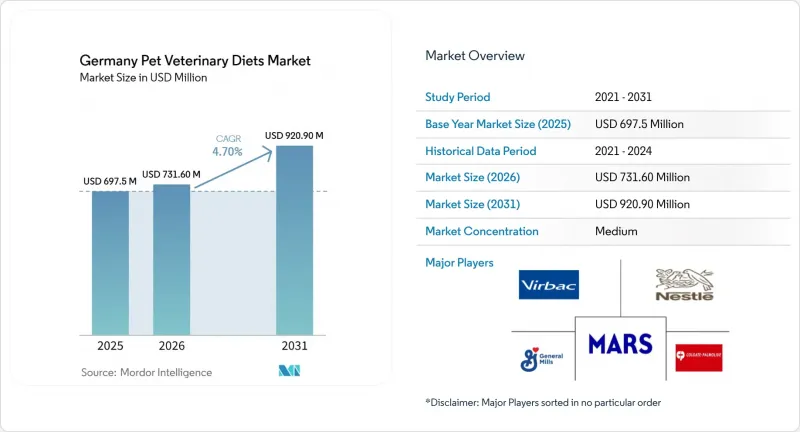
This report is Segmented by Sub Product (Diabetes, Renal, Urinary Tract Disease, Digestive Sensitivity, Oral Care Diets, Derma Diets and More) by Pets (Cats, Dogs, and Other Pets) by Distribution Channel (Convenience Stores, Online Channel, Specialty Stores, Supermarkets/Hypermarkets, and Other Channels). The Market Forecasts are Provided in Terms of Value in USD and Volume in Metric Tons.
Germany Pet Veterinary Diets Market Trends and Insights
Rising Diagnosis of Chronic Companion-Animal Conditions
German veterinary clinics are diagnosing more cases of renal disease, dermatological sensitivity, diabetes mellitus, urinary disorders, and obesity in cats and dogs. Each confirmed condition often leads to a diet recommendation that may persist for months or years. As a result, the Germany pet veterinary diets market is growing not only as more pets enter treatment but also as treatment durations extend after diagnosis. Improved in-clinic testing also helps veterinarians identify health issues earlier, extending the period during which diet can support disease management. A 2026 paper in the Journal of the American Veterinary Medical Association states that aging is a modifiable factor in companion animal health and supports the role of targeted nutrition in extending healthy life years. Germany's dense veterinary network reinforces this trend, as veterinarians can quickly translate diagnoses into nutrition plans at the point of care. Therefore, routine clinical practice, rather than short-term consumer trends, continues to support the growth of the Germany pet veterinary diets market.
Veterinary-Led Prescription Credibility
Veterinarians remain the most trusted source for German pet owners when it comes to therapeutic nutrition. This trust gives established prescription brands a structural advantage, as decisions often begin in the examination room rather than on a retail shelf. The Germany pet veterinary diets market benefits from this channel structure because it reduces direct substitution with standard premium food. Royal Canin strengthened this process in Germany by integrating feeding recommendations into the easyVET practice management software and the petsXL pet health app, placing nutrition advice directly into the clinical workflow. This integration shortens the decision path between diagnosis and purchase. It also improves repeat compliance because the recommendation remains linked to the patient record. Over time, this dynamic keeps the Germany pet veterinary diets market closely tied to professional advice and helps preserve price discipline across leading brands.
High Product Premium Versus Standard Pet Food
Veterinary diets continue to command a strong premium over standard pet food, which remains the clearest barrier to faster adoption. The price gap limits trial, especially among first-time users whose pets have milder conditions or who compare prescription food with premium wellness products. The Germany pet veterinary diets market faces lower exposure when animals have severe or chronic diseases. However, it faces higher exposure in categories such as weight management and oral care, where substitute products are available. The pressure also varies by pet type. Cat owners often continue using prescribed diets for kidney or urinary conditions despite high prices. In contrast, dog owners are more likely to compare alternatives in obesity management and digestive care if they believe the condition can be managed without a strict prescription program. German pet owners also make feeding decisions pragmatically, which means price and perceived value remain important even when emotional attachment to pets is high. This makes premium pricing a significant drag on volume growth in the Germany pet veterinary diets market, even though it supports strong revenue per unit for leading brands.
Other drivers and restraints analyzed in the detailed report include:
- Premiumization of Health-Focused Pet Food
- Aging Pet Population and Higher Therapeutic Diet Adoption
- Tight German and European Feed Additive Compliance Burden
For complete list of drivers and restraints, kindly check the Table Of Contents.
Segment Analysis
Digestive sensitivity holds 28.0% of the Germany pet veterinary diets market size in 2025, making it the largest sub-product category in the market. This position reflects the steady use of hydrolyzed-protein and limited-ingredient formulas for dogs and cats with recurring gastrointestinal issues. German veterinarians continue to use these diets as an early step in managing chronic enteropathy and food sensitivity, sustaining broad demand across both major pet types. Renal diets also hold a strong position in the Germany pet veterinary diets market, as kidney-related conditions often require early and long-duration feeding support.
Obesity diets are projected to expand at a CAGR of 8.5% from 2026 to 2031, making them the fastest-growing sub-product category in the Germany pet veterinary diets market. The category is gaining momentum as weight management becomes a more routine part of veterinary consultations and as owners increasingly accept diet as a practical intervention for long-term control. Diabetes, oral care, derma diets, urinary tract disease, and other veterinary diets continue to serve important niche needs, while Hill's Pet Nutrition, Inc.'s June 2026 launches show how multi-condition formulas are widening the addressable need within the Germany pet veterinary diets market.
Complete Report Scope:
- By Sub Product
- Diabetes
- Renal
- Urinary Tract Disease
- Digestive Sensitivity
- Oral Care Diets
- Derma Diets
- Obesity Diets
- Other Veterinary Diets
- By Pets
- Cats
- Dogs
- Other Pets
- By Distribution Channel
- Convenience Stores
- Online Channel
- Specialty Stores
- Supermarkets/Hypermarkets
- Other Channels
List of Companies Covered in this Report:
- Mars, Incorporated
- Nestle S.A. (Purina)
- Hill's Pet Nutrition, Inc. (Colgate-Palmolive Company)
- Virbac
- Blue Buffalo (General Mills, Inc.)
- Schell and Kampeter, Inc.
- Heristo Aktiengesellschaft
- Deuerer GmbH
- Mera Tiernahrung GmbH
- Farmina Pet Foods
- Bosch Tiernahrung GmbH and Co. KG
- United Petfood Group
- Affinity Petcare S.A.
- Wellness Pet Company, Inc.
Additional Benefits:
- The market estimate (ME) sheet in Excel format
- 3 months of analyst support
TABLE OF CONTENTS
1 Introduction
- 1.1 Study Assumptions and Market Definition
- 1.2 Scope of the Study
- 1.3 Research Methodology
2 Report Offers
3 Executive Summary and Key Findings
4 Key Industry Trends
- 4.1 Pet Population
- 4.1.1 Cats
- 4.1.2 Dogs
- 4.1.3 Other Pets
- 4.2 Pet Expenditure
- 4.3 Consumer Trends
5 Supply and Production Dynamics
- 5.1 Trade Analysis
- 5.2 Ingredient Trends
- 5.3 Value Chain And Distribution Channel Analysis
- 5.4 Regulatory Framework
- 5.5 Market Drivers
- 5.5.1 Rising Diagnosis of Chronic Companion-Animal Conditions
- 5.5.2 Veterinary-Led Prescription Credibility
- 5.5.3 Premiumization of Health-Focused Pet Food
- 5.5.4 Aging Pet Population and Higher Therapeutic Diet Adoption
- 5.5.5 E-Commerce Access to Specialized Diets
- 5.5.6 Private-Label Therapeutic Formulation Expansion
- 5.6 Market Restraints
- 5.6.1 High Product Premium Versus Standard Pet Food
- 5.6.2 Tight German and European Feed Additive Compliance Burden
- 5.6.3 Ingredient Cost Volatility for Specialized Proteins and Functional Inputs
- 5.6.4 Consumer Pushback Against Overmedicalized Pet Food Claims
6 Market Size And Growth Forecasts (Value and Volume)
- 6.1 By Sub Product
- 6.1.1 Diabetes
- 6.1.2 Renal
- 6.1.3 Urinary Tract Disease
- 6.1.4 Digestive Sensitivity
- 6.1.5 Oral Care Diets
- 6.1.6 Derma Diets
- 6.1.7 Obesity Diets
- 6.1.8 Other Veterinary Diets
- 6.2 By Pets
- 6.2.1 Cats
- 6.2.2 Dogs
- 6.2.3 Other Pets
- 6.3 By Distribution Channel
- 6.3.1 Convenience Stores
- 6.3.2 Online Channel
- 6.3.3 Specialty Stores
- 6.3.4 Supermarkets/Hypermarkets
- 6.3.5 Other Channels
7 Competitive Landscape
- 7.1 Key Strategic Moves
- 7.2 Market Share Analysis
- 7.3 Brand Positioning Matrix
- 7.4 Market Claim Analysis
- 7.5 Company Landscape
- 7.6 Company Profiles (Includes Global Level Overview, Market Level Overview, Core Business Segments, Financials, Key Information, Market Rank, Market Share, Products and Services, and Analysis of Recent Developments).
- 7.6.1 Mars, Incorporated
- 7.6.2 Nestle S.A. (Purina)
- 7.6.3 Hill's Pet Nutrition, Inc. (Colgate-Palmolive Company)
- 7.6.4 Virbac
- 7.6.5 Blue Buffalo (General Mills, Inc.)
- 7.6.6 Schell and Kampeter, Inc.
- 7.6.7 Heristo Aktiengesellschaft
- 7.6.8 Deuerer GmbH
- 7.6.9 Mera Tiernahrung GmbH
- 7.6.10 Farmina Pet Foods
- 7.6.11 Bosch Tiernahrung GmbH and Co. KG
- 7.6.12 United Petfood Group
- 7.6.13 Affinity Petcare S.A.
- 7.6.14 Wellness Pet Company, Inc.
8 Key Strategic Questions for Stakeholders

