PUBLISHER: Mordor Intelligence | PRODUCT CODE: 2119093

PUBLISHER: Mordor Intelligence | PRODUCT CODE: 2119093
Spain Pet Veterinary Diets - Market Share Analysis, Industry Trends & Statistics, Growth Forecasts (2026 - 2031)
According to Mordor Intelligence, the Spain pet veterinary diets market size was valued at USD 93.0 million in 2025 and estimated to grow from USD 98.6 million in 2026 to reach USD 133.8 million by 2031, at a CAGR of 6.3% during the forecast period 2026-2031.
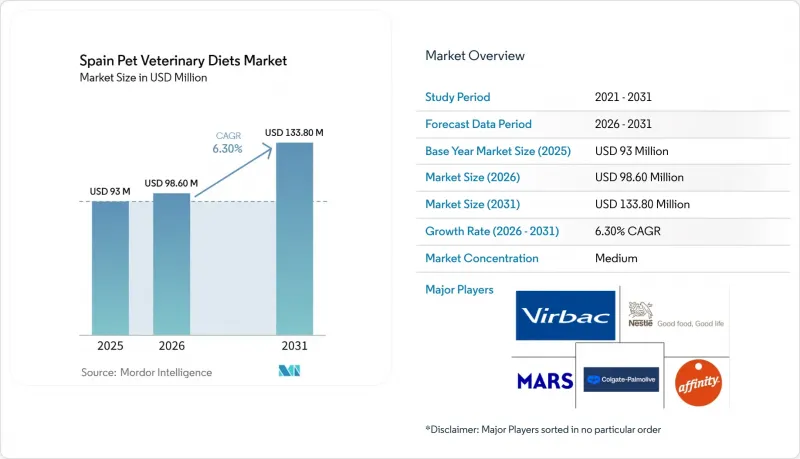
This report is Segmented by Sub Product (Diabetes, Renal, Urinary Tract Disease, Digestive Sensitivity, Oral Care Diets, Derma Diets, and More), by Pets (Cats, Dogs, and Other Pets), by Distribution Channel (Convenience Stores, Online Channel, Specialty Stores, Supermarkets/Hypermarkets, and Others). The Market Forecasts are Provided in Terms of Value in USD and Volume in Metric Tons.
Spain Pet Veterinary Diets Market Trends and Insights
Rising Veterinary Diagnosis of Chronic Pet Conditions in Spain
The Spain pet veterinary diets market benefits directly from Spain's network of 7,032 veterinary clinics, which gives the country one of the densest small animal clinical systems in southern Europe. A wider clinic base improves the detection of chronic kidney disease, diabetes, obesity, urinary disorders, and digestive disorders at earlier stages of care. A peer-reviewed study published in 2025 on cancer cases at a Spanish veterinary teaching hospital reported an annual diagnosis rate of 530 per 100,000 animals, demonstrating that clinical monitoring is producing actionable findings at scale. Once a chronic condition is identified, therapeutic nutrition usually becomes part of a repeat treatment plan rather than a one-time purchase. That pattern supports stable reorder demand across long treatment periods. As Spain's veterinary clinic sector continues to grow above gross domestic product growth, the recommendation funnel for the Spain pet veterinary diets market becomes broader and more consistent.
Veterinarian Recommendation Strongly Shapes Therapeutic Diet Purchases
The Spain pet veterinary diets market is still defined by the veterinarian's role as the main purchase trigger for therapeutic nutrition. Owners generally do not enter this category through impulse buying, as most products are introduced following a clinical discussion of a diagnosed condition. Brands with stronger veterinary education programs, case support, and prescription follow-up tools therefore capture more reliable product movement. Hill's Pet Nutrition reinforced this channel in 2026 through a responsible pet ownership and animal welfare initiative with the Colegio de Veterinarios de Malaga, which strengthened its ties with practicing veterinarians. Royal Canin supports the same model through its Clinical Alliance selective distribution approach, which protects clinical positioning and limits channel dilution. This structure gives the Spain pet veterinary diets market a sticky demand profile, because a recommendation made inside the clinic often leads to repeat sales over several months.
High Price Premium Versus Standard Pet Food Limits Mass Adoption
The market still faces a clear price barrier when owners compare prescription diets with standard premium food sold through general retail. Therapeutic formulas carry higher costs because they depend on tighter formulation standards, condition-specific claims, and more specialized channel support. This gap is more difficult for households in semi-urban and rural areas, where lower-cost substitutes are easier to find and specialist retail presence is weaker. The result is not only slower first-time adoption, but also weaker adherence over the full treatment period. Owners may begin a renal, urinary, or digestive protocol after a clinic visit and then stop when repeat purchases become too expensive. The Spain pet veterinary diets market will therefore continue to reward brands that offer smaller packs, clinic-linked subscriptions, or better value presentation without weakening clinical positioning.
Other drivers and restraints analyzed in the detailed report include:
- Higher Demand for Condition-Specific Diets Among Aging Pets
- Urban Small-Breed Pet Ownership Expands the Addressable Diet Base
- Reliance on Imported Inputs Exposes Brands to Cost Volatility
For complete list of drivers and restraints, kindly check the Table Of Contents.
Segment Analysis
Obesity diets were the largest sub-product in the Spain pet veterinary diets market size, with 22.0% share in 2025, and they are also forecast to grow at the fastest 7.4% CAGR during 2026-2031. This combination of leadership and momentum reflects the broad clinical relevance of weight management across both dogs and cats. A 2025 peer-reviewed cross-country study covering 10 European markets found that owner-reported overweight and obesity rates in dogs ranged from 6.0% to 31.3% across countries. The same draft also cited a Spanish academic study estimating that up to 40% of dogs in some regions had body condition scores indicating overweight or obesity. That disease burden is especially important because obesity often overlaps with diabetes, mobility issues, and digestive pressure, which expands the need for specialist nutrition. Royal Canin's March 2026 launch of Glycobalance for dogs and Glycoadvanced for cats at Iberzoo Propet 2026 showed how product design in the Spain pet veterinary diets market is shifting toward co-morbidity management rather than single-condition feeding.
Renal diets remain one of the most clinically important categories in the Spain pet veterinary diets market because chronic kidney disease rises sharply in older cats and requires sustained nutritional control. Peer-reviewed literature continues to support phosphorus-restricted renal formulas as a tool for slowing disease progression, which keeps veterinary recommendation levels high in this segment. Digestive sensitivity and urinary tract disease diets also hold strong positions because their benefits are easier for owners to observe during treatment, especially when symptoms improve quickly. Oral care diets and derma diets occupy smaller but rising niches, supported by increasing attention to dermatology and dentistry within Spain's clinic network. Other veterinary diets, including hepatic, cardiac, and developmental formulas, serve smaller patient pools but continue to gain structure from the FEDIAF 2025 nutrient guidance. Taken together, this broad sub product mix gives the Spain pet veterinary diets market multiple growth lanes beyond its long-established renal and digestive core.
Complete Report Scope:
- By Sub Product
- Diabetes
- Digestive Sensitivity
- Oral Care Diets
- Renal
- Urinary Tract Disease
- Obesity Diets
- Derma Diets
- Other Veterinary Diets
- By Pets
- Cats
- Dogs
- Other Pets
- By Distribution Channel
- Convenience Stores
- Online Channel
- Specialty Stores
- Supermarkets/Hypermarkets
- Other Channels
List of Companies Covered in this Report:
- Mars, Incorporated
- Nestle S.A.
- Colgate-Palmolive Company (Hills Pet Nutrition)
- Affinity Petcare, S.A.
- Virbac S.A.
- Dechra Pharmaceuticals PLC
- Farmina Pet Foods Holding B.V.
- VAFO Group a.s.
- Dibaq Group
- Bioiberica S.A.U.
- Mera Tiernahrung GmbH
- Kudo Petfood Spain S.L.
- Lenda Petfood S.L.
- Picart Pet Care S.A.
- Husse AB
Additional Benefits:
- The market estimate (ME) sheet in Excel format
- 3 months of analyst support
TABLE OF CONTENTS
1 Introduction
- 1.1 Study Assumptions and Market Definition
- 1.2 Scope of the Study
- 1.3 Research Methodology
- 1.4 Report Offers
2 Executive Summary and Key Findings
3 Key Industry Trends
- 3.1 Pet Population
- 3.1.1 Cats
- 3.1.2 Dogs
- 3.1.3 Other Pets
- 3.2 Pet Expenditure
- 3.3 Consumer Trends
4 Supply and Production Dynamics
- 4.1 Trade Analysis
- 4.2 Ingredient Trends
- 4.3 Value Chain and Distribution Channel Analysis
- 4.4 Regulatory Framework
- 4.5 Market Drivers
- 4.5.1 Rising veterinary diagnosis of chronic pet conditions in Spain
- 4.5.2 Veterinarian recommendation strongly shapes therapeutic diet purchases
- 4.5.3 Premiumization of pet care supports willingness to pay for veterinary diets
- 4.5.4 Growth of online replenishment for specialty pet diets
- 4.5.5 Higher demand for condition-specific diets among aging pets
- 4.5.6 Urban small-breed pet ownership expands the addressable diet base
- 4.6 Market Restraints
- 4.6.1 High price premium versus standard pet food limits mass adoption
- 4.6.2 Prescription-dependent purchase path restricts impulse buying
- 4.6.3 Low consumer awareness of therapeutic versus premium maintenance diets
- 4.6.4 Reliance on imported inputs exposes brands to cost volatility
- 4.7 Regulatory Landscape
- 4.8 Technological Outlook
- 4.9 Porter's Five Forces Analysis
- 4.9.1 Threat of New Entrants
- 4.9.2 Bargaining Power of Suppliers
- 4.9.3 Bargaining Power of Buyers
- 4.9.4 Threat of Substitutes
- 4.9.5 Intensity of Competitive Rivalry
5 Market Size And Growth Forecasts (Value and Volume)
- 5.1 By Sub Product
- 5.1.1 Diabetes
- 5.1.2 Digestive Sensitivity
- 5.1.3 Oral Care Diets
- 5.1.4 Renal
- 5.1.5 Urinary Tract Disease
- 5.1.6 Obesity Diets
- 5.1.7 Derma Diets
- 5.1.8 Other Veterinary Diets
- 5.2 By Pets
- 5.2.1 Cats
- 5.2.2 Dogs
- 5.2.3 Other Pets
- 5.3 By Distribution Channel
- 5.3.1 Convenience Stores
- 5.3.2 Online Channel
- 5.3.3 Specialty Stores
- 5.3.4 Supermarkets/Hypermarkets
- 5.3.5 Other Channels
6 Competitive Landscape
- 6.1 Market Concentration
- 6.2 Strategic Moves
- 6.3 Market Share Analysis
- 6.4 Company Profiles (Includes Global Level Overview, Market Level Overview, Core Segments, Financials as Available, Strategic Information, Market Rank/Share, Products and Services, Recent Developments)
- 6.4.1 Mars, Incorporated
- 6.4.2 Nestle S.A.
- 6.4.3 Colgate-Palmolive Company (Hills Pet Nutrition)
- 6.4.4 Affinity Petcare, S.A.
- 6.4.5 Virbac S.A.
- 6.4.6 Dechra Pharmaceuticals PLC
- 6.4.7 Farmina Pet Foods Holding B.V.
- 6.4.8 VAFO Group a.s.
- 6.4.9 Dibaq Group
- 6.4.10 Bioiberica S.A.U.
- 6.4.11 Mera Tiernahrung GmbH
- 6.4.12 Kudo Petfood Spain S.L.
- 6.4.13 Lenda Petfood S.L.
- 6.4.14 Picart Pet Care S.A.
- 6.4.15 Husse AB
7 Market Opportunities and Future Outlook

