PUBLISHER: Mordor Intelligence | PRODUCT CODE: 2100583

PUBLISHER: Mordor Intelligence | PRODUCT CODE: 2100583
South America Specialty Food Ingredient - Market Share Analysis, Industry Trends & Statistics, Growth Forecasts (2026 - 2031)
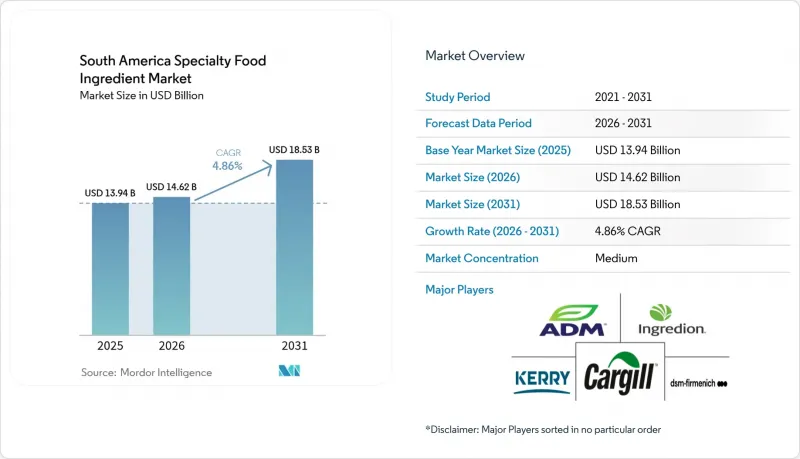
According to Mordor Intelligence, the specialty food ingredients market size in South America is expected to grow from USD 13.94 billion in 2025 to USD 14.62 billion in 2026 and is forecast to reach USD 18.53 billion by 2031 at 4.86% CAGR over 2026-2031.
This report is Segmented by Product Type (Functional Food Ingredient, Specialty Starch and Texturants, Sweetener, and More), by Application (Bakery Products, Beverages, Meat, Poultry, and Seafood, Dairy Products, Confectionery, and More), and by Geography (Brazil, Chile, Argentina, and Rest of South America). The Market Forecasts are Provided in Terms of Value (USD).
South America Specialty Food Ingredient Market Trends and Insights
Expansion of Food Processing Sector
The specialty food ingredients market in South America demonstrates robust growth, primarily driven by Brazil's food processing industry, which generated revenues of USD 233 billion in 2024, representing a 9.9% increase from the previous year, according to the USDA Foreign Agricultural Service. The market expansion stems from increasing requirements for functional ingredients that enhance product quality, extend shelf life, and deliver specific nutritional benefits. According to the Brazilian Institute of Geography and Statistics (IBGE), the country's 2025 harvest increased by 5.8% compared to 2024, reaching 311 million tonnes . Soybean production is projected to rise by 10.9%, adding up to 160.2 million tonnes in 2025, while corn (1st crop) production is expected to increase by 9.1% to 24.9 million tonnes in relation to the 2024 harvest, according to the first forecast of the Systematic Survey of Agricultural Production (LSPA). This substantial agricultural output strengthens the specialty food ingredients market by ensuring a consistent supply of raw materials for ingredient manufacturing.
Rise of Plant Based and Vegan Diets
The South American specialty food ingredients market is experiencing significant growth due to increasing consumer adoption of plant-based and vegan diets. Health consciousness, animal welfare considerations, and environmental concerns are driving consumers, particularly urban residents and younger demographics, to reduce their consumption of animal-based products. This shift has increased demand for plant-based alternatives, including meat substitutes, dairy-free beverages, egg alternatives, and vegan snacks. Brazilian retail sales of plant-based meat and seafood alternatives reached USD 223.5 million in 2023, representing a 38% increase from 2022, according to the Good Food Institute. Government support is also strengthening the market, with several South American authorities implementing supportive policies and initiatives. The Brazilian Ministry of Health's dietary guidelines promote whole, minimally processed plant-based foods while recommending reduced consumption of meat and ultra-processed products. Additionally, Sao Paulo has implemented "Meatless Monday" programs in public schools and institutions, expanding the demand for plant-based ingredients in institutional food service.
Expensive Certification and Testing Requirements
Stringent certification and testing requirements across South America create significant cost barriers for specialty ingredient manufacturers, particularly affecting smaller companies with limited resources. Brazil's National Health Surveillance Agency (Anvisa) regulates food additives and technological aids through RDC 778/2023 and IN 211/2023, which specify permitted additives and their usage limits. The regulatory framework operates on risk analysis principles to ensure safety and technological necessity, requiring substantial investment in testing and documentation. Regulatory updates based on scientific advancements and international standards create ongoing compliance challenges. While RDC 843/2024 exempts certain additives from registration requirements for industrial food production, the complex regulatory landscape increases costs and potentially restricts innovation and market entry for new ingredients.
Other drivers and restraints analyzed in the detailed report include:
- Consumer Demand for Fortified Food and Beverage Products
- Technological Advancements in Ingredient Processing
- Lack of Ingredients Traceability System
For complete list of drivers and restraints, kindly check the Table Of Contents.
Segment Analysis
The product type segmentation shows that Functional Food Ingredients held a 16.74% market share in 2025, driven by increasing consumer awareness of health benefits and demand for foods with specific functional properties. This segment's growth is supported by scientific advancements in ingredient efficacy and bioavailability, as manufacturers invest in clinical validation to substantiate health claims. The Food Ingredients South America (FiSA) 2024 event report by Sebrae highlighted sustainability, health, and technology trends in food production. The event, held from August 6-8, 2024, in Sao Paulo, showcased innovations in plant-based products, upcycled ingredients, and food waste reduction solutions.
From 2026 to 2031, the enzymes category is projected to witness a CAGR of 5.71%. The rising adoption of enzymes across diverse sectors such as food, agriculture, and pharmaceuticals drives this growth. These industries favor enzymes for their advantages, including heightened efficiency, shortened processing times, and environmentally friendly attributes. Specifically, in the food sector, enzymes play a pivotal role in enhancing product quality, substituting synthetic chemicals, and bolstering the eco-friendliness of production processes. Ingredion's 2024 Annual Report indicated double-digit organic sales growth in its Texture & Healthful Solutions segment, attributed to higher-value specialty starches and clean-label texturizers. The company maintains manufacturing facilities in South America, focusing on local sourcing and efficient supply chains. The report noted successful debottlenecking initiatives in Colombia and Mexico, which increased production capacity for specialty ingredients.
Complete Report Scope:
- By Product Type
- Functional Food Ingredient
- Speciality Starch and Texturants
- Sweetener
- Food Flavors and Enhancers
- Acidulants
- Preservatives
- Emulsifiers
- Colorants
- Enzymes
- Proteins
- Speciality Fats & Oils
- Food Hydrocolloids & Polysaccharides
- Anti-Caking Agents
- Others
- By Application
- Bakery Products
- Beverages
- Meat, Poultry, and Seafood
- Dairy Products
- Confectionery
- Fats & Oils
- Dressings/Condiments/Sauces/Marinade
- Pasta, Soup and Noodles
- Prepared Food
- Plant-based Food and Beverage
- Other Applications
- By Geography
- Brazil
- Chile
- Argentina
- Rest of South America
List of Companies Covered in this Report:
- Cargill, Incorporated
- The Archer-Daniels-Midland Company
- Ingredion Incorporated
- Kerry Group plc
- DSM-Firmenich AG
- Givaudan S.A.
- International Flavors & Fragrances, Inc.
- Tate & Lyle PLC
- BASF SE
- Lallemand Inc.
- Sensient Technologies Corporation
- Corbion NV
- Duas Rodas Industrial S.A.
- Oterra A/S
- Bunge Global SA
- AAK AB
- Symrise AG
- GLG Life Tech Corp
- Takasago International Corporation
- Bell Flavors & Fragrances, Inc.
Additional Benefits:
- The market estimate (ME) sheet in Excel format
- 3 months of analyst support
TABLE OF CONTENTS
1 INTRODUCTION
- 1.1 Study Assumptions and Market Definition
- 1.2 Scope of the Study
2 RESEARCH METHODOLOGY
3 EXECUTIVE SUMMARY
4 MARKET LANDSCAPE
- 4.1 Market Overview
- 4.2 Market Drivers
- 4.2.1 Expansion of Food Processing Sector
- 4.2.2 Rise of Plant-Based and Vegan Diets
- 4.2.3 Consumer Demand for Fortified Food and Beverage Products
- 4.2.4 Technological Advancements in Ingredient Processing
- 4.2.5 Rising consumer demand for natural and clean-label food products
- 4.2.6 Urbanization and Changing Dietary Patterns
- 4.3 Market Restraints
- 4.3.1 Expensive Certification and Testing Requirements
- 4.3.2 Lack of Ingredients Traceability System
- 4.3.3 Limited research and development capabilities compared to other markets
- 4.3.4 Logistical challenges from poor transportation networks
- 4.4 Supply Chain Analysis
- 4.5 Regulatory Outlook
- 4.6 Porter's Five Forces
- 4.6.1 Threat of New Entrants
- 4.6.2 Bargaining Power of Buyers/Consumers
- 4.6.3 Bargaining Power of Suppliers
- 4.6.4 Threat of Substitute Products
- 4.6.5 Intensity of Competitive Rivalry
5 MARKET SIZE AND GROWTH FORECASTS (VALUE)
- 5.1 By Product Type
- 5.1.1 Functional Food Ingredient
- 5.1.2 Speciality Starch and Texturants
- 5.1.3 Sweetener
- 5.1.4 Food Flavors and Enhancers
- 5.1.5 Acidulants
- 5.1.6 Preservatives
- 5.1.7 Emulsifiers
- 5.1.8 Colorants
- 5.1.9 Enzymes
- 5.1.10 Proteins
- 5.1.11 Speciality Fats & Oils
- 5.1.12 Food Hydrocolloids & Polysaccharides
- 5.1.13 Anti-Caking Agents
- 5.1.14 Others
- 5.2 By Application
- 5.2.1 Bakery Products
- 5.2.2 Beverages
- 5.2.3 Meat, Poultry, and Seafood
- 5.2.4 Dairy Products
- 5.2.5 Confectionery
- 5.2.6 Fats & Oils
- 5.2.7 Dressings/Condiments/Sauces/Marinade
- 5.2.8 Pasta, Soup and Noodles
- 5.2.9 Prepared Food
- 5.2.10 Plant-based Food and Beverage
- 5.2.11 Other Applications
- 5.3 By Geography
- 5.3.1 Brazil
- 5.3.2 Chile
- 5.3.3 Argentina
- 5.3.4 Rest of South America
6 COMPETITIVE LANDSCAPE
- 6.1 Market Concentration
- 6.2 Strategic Moves
- 6.3 Market Ranking Analysis
- 6.4 Company Profiles (includes Global-level Overview, Market-level Overview, Core Segments, Financials (if available), Strategic Information, Market Rank/Share, Products & Services, Recent Developments)
- 6.4.1 Cargill, Incorporated
- 6.4.2 The Archer-Daniels-Midland Company
- 6.4.3 Ingredion Incorporated
- 6.4.4 Kerry Group plc
- 6.4.5 DSM-Firmenich AG
- 6.4.6 Givaudan S.A.
- 6.4.7 International Flavors & Fragrances, Inc.
- 6.4.8 Tate & Lyle PLC
- 6.4.9 BASF SE
- 6.4.10 Lallemand Inc.
- 6.4.11 Sensient Technologies Corporation
- 6.4.12 Corbion NV
- 6.4.13 Duas Rodas Industrial S.A.
- 6.4.14 Oterra A/S
- 6.4.15 Bunge Global SA
- 6.4.16 AAK AB
- 6.4.17 Symrise AG
- 6.4.18 GLG Life Tech Corp
- 6.4.19 Takasago International Corporation
- 6.4.20 Bell Flavors & Fragrances, Inc.
7 MARKET OPPORTUNITIES AND FUTURE OUTLOOK

