PUBLISHER: Mordor Intelligence | PRODUCT CODE: 2100743

PUBLISHER: Mordor Intelligence | PRODUCT CODE: 2100743
Indonesia E-commerce Logistics - Market Share Analysis, Industry Trends & Statistics, Growth Forecasts (2026 - 2031)
According to Mordor Intelligence, the Indonesia e-commerce logistics market size is expected to grow from USD 5.27 billion in 2025 to USD 5.74 billion in 2026 and is forecasted to reach USD 8.71 billion by 2031, at 8.71% CAGR over 2026-2031.
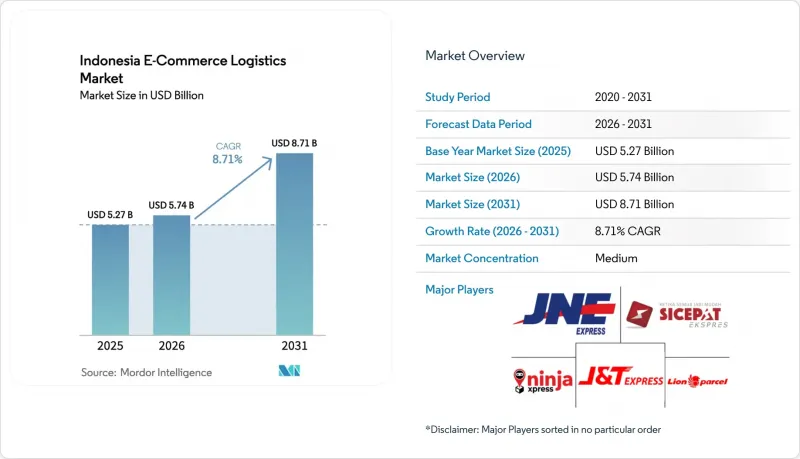
This report is Segmented by Service (Transportation, Warehousing, and More), by Business Model (B2C, B2B, C2C), by Destination (Domestic, Cross-Border), by Delivery Speed (Same-Day, Next-Day, and More), by Product Category (Fashion, Electronics, and More), by City Tier (Tier 1, 2, and More), by Region (West Java, East Java, and More). The Market Forecasts are Provided in Terms of Value (USD).
Indonesia E-commerce Logistics Market Trends and Insights
Live-Stream & Social-Commerce Boom Drives Higher Parcel Frequency
Live-stream shopping compresses buying decisions, leading to more frequent, smaller-ticket orders that lift parcel counts per customer. TikTok Shop's December 2024 return, driven by a USD 1.5 billion partnership with Tokopedia, reached 3.2 million daily checkouts by March 2025. Users are placing 4.7 orders monthly, more than double traditional browsing activity, challenging logistics providers to process higher volumes without commensurate revenue per piece. Parcel density is higher in neighborhoods where influencers are headquartered, enabling route optimization but requiring flexible, on-demand pickups from home-based sellers. Rising compliance oversight under the Ministry of Trade transparency rules rewards established carriers with robust digital documentation. In aggregate, live-stream commerce adds an estimated 2.3 percentage points to the forecast CAGR of the Indonesia E-commerce Logistics Market.
Platform-Owned Captive Logistics Arms Extend Next-Hour Reach
Marketplaces internalize delivery to secure service quality and margin. Shopee Express already serves 487 cities and accounts for 41% of Shopee parcels, offering two-hour windows in 12 metros Lazada eLogistics operates 73 automated hubs processing 850,000 packages daily. Proprietary networks leverage demand visibility and inventory data to pre-position goods close to buyers, enabling predictive routing that supports next-hour commitments across dense corridors. However, the capital burden and draft marketplace regulations that require neutral access for third-party couriers could narrow their advantage. The shift pushes mid-tier independents toward niche capabilities, such as cold-chain or cross-border expertise, and is expected to lift the growth of the Indonesia E-commerce Logistics Market by roughly 1.9 percentage points during 2026-2031.
Urban Congestion & Low-Emission Zones Slow Last-Mile Drop Density
Jakarta peak-hour speeds fell to 11 km/h in 2025, reducing driver productivity and compelling fleet expansion to preserve service levels. Proposed low-emission zones will bar older diesel vans during daytime in core districts, disrupting 68% of existing routes. Surabaya and Bandung pilots impose similar access rules, burdening operators of aging fleets. Micro-fulfillment hubs and two-wheeler couriers partially offset congestion yet require expensive urban real estate. Altogether, regulatory and traffic headwinds are estimated to trim 1.3 percentage points from the CAGR of the Indonesia E-commerce Logistics Market in the near term.
Other drivers and restraints analyzed in the detailed report include:
- Cold-Chain Surge From Online Grocery, Vaccines & Pharma E-Tail
- Nation-Wide E-POD Mandate Cuts Return Losses
- Fuel-Price Volatility After Subsidy Reforms Inflates Delivery Costs
For complete list of drivers and restraints, kindly check the Table Of Contents.
Segment Analysis
Transportation retained 72.78% of 2025 revenue, yet value-added modules are projected to grow at a 10.39% CAGR, widening their slice of the Indonesia E-commerce Logistics Market share. Merchants now view branded packaging, kitting, and returns orchestration as core to customer retention. Authentication and pre-delivery inspection reduced return rates for fashion and electronics by up to 25%. At the same time, the road-based backbone benefits from new toll corridors, such as the 117-kilometer Semarang-Demak expressway that cuts Central Java transit times by 35%. Sea freight continues to link the archipelago, though low sailing frequencies east of Java preserve multi-day windows.
Warehousing absorbs surging inventory as platforms decentralize stock. Modern Grade-A supply grew markedly across the industrial belts of Jakarta, Surabaya, and Bandung, supporting same-day delivery. Even without rail expansion, multi-modal nodes integrate air cargo uplift where wide-body conversions bolstered dedicated capacity by 22% in 2025. Strategic interplay between core transport and wrap-around services therefore sets the pace for value creation inside the Indonesia E-commerce Logistics Market.
B2C channels maintained a leading 75.23% share in the Indonesia E-commerce Logistics Market size in 2025. However, C2C parcels are forecast to grow 13.40% annually, resulting in outsized parcel counts relative to ticket value. Peer-to-peer marketplaces, live-stream influencers, and resale apps collectively registered 127 million trades in 2025, demanding residential pickups, lightweight packaging, and escrow-anchored returns. Dropship models blur traditional lines, forcing carriers to harmonize B2C service levels with C2C variability.
Large marketplaces continue to wield scale leverage, pressuring courier tariffs yet enabling collaborative forecasting that improves route fill rates. Meanwhile, enterprises digitize procurement workflows, prompting steady B2B logistics demand for just-in-time restocks and system integration. The Indonesia E-commerce Logistics Market size linked to C2C therefore broadens overall service portfolios and accelerates the adoption of mobile point-of-sale tools for informal merchants.
Complete Report Scope:
- By Service
- Transportation
- Road
- Rail
- Air
- Sea
- Warehousing & Fulfilment
- Value-Added Services (Labelling, Packaging, Kitting)
- Transportation
- By Business Model
- B2C
- B2B
- C2C
- By Destination
- Domestic
- Cross-border (international)
- By Delivery Speed
- Same-day (less than 24 h)
- Next-day (24-48 h)
- Standard (3-5 days)
- Others (more than 5 days)
- By Product Category
- Foods & Beverages
- Personal & Household Care
- Fashion & Lifestyle (accessories, apparel, footwear)
- Furniture
- Consumer Electronics & Household Appliances
- Other Products
- By City Tier
- Tier 1
- Tier 2
- Tier 3 and Below
- By Provinces
- Central Java
- East Java
- West Java
- Jakarta
- Banten
- Rest of Provinces
List of Companies Covered in this Report:
- JNE Express
- J&T Express
- SiCepat Ekspres
- Ninja Xpress
- Lion Parcel
- Wahana Express
- TIKI
- Pos Indonesia
- Paxel
- DHL Express
- UPS
- FedEx
- GoSend (Gojek)
- Grab Express
- Shipper
- Shopee Express
- Lazada eLogistics
- Anteraja
- PopBox
- SF Express
Additional Benefits:
- The market estimate (ME) sheet in Excel format
- 3 months of analyst support
TABLE OF CONTENTS
1 Introduction
- 1.1 Study Assumptions & Market Definition
- 1.2 Scope of the Study
2 Research Methodology
3 Executive Summary
4 Market Landscape
- 4.1 Market Overview
- 4.2 Market Drivers
- 4.2.1 Live-Stream & Social-Commerce Boom Drives Higher Parcel Frequency
- 4.2.2 Platform-Owned "Captive" Logistics Arms Extend Next-Hour Reach
- 4.2.3 Cold-Chain Surge from Online Grocery, Vaccines & Pharma E-Tail
- 4.2.4 Nation-Wide E-POD (Electronic Proof-Of-Delivery) Mandate Cuts Return Losses
- 4.2.5 Carbon-Credit Incentives Accelerate Electric Van And E-Bike Fleets
- 4.2.6 5G Private Networks in Mega-Fulfilment Hubs Enable Real-Time Robotics
- 4.3 Market Restraints
- 4.3.1 Urban Congestion & Low-Emission Zones Slow Last-Mile Drop Density
- 4.3.2 Fuel-Price Volatility After Subsidy Reforms Inflates Delivery Costs
- 4.3.3 Upcoming Compulsory E-Invoices Add Compliance Delays for MSME Sellers
- 4.3.4 Lack of Battery-Recycling Capacity Hampers Electric-Fleet Scalability
- 4.4 Value / Supply-Chain Analysis
- 4.5 Regulatory Landscape
- 4.6 Technological Outlook
- 4.7 Demand & Supply Analysis
- 4.8 Industry Attractiveness - Porter's Five Forces
- 4.8.1 Threat of New Entrants
- 4.8.2 Bargaining Power of Buyers
- 4.8.3 Bargaining Power of Suppliers
- 4.8.4 Threat of Substitutes
- 4.8.5 Competitive Rivalry
- 4.9 Reverse / Return Logistics Insights
- 4.10 Impact of Geo-Political Events on Supply Chain Shifts
5 Market Size & Growth Forecasts
- 5.1 By Service
- 5.1.1 Transportation
- 5.1.1.1 Road
- 5.1.1.2 Rail
- 5.1.1.3 Air
- 5.1.1.4 Sea
- 5.1.2 Warehousing & Fulfilment
- 5.1.3 Value-Added Services (Labelling, Packaging, Kitting)
- 5.1.1 Transportation
- 5.2 By Business Model
- 5.2.1 B2C
- 5.2.2 B2B
- 5.2.3 C2C
- 5.3 By Destination
- 5.3.1 Domestic
- 5.3.2 Cross-border (international)
- 5.4 By Delivery Speed
- 5.4.1 Same-day (less than 24 h)
- 5.4.2 Next-day (24-48 h)
- 5.4.3 Standard (3-5 days)
- 5.4.4 Others (more than 5 days)
- 5.5 By Product Category
- 5.5.1 Foods & Beverages
- 5.5.2 Personal & Household Care
- 5.5.3 Fashion & Lifestyle (accessories, apparel, footwear)
- 5.5.4 Furniture
- 5.5.5 Consumer Electronics & Household Appliances
- 5.5.6 Other Products
- 5.6 By City Tier
- 5.6.1 Tier 1
- 5.6.2 Tier 2
- 5.6.3 Tier 3 and Below
- 5.7 By Provinces
- 5.7.1 Central Java
- 5.7.2 East Java
- 5.7.3 West Java
- 5.7.4 Jakarta
- 5.7.5 Banten
- 5.7.6 Rest of Provinces
6 Competitive Landscape
- 6.1 Market Concentration
- 6.2 Strategic Moves
- 6.3 Market Share Analysis
- 6.4 Company Profiles (includes Global-level Overview, Market-level Overview, Core Segments, Financials, Strategic Information, Market Rank/Share, Products & Services, Recent Developments)
- 6.4.1 JNE Express
- 6.4.2 J&T Express
- 6.4.3 SiCepat Ekspres
- 6.4.4 Ninja Xpress
- 6.4.5 Lion Parcel
- 6.4.6 Wahana Express
- 6.4.7 TIKI
- 6.4.8 Pos Indonesia
- 6.4.9 Paxel
- 6.4.10 DHL Express
- 6.4.11 UPS
- 6.4.12 FedEx
- 6.4.13 GoSend (Gojek)
- 6.4.14 Grab Express
- 6.4.15 Shipper
- 6.4.16 Shopee Express
- 6.4.17 Lazada eLogistics
- 6.4.18 Anteraja
- 6.4.19 PopBox
- 6.4.20 SF Express
7 Market Opportunities & Future Outlook
- 7.1 White-space & Unmet-need Assessment

