PUBLISHER: Mordor Intelligence | PRODUCT CODE: 2097219

PUBLISHER: Mordor Intelligence | PRODUCT CODE: 2097219
China E-commerce Logistics - Market Share Analysis, Industry Trends & Statistics, Growth Forecasts (2026 - 2031)
According to Mordor Intelligence, China e-commerce logistics market size in 2026 is estimated at USD 235.89 billion, growing from 2025 value of USD 211.94 billion with 2031 projections showing USD 402.89 billion, growing at 11.30% CAGR over 2026-2031.
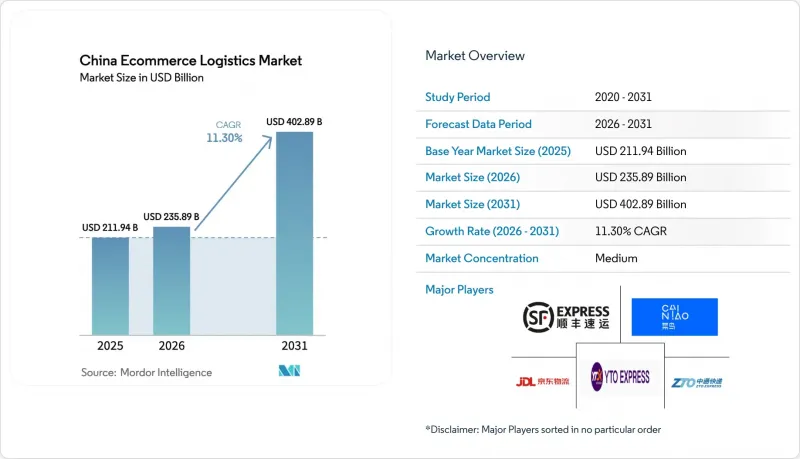
This report Segments by Service (Transportation (Road and More), Warehousing and Fulfilment), by Business Model (B2C, B2B and More), by Destination (Domestic and More), by Delivery Speed (Same-Day and More), by Product Category (Foods and Beverages and More), by City-Tier (Tier 1 and More) and by Geography (East China and More). The Market Forecasts are Provided in Terms of Value (USD).
China E-commerce Logistics Market Trends and Insights
Rising tier-2 / tier-3 disposable incomes shifting e-commerce GMV beyond tier-1 hubs
Secondary cities now deliver a larger share of national online retail value than premier metros, prompting network redesign and fresh distribution-center investments. Chongqing alone committed RMB 40 billion (USD 5.56 billion) to logistics projects that lowered local freight costs by 3.5%. Rural e-commerce participation, meanwhile, improved household financial resilience by 9.63%, highlighting the socioeconomic benefit of broader fulfillment coverage.
Livestream and short-video shopping are elevating impulse-buy conversion rates
Impulse purchases triggered by viral broadcasts generate demand spikes that stretch traditional inventory planning. Providers respond with predictive analytics and cloud-based control towers that redeploy safety stock to micro-fulfillment sites inside dense urban trade areas. Agility becomes a profit driver within the China e-commerce logistics market as retailers lean on one-hour delivery promises to lock in shoppers.
Escalating last-mile labor costs in tier-1 hubs despite automation
Courier wages rise as operators compete for talent to execute doorstep delivery in densely populated towers. Even with driverless truck pilots and automated sorters, human couriers remain indispensable for high-service-level orders, limiting cost-down potential in the Chinese e-commerce logistics market.
Other drivers and restraints analyzed in the detailed report include:
- Community group-buying normalizes high-frequency online grocery purchases
- Silver-economy adoption of simplified apps is expanding the senior shopper base
- Persistent rural address data-quality gaps are raising failed-delivery ratios
For complete list of drivers and restraints, kindly check the Table Of Contents.
Segment Analysis
Transportation dominated 60.12% of the China e-commerce logistics market in 2025, underpinned by a 169,000-km expressway grid that connects production zones with consumption hubs. Rail corridors along the Belt and Road funnel export parcels to Europe, while airfreight supports premium electronics. Value-added services are scaling at a 13.86% CAGR as merchants seek unique packaging, reverse-logistics handling, and compliance-ready labeling. SF Express' "Fengzhiyun" platform shows how data analytics, inventory orchestration, and real-time visibility convert basic haulage contracts into integrated supply-chain partnerships.
Warehousing and micro-fulfillment networks multiply near consumers to enable same-day cut-off times. Robotics automates put-away and picking, trimming unit costs even as wage inflation persists. Air-cargo alliances such as the SF Express-Etihad Cargo joint venture extend reach into the Middle East. Maritime e-packet lanes, especially via Shenzhen and Ningbo, benefit cross-border sellers chasing tax-rebate programs. Competitive advantage now hinges on end-to-end orchestration across these service lines rather than isolated modal excellence, reshaping supplier criteria in the China e-commerce logistics market.
B2C held 71.86% of the China e-commerce logistics market share in 2025, anchored by platform ecosystems that aggregate merchant demand and standardize fulfillment practices. Brands outsource everything from inbound freight to doorstep returns, relying on carrier APIs to sync front-end ordering channels. The C2C segment, expanding at 13.12% CAGR, taps social-commerce momentum as Gen-Z consumers trade secondhand fashion and collectibles. Start-ups launch flat-rate parcel kits and smartphone apps that generate labels through mini-programs, simplifying sporadic shipping for individuals.
Cross-listing between B2C storefronts and C2C resale marketplaces blurs boundaries, with sellers shifting unsold inventory to peer-to-peer channels. That flow diversifies parcel origination points and pushes carriers to offer nationwide pick-up, thereby enlarging the China e-commerce logistics market. Meanwhile, B2B digital procurement platforms deploy bulk rate contracts that stabilize margins yet require multimodal coordination, encouraging carriers to maintain distinct pricing ladders for enterprise versus consumer traffic within the wider China e-commerce logistics industry.
Complete Report Scope:
- By Service
- Transportation
- Road
- Air
- Rail
- Maritime
- Warehousing and Fulfilment
- Value-Added (Labelling, Packaging, Kitting)
- Transportation
- By Business Model
- B2C
- B2B
- C2C
- By Destination
- Domestic
- Cross-Border - Inbound
- Cross-Border - Outbound
- By Delivery Speed
- Same-day (less than 24 h)
- Next-day (24-48 h)
- Standard (3-5 days)
- Economy (more than 5 days)
- Others
- By Product Category
- Foods and Beverages
- Personal and Household Care
- Fashion and Lifestyle (accessories, apparel, footwear)
- Furniture
- Electronics and Household Appliances
- Other Products
- By City-Tier
- Tier 1
- Tier 2
- Tier 3 and Below
- By Geography
- East China
- South China
- North China
- Central China
- Northeast China
- Northwest China
- Southwest China
List of Companies Covered in this Report:
- SF Express
- JD Logistics
- Cainiao Network (Alibaba)
- ZTO Express
- YTO Express
- Yunda Express
- STO Express
- Best Inc.
- China Post EMS
- Deppon Logistics
- Suning Logistics
- J&T Express China
- Dada Group (JDDJ)
- DHL eCommerce China
- FedEx Express China
- UPS China
- Kerry SCM
- CTS International Logistics
- Sinotrans
- 4PX Express
- YunExpress
- Zongteng Group (Winsync, EWE)
- FlashEx
- Meituan Delivery
- YDH Express
- CNE Express
Additional Benefits:
- The market estimate (ME) sheet in Excel format
- 3 months of analyst support
TABLE OF CONTENTS
1 Introduction
- 1.1 Study Assumptions and Market Definition
- 1.2 Scope of the Study
2 Research Methodology
3 Executive Summary
4 Market Landscape
- 4.1 Market Overview
- 4.2 Market Drivers
- 4.2.1 Rising Tier-2/3 Disposable Incomes Shifting E-commerce GMV Beyond Tier-1 Hubs
- 4.2.2 Livestream and Short-Video Shopping Elevating Impulse-Buy Conversion Rates
- 4.2.3 Community Group-Buying Normalising High-Frequency Online Grocery Purchases
- 4.2.4 Silver-Economy Adoption of Simplified Apps Expanding Senior Shopper Base
- 4.2.5 Duty-Free Cross-Border Pilot Zones Fueling Appetite for Premium Imports
- 4.2.6 30-Minute Micro-Fulfilment Creating Instant-Gratification Purchase Expectations
- 4.3 Market Restraints
- 4.3.1 Escalating last-mile labour costs in Tier-1 hubs despite automation
- 4.3.2 Persistent rural address data-quality gaps raising failed-delivery ratio
- 4.3.3 Tightened cross-border data-compliance rules delaying customs clearance
- 4.3.4 Environmental targets raising fleet electrification costs
- 4.4 Value / Supply-Chain Analysis
- 4.5 Government Policies and Regulations
- 4.6 Technological Developments in the Market
- 4.7 Impact of Geopolitical Events on the Market
- 4.8 Porter's Five Forces
- 4.8.1 Threat of New Entrants
- 4.8.2 Bargaining Power of Buyers
- 4.8.3 Bargaining Power of Suppliers
- 4.8.4 Threat of Substitutes
- 4.8.5 Competitive Rivalry
5 Market Size and Growth Forecasts (Value, CNY bn)
- 5.1 By Service
- 5.1.1 Transportation
- 5.1.1.1 Road
- 5.1.1.2 Air
- 5.1.1.3 Rail
- 5.1.1.4 Maritime
- 5.1.2 Warehousing and Fulfilment
- 5.1.3 Value-Added (Labelling, Packaging, Kitting)
- 5.1.1 Transportation
- 5.2 By Business Model
- 5.2.1 B2C
- 5.2.2 B2B
- 5.2.3 C2C
- 5.3 By Destination
- 5.3.1 Domestic
- 5.3.2 Cross-Border - Inbound
- 5.3.3 Cross-Border - Outbound
- 5.4 By Delivery Speed
- 5.4.1 Same-day (less than 24 h)
- 5.4.2 Next-day (24-48 h)
- 5.4.3 Standard (3-5 days)
- 5.4.4 Economy (more than 5 days)
- 5.4.5 Others
- 5.5 By Product Category
- 5.5.1 Foods and Beverages
- 5.5.2 Personal and Household Care
- 5.5.3 Fashion and Lifestyle (accessories, apparel, footwear)
- 5.5.4 Furniture
- 5.5.5 Electronics and Household Appliances
- 5.5.6 Other Products
- 5.6 By City-Tier
- 5.6.1 Tier 1
- 5.6.2 Tier 2
- 5.6.3 Tier 3 and Below
- 5.7 By Geography
- 5.7.1 East China
- 5.7.2 South China
- 5.7.3 North China
- 5.7.4 Central China
- 5.7.5 Northeast China
- 5.7.6 Northwest China
- 5.7.7 Southwest China
6 Competitive Landscape
- 6.1 Market Concentration
- 6.2 Strategic Moves
- 6.3 Market Share Analysis
- 6.4 Company Profiles (includes Global-level Overview, Market-level Overview, Core Segments, Financials, Strategic Info, Market Rank/Share, Products and Services, Recent Developments)
- 6.4.1 SF Express
- 6.4.2 JD Logistics
- 6.4.3 Cainiao Network (Alibaba)
- 6.4.4 ZTO Express
- 6.4.5 YTO Express
- 6.4.6 Yunda Express
- 6.4.7 STO Express
- 6.4.8 Best Inc.
- 6.4.9 China Post EMS
- 6.4.10 Deppon Logistics
- 6.4.11 Suning Logistics
- 6.4.12 J&T Express China
- 6.4.13 Dada Group (JDDJ)
- 6.4.14 DHL eCommerce China
- 6.4.15 FedEx Express China
- 6.4.16 UPS China
- 6.4.17 Kerry SCM
- 6.4.18 CTS International Logistics
- 6.4.19 Sinotrans
- 6.4.20 4PX Express
- 6.4.21 YunExpress
- 6.4.22 Zongteng Group (Winsync, EWE)
- 6.4.23 FlashEx
- 6.4.24 Meituan Delivery
- 6.4.25 YDH Express
- 6.4.26 CNE Express
7 Market Opportunities and Future Outlook

