PUBLISHER: Mordor Intelligence | PRODUCT CODE: 2119888

PUBLISHER: Mordor Intelligence | PRODUCT CODE: 2119888
United Kingdom E-commerce Logistics - Market Share Analysis, Industry Trends & Statistics, Growth Forecasts (2026 - 2031)
According to Mordor Intelligence, the United Kingdom e-commerce logistics market size in 2026 is estimated at USD 21.98 billion, growing from 2025 value of USD 20.76 billion with 2031 projections showing USD 29.22 billion, growing at 5.87% CAGR over 2026-2031.
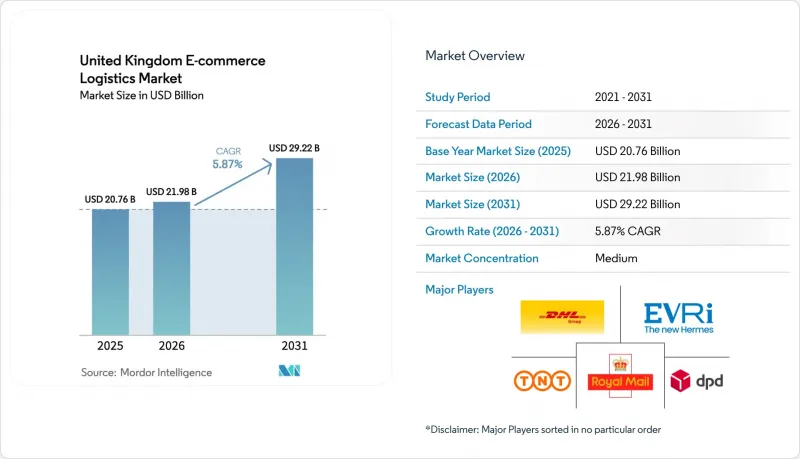
This report Segments by Service (Transportation (Road and More)), Warehousing and Fulfilment, by Business Model (B2C, B2B and More), by Destination (Domestic and More), by Delivery Speed (Same-Day and More), by Product Category (Foods and Beverages and More), by City-Tier (Tier 1 and More) and by Geography (England and More). The Market Forecasts are Provided in Terms of Value (USD).
United Kingdom E-commerce Logistics Market Trends and Insights
Expanding Same-Day and Next-Day Delivery Expectations Among UK Consumers
Same-day parcels are growing at a 9.6% CAGR through 2030, even though they involve higher route complexity and elevated cost. Tier-1 cities, which host 63% of overall parcels, provide the density needed for viable rapid services. Royal Mail has enlarged its parcel locker estate by 1,000 units since January 2025 in partnership with YEEP!, making lockers available at over 21,000 sites. The network upgrade has cut failed first-time deliveries and preserved margins. Smaller couriers struggle to match these service levels, an imbalance highlighted by the DHL-Evri tie-up that joins courier scale with premium van capacity. Vehicle innovation continues as ELM Mobility deploys GBP 25,000 (USD 33,604.8) electric quadricycles engineered for narrow city streets while still carrying full euro-pallets. Foods & beverages receive a direct boost because sub-30-minute grocery missions depend on dense, rapid fulfilment rings close to shoppers.
Post-Brexit Boom in Cross-Border EU-to-UK Fulfilment Hubs
Brexit introduced new customs checks but also incentivized EU retailers to hold local inventory in Britain. Cross-border outbound logistics now records an 8.1% CAGR, driven by UK sellers eyeing the EU's online non-food market. The New Computerized Transit System Phase 5 went live in January 2025, allowing Movement Reference Numbers to replace paper documents, a change that saves time, yet border queues for Dutch carriers still average 4 hours. Providers that erected bonded hubs near the Channel Tunnel and in Northern Ireland gain a timing edge over rivals that rely on in-line clearance. Automation suppliers report surging enquiries because complex cross-border compliance drives demand for high-throughput sortation equipment.
Chronic Driver Shortage and High Wage Inflation in UK Logistics
Carrier payrolls now compete directly with construction and utilities for scarce vocational drivers. Advertised pay has risen 21% since 2024, eroding the cost competitiveness of long-haul lanes. Some operators cut service frequency or cap distance radii to preserve margin, indirectly limiting the achievable scale of the UK e-commerce logistics market. Cross-border specialists feel the pinch most because customs paperwork requires experienced operators. Driver academies funded by large 3PLs signal a long-term solution, but near-term capacity still relies on overtime and agency labor, depressing on-time performance metrics.
Other drivers and restraints analyzed in the detailed report include:
- Rapid Growth of SME D2C Brands Leveraging Online Marketplaces
- Accelerated Warehouse Automation Adoption to Offset UK Labor Shortage
- Congested Urban Road Networks Raising Last-mile Costs
For complete list of drivers and restraints, kindly check the Table Of Contents.
Segment Analysis
Transportation services contributed 67.45% of 2025 revenue, underscoring their central role in the UK e-commerce logistics market. Road haulage remains the workhorse because it offers door-to-door reach within tight delivery windows. Rail has begun to shave costs on routes linking London St Pancras with the Channel Tunnel, encouraged by recently proposed freight rebates. Air cargo volumes eased after Royal Mail cut flights to 18 per day, yet lane rationalization improved asset utilization and cut CO2.
Value-added lines, covering labelling, kitting, and custom packaging, are pacing ahead with a 7.18% CAGR to 2031. The segment thrives on rising SME D2C orders that need branded unboxing and SKU personalization. As automation spreads, mid-cap 3PLs deploy scalable sortation systems to support these specialized flows. Those dynamic supports price premiums above general haulage and diversifies earnings profiles for carriers that once relied solely on thin-margin transport.
B2C shipping dominated with a 71.85% stake in 2025, reflecting entrenched retail platforms and omnichannel store networks that stabilize volume. Predictability allows route balancing across urban and rural drops, an essential lever for profitability.
C2C parcels, spurred by recommerce and peer-to-peer apps, are advancing at 7.36% CAGR as consumers prioritize sustainability and budget values. Logistics providers commercialize pick-up-drop-off (PUDO) solutions tailored to single-item flows, offsetting the cost of doorstep collection. B2B demand remains steady, yet digital procurement portals blur traditional boundaries, folding some B2B traffic into blended network lanes.
Complete Report Scope:
- By Service
- Transportation
- Road
- Air
- Rail
- Maritime
- Warehousing & Fulfilment
- Value-Added (Labelling, Packaging, Kitting)
- Transportation
- By Business Model
- B2C
- B2B
- C2C
- By Destination
- Domestic
- Cross-Border - Inbound
- Cross-Border - Outbound
- By Delivery Speed
- Same-day (less than 24 h)
- Next-day (24-48 h)
- Standard (3-5 days)
- Economy (more than 5 days)
- Others
- By Product Category
- Foods & Beverages
- Personal & Household Care
- Fashion & Lifestyle (accessories, apparel, footwear)
- Furniture
- Electronics & Household Appliances
- Other Products
- By City-Tier
- Tier 1
- Tier 2
- Tier 3 & Below
- By Geography
- England
- Scotland
- Wales
- Northern Ireland
List of Companies Covered in this Report:
- Royal Mail
- Evri (Hermes UK)
- DPD UK
- DHL Parcel UK
- FedEx/TNT
- UPS
- Yodel
- APC Overnight
- GXO Logistics
- Clipper Logistics
- Parcel2Go
- Agility Logistics
- Palletforce
- CitySprint
- Deliveroo HOP Logistics
- Gophr
- Whistl
- DHL Supply Chain
- Huboo Technologies
- ShipBob UK
- Stowga
- Zeus Labs
- International Distributions Services (IDS)
- Parcelforce Worldwide
Additional Benefits:
- The market estimate (ME) sheet in Excel format
- 3 months of analyst support
TABLE OF CONTENTS
1 Introduction
- 1.1 Study Assumptions & Market Definition
- 1.2 Scope of the Study
2 Research Methodology
3 Executive Summary
4 Market Landscape
- 4.1 Market Overview
- 4.2 Market Drivers
- 4.2.1 Expanding Same-Day & Next-Day Delivery Expectations Among UK Consumers
- 4.2.2 Post-Brexit Boom in Cross-border EU-to-UK Fulfilment Hubs
- 4.2.3 Rapid Growth of SME D2C Brands Leveraging Online Marketplaces
- 4.2.4 Accelerated Warehouse Automation Adoption to Offset UK Labour Shortage
- 4.2.5 Rise of Urban Micro-Fulfilment Centres in Tier-1 Cities (London, Manchester)
- 4.2.6 Retailers' Shift Toward Omnichannel Click-&-Collect Models
- 4.3 Market Restraints
- 4.3.1 Chronic Driver Shortage & High Wage Inflation in UK Logistics
- 4.3.2 Congested Urban Road Networks Raising Last-mile Costs
- 4.3.3 Heightened ESG Regulations on Delivery Emissions (UK Net-Zero 2050)
- 4.3.4 Restrictions on Warehouse Planning Permissions in South-East England
- 4.4 Value / Supply-Chain Analysis
- 4.5 Government Policies & Regulations
- 4.6 Technological Developments in the Market
- 4.7 Impact of Geopolitical Events on the Market
- 4.8 Porter's Five Forces
- 4.8.1 Bargaining Power of Suppliers
- 4.8.2 Bargaining Power of Buyers
- 4.8.3 Threat of New Entrants
- 4.8.4 Threat of Substitutes
- 4.8.5 Competitive Rivalry
5 Market Size & Growth Forecasts (Value & Volume)
- 5.1 By Service
- 5.1.1 Transportation
- 5.1.1.1 Road
- 5.1.1.2 Air
- 5.1.1.3 Rail
- 5.1.1.4 Maritime
- 5.1.2 Warehousing & Fulfilment
- 5.1.3 Value-Added (Labelling, Packaging, Kitting)
- 5.1.1 Transportation
- 5.2 By Business Model
- 5.2.1 B2C
- 5.2.2 B2B
- 5.2.3 C2C
- 5.3 By Destination
- 5.3.1 Domestic
- 5.3.2 Cross-Border - Inbound
- 5.3.3 Cross-Border - Outbound
- 5.4 By Delivery Speed
- 5.4.1 Same-day (less than 24 h)
- 5.4.2 Next-day (24-48 h)
- 5.4.3 Standard (3-5 days)
- 5.4.4 Economy (more than 5 days)
- 5.4.5 Others
- 5.5 By Product Category
- 5.5.1 Foods & Beverages
- 5.5.2 Personal & Household Care
- 5.5.3 Fashion & Lifestyle (accessories, apparel, footwear)
- 5.5.4 Furniture
- 5.5.5 Electronics & Household Appliances
- 5.5.6 Other Products
- 5.6 By City-Tier
- 5.6.1 Tier 1
- 5.6.2 Tier 2
- 5.6.3 Tier 3 & Below
- 5.7 By Geography
- 5.7.1 England
- 5.7.2 Scotland
- 5.7.3 Wales
- 5.7.4 Northern Ireland
6 Competitive Landscape
- 6.1 Market Concentration
- 6.2 Strategic Moves & Partnerships
- 6.3 Market Share Analysis
- 6.4 Company Profiles (includes Global level Overview, Market level overview, Core Segments, Financials as available, Strategic Information, Market Rank/Share for key companies, Products & Services, and Recent Developments)
- 6.4.1 Royal Mail
- 6.4.2 Evri (Hermes UK)
- 6.4.3 DPD UK
- 6.4.4 DHL Parcel UK
- 6.4.5 FedEx/TNT
- 6.4.6 UPS
- 6.4.7 Yodel
- 6.4.8 APC Overnight
- 6.4.9 GXO Logistics
- 6.4.10 Clipper Logistics
- 6.4.11 Parcel2Go
- 6.4.12 Agility Logistics
- 6.4.13 Palletforce
- 6.4.14 CitySprint
- 6.4.15 Deliveroo HOP Logistics
- 6.4.16 Gophr
- 6.4.17 Whistl
- 6.4.18 DHL Supply Chain
- 6.4.19 Huboo Technologies
- 6.4.20 ShipBob UK
- 6.4.21 Stowga
- 6.4.22 Zeus Labs
- 6.4.23 International Distributions Services (IDS)
- 6.4.24 Parcelforce Worldwide
7 Market Opportunities & Future Outlook
- 7.1 White-space & Unmet-need Assessment

