PUBLISHER: Mordor Intelligence | PRODUCT CODE: 2113269

PUBLISHER: Mordor Intelligence | PRODUCT CODE: 2113269
Italy Hair Care - Market Share Analysis, Industry Trends & Statistics, Growth Forecasts (2026 - 2031)
According to Mordor Intelligence, the Italy hair care market size was valued at USD 1.82 billion in 2025 and estimated to grow from USD 1.87 billion in 2026 to reach USD 2.15 billion by 2031, at a CAGR of 2.83% during the forecast period (2026-2031).
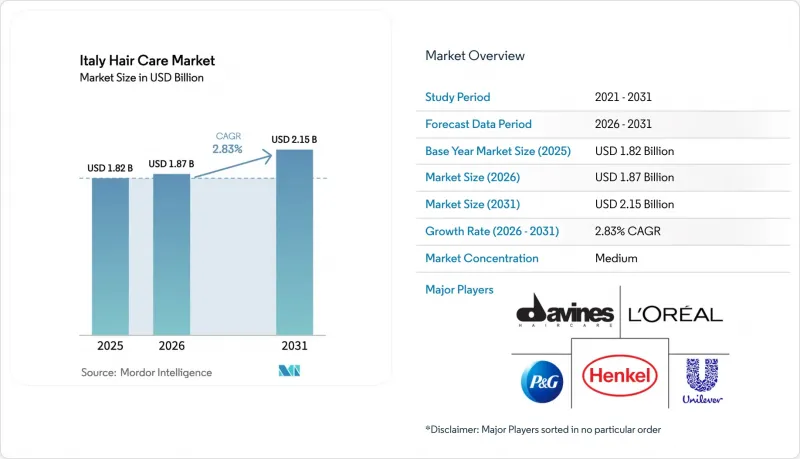
This report is Segmented by Product Type (Shampoo, Conditioner, Hair Styling Products, and More), Category (Premium and Mass), Ingredient Type (Natural/Organic and Synthetic/Conventional), and Distribution Channel (Supermarkets/Hypermarkets, Specialty Stores, and More). The Market Forecasts are Provided in Terms of Value (USD).
Italy Hair Care Market Trends and Insights
Growing awareness of hair and scalp health
Awareness about hair and scalp health is becoming a significant factor driving the growth of Italy's hair care market. Consumers are now treating their scalps with the same care as their facial skin, seeking products backed by clinical research. This trend is further supported by the high prevalence of hair loss in the country. According to the World Population Review, 44.37% of Italian men experienced male pattern baldness in 2024. This has led to a growing demand for products that address hair loss, strengthen hair, and improve scalp health. Social media platforms like Instagram and TikTok, where dermatologists share educational content, have played a major role in increasing interest in products such as microbiome-friendly shampoos, exfoliating treatments, and scalp serums. As a result, pharmacies and perfumeries in cities such as Milan and Rome are experiencing a surge in sales of these specialized products.
Ingredient-conscious consumers prefer sulfate-free, silicone-free, and low-toxicity premium hair care products
Ingredient-conscious buying is becoming a key factor driving growth in Italy's hair care market. Consumers are increasingly looking for products that are free from sulfates, silicones, and other harsh chemicals, as these are believed to promote better scalp health and long-term hair care. In response, brands are introducing cleaner and more sustainable product lines. For example, KIKO Milano launched a vegan hair care range in collaboration with stylist Rossano Ferretti in March 2024. This range focuses on natural ingredients and adheres to the Cosmetic Organic and Natural Standard certification standards, which emphasize organic and environmentally friendly formulations. The European Union Greenwashing Directive 2024/825 introduced stricter regulations on sustainability claims. This means brands must now provide clear and verified information about their ingredients and environmental impact.
Environmental packaging mandates increase compliance costs
Environmental packaging rules are becoming a significant challenge for Italy's hair care market as they increase costs and operational complexities, especially for smaller brands. The new European Union regulations require companies to use more recycled materials in their plastic packaging and ensure better traceability of these materials. This forces manufacturers to redesign their packaging, including bottles, caps, and labels, while also upgrading their production lines or partnering with specialized contract packers who can meet these stricter standards. Even brands that have already adopted refill pouches or sustainable packaging formats face high upfront costs for new equipment and the need to educate consumers about these changes. The introduction of digital product passports and QR-coded packaging adds extra expenses for IT systems and data management to monitor materials like microplastics.
Other drivers and restraints analyzed in the detailed report include:
- Consumer shift toward multifunctional and targeted hair treatments
- Increased awareness through advertising and influencer campaigns
- Regulatory constraints on formulation and claims
For complete list of drivers and restraints, kindly check the Table Of Contents.
Segment Analysis
Shampoo continued to dominate Italy's hair care market in 2025, accounting for 45.73% of the total market share. This highlights its importance as a staple product that is frequently purchased and replenished by consumers. Shampoos cater to a wide range of hair types and age groups, making them essential for use at home. The availability of options across mass-market, premium, and salon-grade categories further strengthens their position. The consistent demand for specialized variants, such as anti-dandruff, color-protect, and scalp-care shampoos, ensures steady sales growth in this segment.
Hair styling products are projected to grow at the fastest rate, with a 3.57% CAGR expected through 2031, surpassing the growth of shampoos and conditioners. This growth is driven by changing consumer preferences, as more Italians opt for heat-free styling solutions and multifunctional products, such as texture sprays and styling creams, that offer hold, shine, and protection. Social media influencers and salon professionals are playing a key role in promoting innovative styling formats such as mists, serums, and leave-in treatments. These trends are encouraging consumers to experiment with their hair care routines, leading to increased demand for premium and versatile styling products.
In 2025, mass-market hair care brands led the Italian market, contributing 79.46% of the total revenue. These brands maintain a strong presence in supermarkets, hypermarkets, and discount stores, making their products easily accessible to a wide range of consumers. Their affordability and familiarity make them popular, especially among price-sensitive households in Southern Italy and larger families. Frequent promotional campaigns and competition from private-label products help these brands maintain their dominance in terms of sales volume.
The premium hair care segment is projected to grow at a 3.85% CAGR from 2026 to 2031, surpassing the overall market growth rate. This growth is driven by increasing consumer preference for high-performance and salon-quality products. Factors such as endorsements from professionals, influencer marketing, and the convenience of online subscription services are making premium products more appealing and easier to purchase. Furthermore, private-equity investments are helping niche brands expand, particularly those focusing on scalp care, repair solutions, and sustainability. These trends are fueling the shift toward premiumization in Italy's hair care market.
Complete Report Scope:
- By Product Type
- Shampoo
- Conditioner
- Hair Colorants
- Hair Styling Products
- Others
- By Category
- Mass
- Premium
- Ingredient Type
- Natural/Organic
- Synthetic/Conventional
- By Distribution Channel
- Supermarkets/Hypermarkets
- Specialty Stores
- Online Retail Stores
- Others
List of Companies Covered in this Report:
- L'Oreal SA
- The Procter & Gamble Company
- Unilever plc
- Henkel AG & Co. KGaA
- Davines Group
- Coty Inc.
- Revlon Inc.
- Shiseido Co. Ltd.
- Kao Corp.
- Oriflame Cosmetics AG
- Alfaparf Group
- Kemon S.p.A.
- Framesi S.p.A.
- Sodalis Group
- H.S.A. Cosmetics
- Giuliani S.p.A.
- Estee Lauder Companies Inc.
- Lush Cosmetics Ltd.
- Kenvue Inc.
- Groupe Rocher
Additional Benefits:
- The market estimate (ME) sheet in Excel format
- 3 months of analyst support
TABLE OF CONTENTS
1 INTRODUCTION
- 1.1 Study Assumptions and Market Definition
- 1.2 Scope of the Study
2 RESEARCH METHODOLOGY
3 EXECUTIVE SUMMARY
4 MARKET LANDSCAPE
- 4.1 Market Overview
- 4.2 Market Drivers
- 4.2.1 Growing awareness of hair and scalp health
- 4.2.2 Ingredient-conscious consumers prefer sulfate-free, silicone-free, and low-toxicity premium hair care products
- 4.2.3 Brand collaborations with lifestyle and beauty influencers
- 4.2.4 Increased awareness through advertising and influencer campaigns
- 4.2.5 Consumer shift toward multifunctional and targeted hair treatments
- 4.2.6 Preference for premium, heritage, and "Made-in-Italy" brands
- 4.3 Market Restraints
- 4.3.1 Environmental packaging mandates increase compliance costs
- 4.3.2 Regulatory constraints on formulation and claims
- 4.3.3 Competition from counterfeit or unregulated products
- 4.3.4 Shift to DIY reducing professional channel strength
- 4.4 Value Chain Analysis
- 4.5 Regulatory Outlook
- 4.6 Consumer Behaviour Analysis
- 4.7 Porter's Five Forces
- 4.7.1 Threat of New Entrants
- 4.7.2 Bargaining Power of Buyers
- 4.7.3 Bargaining Power of Suppliers
- 4.7.4 Threat of Substitute Products
- 4.7.5 Intensity of Competitive Rivalry
5 MARKET SIZE AND GROWTH FORECASTS (VALUE)
- 5.1 By Product Type
- 5.1.1 Shampoo
- 5.1.2 Conditioner
- 5.1.3 Hair Colorants
- 5.1.4 Hair Styling Products
- 5.1.5 Others
- 5.2 By Category
- 5.2.1 Mass
- 5.2.2 Premium
- 5.3 Ingredient Type
- 5.3.1 Natural/Organic
- 5.3.2 Synthetic/Conventional
- 5.4 By Distribution Channel
- 5.4.1 Supermarkets/Hypermarkets
- 5.4.2 Specialty Stores
- 5.4.3 Online Retail Stores
- 5.4.4 Others
6 COMPETITIVE LANDSCAPE
- 6.1 Market Concentration
- 6.2 Strategic Moves
- 6.3 Market Positioning Analysis
- 6.4 Company Profiles (includes Global-level Overview, Market-level Overview, Core Segments, Financials (if available), Strategic Information, Market Rank/Share, Products and Services, Recent Developments)
- 6.4.1 L'Oreal SA
- 6.4.2 The Procter & Gamble Company
- 6.4.3 Unilever plc
- 6.4.4 Henkel AG & Co. KGaA
- 6.4.5 Davines Group
- 6.4.6 Coty Inc.
- 6.4.7 Revlon Inc.
- 6.4.8 Shiseido Co. Ltd.
- 6.4.9 Kao Corp.
- 6.4.10 Oriflame Cosmetics AG
- 6.4.11 Alfaparf Group
- 6.4.12 Kemon S.p.A.
- 6.4.13 Framesi S.p.A.
- 6.4.14 Sodalis Group
- 6.4.15 H.S.A. Cosmetics
- 6.4.16 Giuliani S.p.A.
- 6.4.17 Estee Lauder Companies Inc.
- 6.4.18 Lush Cosmetics Ltd.
- 6.4.19 Kenvue Inc.
- 6.4.20 Groupe Rocher
7 MARKET OPPORTUNITIES AND FUTURE OUTLOOK

