PUBLISHER: Mordor Intelligence | PRODUCT CODE: 2154408

PUBLISHER: Mordor Intelligence | PRODUCT CODE: 2154408
South America Hair Care - Market Share Analysis, Industry Trends & Statistics, Growth Forecasts (2026 - 2031)
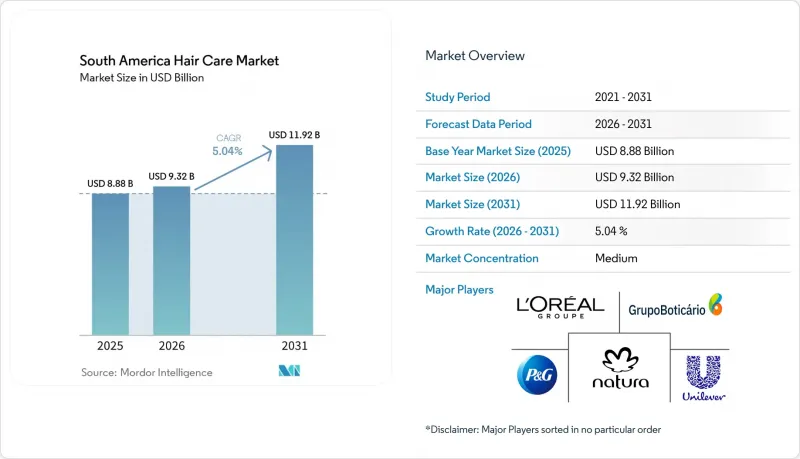
According to Mordor Intelligence, the South America hair care market was valued at USD 8.88 billion in 2025 and is projected to grow from USD 9.32 billion in 2026 to USD 11.92 billion by 2031, registering a CAGR of 5.04% during the forecast period (2026-2031).
South America Hair Care Market Trends and Insights
Growing Demand for Textured-Hair Care Solutions
South America's diverse hair textures continue to drive demand for specialized hair care products that address curl definition, moisture retention, scalp health, frizz control, and damage repair. According to 2024 data from the Instituto Brasileiro de Geografia e Estatistica (IBGE), the self-identified Black population accounted for 9.0% in Brazil's North region, 13.4% in the Northeast, 9.9% in the Central-West, 11.4% in the Southeast, and 5.3% in the South. This demographic diversity supports the growing need for formulations designed for curly, coily, and textured hair, encouraging brands to develop targeted shampoos, conditioners, masks, leave-in treatments, and styling products. Key examples include Natura Lumina's Curly Hair line, Salon Line's #todecacho range, and Lola Cosmetics' Meu Cacho Minha Vida range, which offer curl creams, conditioners, treatment masks, and styling solutions tailored to the needs of textured hair consumers.
Increasing Hair-Coloring and Chemical-Treatment Adoption
Hair coloring, smoothing, and other chemical treatments remain integral to hair-care routines across South America, particularly in key markets such as Brazil, Argentina, and Chile, where consumers increasingly seek professional-quality results at home and in salons. According to the International Monetary Fund (IMF), the region's GDP per capita reached approximately USD 11.73 thousand in 2025, supporting discretionary spending on beauty and personal care products. As purchasing power increases, consumers are allocating more of their spending to salon treatments, hair-coloring products, and specialized solutions that maintain color vibrancy, improve hydration, control frizz, and repair damage from chemical processing. This trend is expanding opportunities for hair-care brands to introduce professional-grade products through retail channels and develop targeted treatment ranges that address the evolving needs of consumers with increasingly sophisticated hair-care routines.
Counterfeit and Imitation Products
Counterfeit and imitation hair-care products constrain the South American hair-care market by diverting sales from established brands, intensifying price competition, and undermining consumer confidence in branded products. These products are often sold through informal channels and online platforms at lower prices, making them particularly appealing to price-sensitive consumers. However, counterfeit products may contain unauthorized, low-quality, or potentially harmful ingredients and frequently fail to comply with established quality, labeling, and safety regulations, posing health risks and damaging brand reputations. In July 2025, Brazil's Federal Revenue Service and Federal Police conducted Operation Queda de Dalila in Uberaba, Minas Gerais, targeting smuggled and unregistered hair-care products. The continued expansion of online retail may further complicate product authentication and enforcement efforts, increasing the need for stronger retailer oversight, supply chain traceability, and regulatory enforcement.
Other drivers and restraints analyzed in the detailed report include:
- Growing Influence of Social Media and Beauty Trends
- Expansion of Men's Hair-Care and Grooming
- Import Dependence and Currency Fluctuations
For complete list of drivers and restraints, kindly check the Table Of Contents.
Segment Analysis
Shampoo dominated the South America hair care market in 2025, accounting for 38.73% of the total market value. The segment's leadership reflects the high frequency of hair-washing routines and the essential role of shampoo in daily hair cleansing and maintenance. Demand for multifunctional formulations offering moisturizing, anti-dandruff, strengthening, and scalp-care benefits further supported segment growth. Consumers increasingly prefer shampoos tailored to specific hair textures, scalp conditions, and treatment requirements, encouraging manufacturers to expand their specialized product portfolios.
Hair styling products are expected to be the fastest-growing product type, registering a CAGR of 6.43% through 2031. Growth is driven by increasing consumer interest in products that provide styling, curl definition, volume, hold, and finishing benefits for diverse hair types. Wider product availability across supermarkets, health and beauty stores, and online retail platforms is improving accessibility and supporting adoption. Premium and specialized styling formulations, including products designed for textured hair and natural ingredients, are also expected to contribute to the segment's expansion.
Mass products accounted for 72.18% of the South American hair care market in 2025, reflecting consumers' strong preference for affordable, easily accessible hair care products. These products cater to everyday hair cleansing, conditioning, and styling needs, making them a preferred choice among a broad consumer base. Their extensive presence in supermarkets, hypermarkets, health and beauty stores, and other retail outlets supports higher product visibility and purchase convenience. Competitive pricing, frequent promotions, and a wide product assortment further reinforce the segment's leading market position.
Premium hair care products are projected to register a CAGR of 6.01% through 2031, outpacing the overall South America hair care market's growth rate. Growth in this segment is driven by rising demand for specialized formulations addressing concerns such as hair damage, scalp health, color protection, and frizz control. Consumers are also showing greater interest in products containing high-quality, natural, and advanced ingredients that offer differentiated benefits. Rising disposable incomes and a growing willingness to invest in personalized hair care solutions are expected to support premium segment expansion.
Complete Report Scope:
- By Product Type
- Shampoo
- Conditioner
- Hair Colorants
- Hair Styling Products
- Others
- By Category
- Premium Products
- Mass Products
- By Ingredient Type
- Natural and Organic
- Conventional and Synthetic
- By Distribution Channel
- Supermarkets/Hypermarkets
- Health and Beauty Stores
- Online Retail Stores
- Other Distribution Channels
- By Country
- Brazil
- Argentina
- Colombia
- Chile
- Peru
- Venezuela
- Rest of South America
List of Companies Covered in this Report:
- L'Oreal SA
- Unilever plc
- The Procter & Gamble Company
- Natura & Co
- Henkel AG & Co. KGaA
- Grupo Boticario
- Kenvue Inc.
- Coty Inc.
- Wella Company
- Davines Group
- Keune Haircosmetics
- Embelleze
- Inoar Cosmeticos
- Amend Cosmeticos
- Haskell Cosmeticos
- Bio Extratus
- Salon Brazil
- Skala Cosmeticos
- Alfaparf Milano Group
- Capilatis S.A.
Additional Benefits:
- The market estimate (ME) sheet in Excel format
- 3 months of analyst support
TABLE OF CONTENTS
1 INTRODUCTION
- 1.1 Study Assumptions and Market Definition
- 1.2 Scope of the Study
2 RESEARCH METHODOLOGY
3 EXECUTIVE SUMMARY
4 MARKET LANDSCAPE
- 4.1 Market Overview
- 4.2 Market Drivers
- 4.2.1 Rising beauty consciousness and personal grooming expenditure
- 4.2.2 Growing demand for textured-hair care solutions
- 4.2.3 Demand for multifunctional and treatment-oriented products
- 4.2.4 Expansion of men's hair-care and grooming
- 4.2.5 Growing influence of social media and beauty trends
- 4.2.6 Increasing hair-coloring and chemical-treatment adoption
- 4.3 Market Restraints
- 4.3.1 Economic volatility and fluctuating consumer purchasing power
- 4.3.2 Counterfeit and imitation products
- 4.3.3 Import dependence and currency fluctuations
- 4.3.4 Intense competition among domestic and international brands
- 4.4 Regulatory Outlook
- 4.5 Consumer Behavior Analysis
- 4.6 Porter's Five Forces
- 4.6.1 Threat of New Entrants
- 4.6.2 Bargaining Power of Buyers
- 4.6.3 Bargaining Power of Suppliers
- 4.6.4 Threat of Substitute Products
- 4.6.5 Intensity of Competitive Rivalry
5 MARKET SIZE AND GROWTH FORECASTS (VALUE)
- 5.1 By Product Type
- 5.1.1 Shampoo
- 5.1.2 Conditioner
- 5.1.3 Hair Colorants
- 5.1.4 Hair Styling Products
- 5.1.5 Others
- 5.2 By Category
- 5.2.1 Premium Products
- 5.2.2 Mass Products
- 5.3 By Ingredient Type
- 5.3.1 Natural and Organic
- 5.3.2 Conventional and Synthetic
- 5.4 By Distribution Channel
- 5.4.1 Supermarkets/Hypermarkets
- 5.4.2 Health and Beauty Stores
- 5.4.3 Online Retail Stores
- 5.4.4 Other Distribution Channels
- 5.5 By Country
- 5.5.1 Brazil
- 5.5.2 Argentina
- 5.5.3 Colombia
- 5.5.4 Chile
- 5.5.5 Peru
- 5.5.6 Venezuela
- 5.5.7 Rest of South America
6 COMPETITIVE LANDSCAPE
- 6.1 Market Concentration
- 6.2 Strategic Moves
- 6.3 Market Share Analysis
- 6.4 Company Profiles (includes Global-level Overview, Market-level Overview, Core Segments, Financials (if available), Strategic Information, Market Rank/Share, Products and Services, Recent Developments)
- 6.4.1 L'Oreal SA
- 6.4.2 Unilever plc
- 6.4.3 The Procter & Gamble Company
- 6.4.4 Natura & Co
- 6.4.5 Henkel AG & Co. KGaA
- 6.4.6 Grupo Boticario
- 6.4.7 Kenvue Inc.
- 6.4.8 Coty Inc.
- 6.4.9 Wella Company
- 6.4.10 Davines Group
- 6.4.11 Keune Haircosmetics
- 6.4.12 Embelleze
- 6.4.13 Inoar Cosmeticos
- 6.4.14 Amend Cosmeticos
- 6.4.15 Haskell Cosmeticos
- 6.4.16 Bio Extratus
- 6.4.17 Salon Brazil
- 6.4.18 Skala Cosmeticos
- 6.4.19 Alfaparf Milano Group
- 6.4.20 Capilatis S.A.
7 MARKET OPPORTUNITIES AND FUTURE OUTLOOK

