PUBLISHER: Mordor Intelligence | PRODUCT CODE: 2118151

PUBLISHER: Mordor Intelligence | PRODUCT CODE: 2118151
Indonesia Hair Care - Market Share Analysis, Industry Trends & Statistics, Growth Forecasts (2026 - 2031)
According to Mordor Intelligence, the Indonesia hair care market size was valued at USD 1.21 billion in 2025 and is estimated to grow from USD 1.28 billion in 2026 to reach USD 1.68 billion by 2031, at a CAGR of 5.92% during the forecast period (2026-2031).
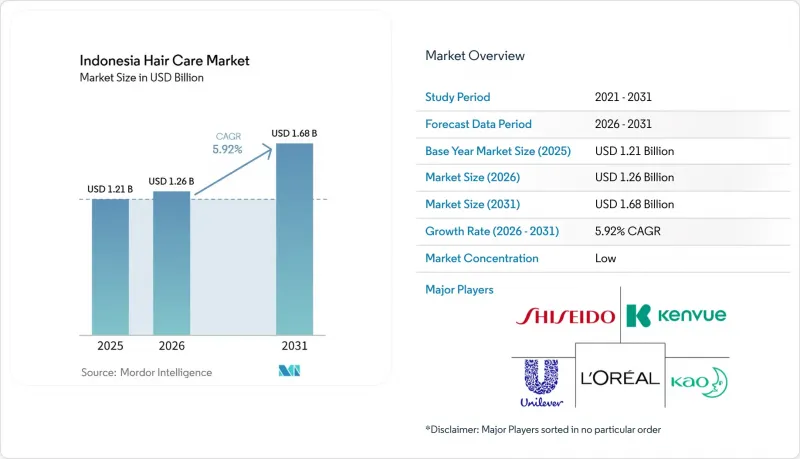
This report is Segmented by Product Type (Shampoo, Conditioner, Hair Colorants, Hair Styling Products, and Other Product Types), Category (Premium, Mass), Ingredient Type (Natural/Organic and Conventional/Synthetic), and Distribution Channel (Specialty Stores, Supermarkets/Hypermarkets, Online Retail, and Other Channels). Market Forecasts are Provided in Terms of Value (USD).
Indonesia Hair Care Market Trends and Insights
Growing Demand for Halal-Certified and Natural Ingredient-Based Hair Care Products
Cosmetics distributed in Indonesia must have halal certification by October 17, 2026, under the product assurance framework administered by BPJH. The requirement covers shampoos, conditioners, treatments, serums, and colorants sold in the country. It makes supply-chain review more important because manufacturers need to verify ingredients and production processes before a product reaches retail. Halal status is also becoming a broader trust signal for consumers who link it with ingredient safety and responsible sourcing. Domestic brands with established halal systems may move faster than importers that depend on formulas not yet adapted for Indonesia. This setting favors botanical formulations that can meet both consumer preferences and halal requirements in the Indonesia hair care market.
Expansion of Social Commerce and Digital Beauty Influencing Product Adoption
Personal grooming and hair hygiene are becoming more visible in daily consumer routines, particularly in Java and other large urban markets. Social commerce shortens the path from a product demonstration to a purchase through creator content, live selling, and affiliate links. TikTok Shop and Shopee Live are useful for scalp treatments, botanical oils, cooling products, and styling products because creators can show application and describe intended benefits. Makarizo held 11.25% of hair care platform share on Shopee Indonesia in Q1 2025, showing the ability of a local brand to gain digital visibility. This route to consumers reduces reliance on television advertising and large in-store campaigns. Brands in the Indonesia hair care market need product education, affiliate programs, and clear digital product pages alongside established retail activity.
Availability of Counterfeit and Unregistered Products
Counterfeit and unregistered cosmetics create price pressure for compliant companies in the Indonesia hair care market. ANTARA reported that authorities seized more than 2 million illegally distributed cosmetics valued at IDR 27.6 billion, equal to USD 1.7 million, in a 2025 enforcement action. The products were largely linked to unlicensed imports, which avoid the testing, registration, and compliance costs carried by established brands. In Q1 2026 surveillance, BPOM identified 11 dangerous cosmetic products, including an anti-dandruff shampoo, that contained prohibited or unsafe ingredients. Informal social selling and unverified online stores can make enforcement more difficult because products may move outside established retail controls. Stronger enforcement before the October 2026 deadline can improve formalization, but informal channels will remain a challenge in price-sensitive areas.
Other drivers and restraints analyzed in the detailed report include:
- Rising Demand for Hair Care Products Tailored to Hijab Wearers and Tropical Climate Conditions
- Premiumization Driven by Demand for Scalp Care and Hair Repair Solutions
- Distribution Challenges Across Indonesia's Archipelago
For complete list of drivers and restraints, kindly check the Table Of Contents.
Segment Analysis
Shampoo held 43.81% of the Indonesia hair care market in 2025, making it the category's main volume base across income groups. Frequent household use supports repeat purchases and makes shampoo the usual entry point to a broader routine. Single-use sachets remain important for consumers who prefer low out-of-pocket spending per purchase. Conditioner has lower penetration than shampoo, which gives brands an opportunity to explain its role in post-wash care. This may be relevant for consumers who experience friction-related hair damage from head coverings or daily styling.
Hair styling products are projected to grow at an 8.02% CAGR through 2031, the fastest rate among product types. Urban consumers are adding setting, smoothing, finishing, and heat-protection steps after basic cleansing. Short product videos and styling tutorials help build demand for waxes, serums, and similar products. Other products, such as hair tonics, scalp treatments, and hair vitamins, are increasingly presented as preventive care rather than only therapeutic remedies. Companies that link shampoo with a complementary treatment or styling product can increase the value of the consumer basket in the Indonesia hair care market.
The mass segment accounted for more than 85% of the Indonesia hair care market size in 2025, supported by sachet formats and broad availability in rural and semi-urban locations. Price per use remains central for many mass consumers, particularly where routine products are purchased frequently. Mass brands can protect volume by maintaining small pack sizes and dependable traditional trade distribution. At the same time, halal certification and botanical ingredient narratives can make accessible products appear more credible without moving them beyond mass price points. This has narrowed the perceived distance between some local mass brands and imported premium alternatives.
Premium products are forecast to grow at a 7.62% CAGR through 2031 as consumers pay more for scalp care, ingredient transparency, and product claims linked with repair. Digital-native millennials and Gen Z consumers often compare local products with Korean and Japanese beauty standards before making purchases. Affiliate creators and online reviews can validate a premium purchase before a consumer tries a product. Several local companies sell premium stock-keeping units online while retaining mass sachet lines in traditional trade. This dual approach helps the Indonesia hair care market serve urban margin opportunities without giving up rural volume.
Complete Report Scope:
- By Product Type
- Shampoo
- Conditioner
- Hair Colorants
- Hair Styling Products
- Other Product Types
- By Category
- Premium Products
- Mass Products
- By Ingredient Type
- Natural and Organic
- Conventional / Synthetic
- By Distribution Channel
- Specialty Stores
- Supermarkets / Hypermarkets
- Online Retail Stores
- Other Channels
List of Companies Covered in this Report:
- Kao Corporation
- Procter & Gamble Co.
- Unilever Plc
- Kenvue
- L'Oreal SA
- Shiseido Company, Limited
- Henkel AG & Co. KGaA (Schwarzkopf Professional)
- Mandom Corporation
- PT Kino Indonesia Tbk
- PT Paragon Technology and Innovation
- PT Mustika Ratu Tbk
- PT Martina Berto Tbk
- PT Gondowangi Tradisional Kosmetika
- PT Victoria Care Indonesia Tbk
- PT Lion Wings
- Lion Corporation
- Unicharm Corporation
- Wella Company
- Wings Group
- Paragon Technology & Innovation
Additional Benefits:
- The market estimate (ME) sheet in Excel format
- 3 months of analyst support
TABLE OF CONTENTS
1 INTRODUCTION
- 1.1 Study Assumptions and Market Definition
- 1.2 Scope of the Study
2 RESEARCH METHODOLOGY
3 EXECUTIVE SUMMARY
4 MARKET LANDSCAPE
- 4.1 Market Overview
- 4.2 Market Drivers
- 4.2.1 Increasing Consumer Awareness of Personal Grooming and Hair Hygiene
- 4.2.2 Growing Demand for Halal-Certified and Natural Ingredient-Based Hair Care Products
- 4.2.3 Expansion of Social Commerce and Digital Beauty Influencing Product Adoption
- 4.2.4 Premiumization Driven by Demand for Scalp Care and Hair Repair Solutions
- 4.2.5 Rising Demand for Hair Care Products Tailored to Hijab Wearers and Tropical Climate Conditions
- 4.2.6 Growing Utilization of Indigenous Botanical Ingredients to Differentiate Hair Care Formulations
- 4.3 Market Restraints
- 4.3.1 Availability of Counterfeit and Unregistered Products
- 4.3.2 Increasing Regulatory Compliance Requirements
- 4.3.3 Distribution Challenges Across Indonesia's Archipelago
- 4.3.4 Competition from Traditional Homemade Hair Treatments
- 4.4 Consumer Behavior Analysis
- 4.5 Regulatory Landscape
- 4.6 Technological Outlook
- 4.7 Porter's Five Forces
- 4.7.1 Threat of New Entrants
- 4.7.2 Bargaining Power of Buyers/Consumers
- 4.7.3 Bargaining Power of Suppliers
- 4.7.4 Threat of Substitute Products
- 4.7.5 Intensity of Competitive Rivalry
5 MARKET SIZE AND GROWTH FORECASTS (VALUE)
- 5.1 By Product Type
- 5.1.1 Shampoo
- 5.1.2 Conditioner
- 5.1.3 Hair Colorants
- 5.1.4 Hair Styling Products
- 5.1.5 Other Product Types
- 5.2 By Category
- 5.2.1 Premium Products
- 5.2.2 Mass Products
- 5.3 By Ingredient Type
- 5.3.1 Natural and Organic
- 5.3.2 Conventional / Synthetic
- 5.4 By Distribution Channel
- 5.4.1 Specialty Stores
- 5.4.2 Supermarkets / Hypermarkets
- 5.4.3 Online Retail Stores
- 5.4.4 Other Channels
6 COMPETITIVE LANDSCAPE
- 6.1 Market Concentration
- 6.2 Strategic Moves
- 6.3 Market Ranking Analysis
- 6.4 Company Profiles (includes Global level Overview, Market level overview, Core Segments, Financials as available, Strategic Information, Market Rank/Share for key companies, Products & Services, and Recent Developments)
- 6.4.1 Kao Corporation
- 6.4.2 Procter & Gamble Co.
- 6.4.3 Unilever Plc
- 6.4.4 Kenvue
- 6.4.5 L'Oreal SA
- 6.4.6 Shiseido Company, Limited
- 6.4.7 Henkel AG & Co. KGaA (Schwarzkopf Professional)
- 6.4.8 Mandom Corporation
- 6.4.9 PT Kino Indonesia Tbk
- 6.4.10 PT Paragon Technology and Innovation
- 6.4.11 PT Mustika Ratu Tbk
- 6.4.12 PT Martina Berto Tbk
- 6.4.13 PT Gondowangi Tradisional Kosmetika
- 6.4.14 PT Victoria Care Indonesia Tbk
- 6.4.15 PT Lion Wings
- 6.4.16 Lion Corporation
- 6.4.17 Unicharm Corporation
- 6.4.18 Wella Company
- 6.4.19 Wings Group
- 6.4.20 Paragon Technology & Innovation
7 MARKET OPPORTUNITIES AND FUTURE OUTLOOK

