PUBLISHER: Mordor Intelligence | PRODUCT CODE: 2121450

PUBLISHER: Mordor Intelligence | PRODUCT CODE: 2121450
United Kingdom Hair Care - Market Share Analysis, Industry Trends & Statistics, Growth Forecasts (2026 - 2031)
According to Mordor Intelligence, the United Kingdom hair care market size is projected to be USD 2.52 billion in 2025, USD 2.66 billion in 2026, and reach USD 3.21 billion by 2031, growing at a CAGR of 3.83% from 2026 to 2031.
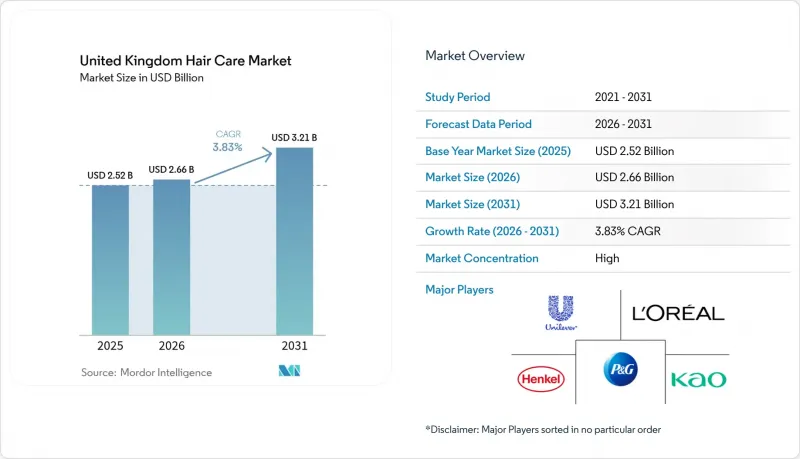
This report is Segmented by Product Type (Shampoo, Conditioner, Hair Colorants, Hair Styling Products, Other Product Types), Category (Premium Products, Mass Products), Ingredient Type (Natural and Organic, Conventional/Synthetic), and Distribution Channel (Specialty Stores, Supermarkets/Hypermarkets, Online Retail Stores, Other Channels). The Market Forecasts are Provided in Terms of Value (USD).
United Kingdom Hair Care Market Trends and Insights
Consumers' inclination toward natural and organic products
United Kingdom consumers are shifting their spending toward natural-origin formulations, surpassing broader European trends. This change is primarily driven by increasing skepticism toward traditional synthetic ingredients and a preference for transparent supply chains. The Soil Association's Organic Market Report 2025 highlights that organic beauty and personal-care sales in the UK reached GBP 151 million, reflecting an 11 percent year-on-year growth. Hair-care products, in particular, are gaining momentum as brands reformulate to comply with COSMOS certification standards. This intersection of consumer demand and sustainable sourcing is revolutionizing ingredient procurement. Leading brands are investing in fermentation platforms to ensure supply and support clean-beauty claims, while avoiding the land-use and deforestation issues linked to botanical extraction. In the UK, the lack of a legal definition for "natural" in cosmetics regulation compels brands to depend on third-party certifications such as COSMOS, Soil Association Organic, or B Corp. This approach not only strengthens compliance but also provides a marketing advantage for certified brands, while exposing uncertified ones to potential greenwashing allegations.
Increased awareness of pollution and UV damage drives demand for protective hair care products
Urban pollution and increased UV exposure are driving significant demand for hair-care products that protect the cuticle and scalp from oxidative stress. This segment, which was almost non-existent a decade ago, now occupies premium shelf space and features dedicated product lines. In October 2024, the UK's Scientific Advisory Group on Chemical Safety (SAG-CS) issued Opinion 14, approving benzophenone-3 as a UV filter. Brands can now use it at concentrations of up to 2.2 percent for full-body applications and up to 6 percent in products for the face, hands, and lips. This decision provides regulatory clarity for brands looking to incorporate UV filters into leave-on hair treatments and scalp serums. However, challenges remain: the UK's Cosmetic Products Regulation 2026 will ban Enzacamene, another UV filter, starting July 15, 2026. This will require reformulation for any products still relying on that molecule. The strategic takeaway is clear: brands that adopt next-generation UV-defense technologies, such as antioxidant complexes, film-forming polymers, and approved UV filters, are poised to capture market share in the protective hair-care segment. Conversely, those slow to reformulate risk delisting or regulatory penalties. Reflecting the urgency, public sector spending on pollution abatement in the UK rose from GBP 761 million in 2024 to GBP 1,357 million in 2025, highlighting growing pollution concerns and the resulting demand for protective hair-care products.
Health concerns over legacy chemical ingredients
Consumer and regulatory scrutiny of synthetic preservatives, UV filters, and colorants is driving reformulation cycles that disrupt product portfolios and place pressure on research and development budgets. Beginning in July and August 2026, the UK's Cosmetic Products Regulation 2026 will enforce significant bans. Enzacamene, along with 16 other substances classified as carcinogenic, mutagenic, or reprotoxic, will be prohibited. This includes trimethylbenzoyl diphenylphosphine oxide (TPO), widely used in nail products, and tetrabromobisphenol-A, a flame retardant. Furthermore, the regulation will lower the formaldehyde-release labeling threshold from 0.05 percent to 0.001 percent. These changes follow the January 2025 implementation of restrictions on 64 CMR substances and kojic acid under UK SI 2024/1334. While kojic acid was banned in hair-care products, it remains permitted at 1 percent in facial and hand formulations. These cumulative regulations are reducing the pool of approved ingredients and driving up formulation costs. Brands are now required to conduct new safety assessments, stability tests, and clinical trials to validate reformulated products. Multinational brands operating across both the UK and EU markets face additional challenges due to regulatory divergence. The EU implemented bans on certain substances earlier, while the UK's phased approach, which includes transitional sell-through periods, demands parallel SKU management and dual labeling. Smaller brands and contract manufacturers are disproportionately burdened, as they often lack in-house toxicology expertise and regulatory-affairs teams to navigate these changes. This dynamic is driving consolidation in the market, favoring larger, well-resourced players.
Other drivers and restraints analyzed in the detailed report include:
- Rising influence of social media and celebrity endorsement
- Growing demand for personalized/ai-driven hair-care solutions
- Proliferation of counterfeit and grey-market products
For complete list of drivers and restraints, kindly check the Table Of Contents.
Segment Analysis
In 2025, shampoo held a significant 24.26% share of the UK's hair care market. This dominance was primarily attributed to its high purchase frequency and the introduction of bond-repair innovations, which transitioned from exclusive salon offerings to widely available mass-market products. On the other hand, the UK's market for hair styling products is anticipated to expand at a robust 5.1% CAGR during the forecast period of 2026 to 2031. This growth is driven by the increasing adoption of multi-step hair care routines, which prominently feature products like heat protectants and texturizing sprays. Henkel, in 2024, reported notable organic sales growth, largely propelled by the rising demand for styling products.
Consumers are demonstrating a growing willingness to allocate a larger portion of their spending to styling products, motivated by the desire to achieve salon-quality results in the comfort of their homes. Additionally, the emergence of leave-in hybrid products is blurring the lines between hair treatments and styling solutions, offering dual benefits. In 2025, Tesco listed an extensive range of over 1,600 hair SKUs, with pricing data indicating that styling creams achieved profit margins 2-3 times higher than those of shampoos. This substantial margin potential is attracting investments from both mass-market and premium brands, underscoring the likelihood that the styling segment will remain a key driver of incremental revenue growth within the hair care sector.
In 2025, mass lines held a commanding 71.65% share of the UK hair care market, driven by the robust performance of supermarket own-label products and the preferences of price-conscious consumers. However, the premium segment is anticipated to grow at a notable 5.7% CAGR through 2031. This growth is attributed to a shift in consumer behavior, where individuals are increasingly focusing on purchasing effective "hero" products that deliver tangible results, rather than diversifying their shopping baskets. Social commerce is now playing a pivotal role in directing consumer traffic straight to brand websites and specialized e-tailers, effectively bypassing the traditionally price-driven supermarket aisles.
Premium brands are distinguishing themselves in the market by forming strategic partnerships with dermatologists, utilizing AI-powered diagnostic tools, and introducing refillable product ecosystems. These initiatives not only enhance the consumer experience but also justify the higher price points of GBP 20-60. Furthermore, subscription-based models and exclusive collaborations with retailers are helping these brands safeguard their profit margins. In contrast, mass-market brands are facing challenges such as promotional fatigue and rising raw material costs. To address these issues and defend their market share, these brands are focusing on innovation by incorporating multiple benefits, such as bond repair, scalp health, and appealing fragrances, into products priced under GBP 10, aiming to sustain their sales volumes.
Complete Report Scope:
- By Product Type
- Shampoo
- Conditioner
- Hair Colorants
- Hair Styling Products
- Other Product Types
- By Category
- Premium Products
- Mass Products
- By Ingredient Type
- Natural and Organic
- Conventional/Synthetic
- By Distribution Channel
- Specialty Stores
- Supermarkets/Hypermarkets
- Online Retail Stores
- Other Channels
List of Companies Covered in this Report:
- LOreal SA
- Unilever plc
- The Procter and Gamble Company
- Henkel AG and Co. KGaA
- Kao Corporation
- Wella Company
- Faith In Nature
- PDC Brands
- Kenvue Inc.
- Moroccanoil
- The Estee Lauder Companies Inc.
- John Paul Mitchell Systems Inc.
- Revlon Inc.
- Davines S.p.A.
- Philip Kingsley Products Ltd.
- Olaplex Holdings Inc.
- Straand Pty Ltd.
- Federici Brands Ltd.
- KMI Brands Limited
- Dabur Limited
Additional Benefits:
- The market estimate (ME) sheet in Excel format
- 3 months of analyst support
TABLE OF CONTENTS
1 INTRODUCTION
- 1.1 Study Assumptions and Market Definition
- 1.2 Scope of the Study
2 RESEARCH METHODOLOGY
3 EXECUTIVE SUMMARY
4 MARKET LANDSCAPE
- 4.1 Market Overview
- 4.2 Market Drivers
- 4.2.1 Consumers' inclination toward natural and organic products
- 4.2.2 Increased awareness of pollution and Ultraviolet damage drives demand for protective hair care products
- 4.2.3 Rising influence of social media and celebrity endorsement
- 4.2.4 Growing demand for personalised/AI-driven hair-care solutions
- 4.2.5 Water-scarcity push toward waterless and solid formats
- 4.2.6 Breakthrough scalp-microbiome actives spur new product lines
- 4.3 Market Restraints
- 4.3.1 Health concerns over legacy chemical ingredients
- 4.3.2 Proliferation of counterfeit and grey-market products
- 4.3.3 Stringent regulations on cosmetic ingredients
- 4.3.4 Supply-chain shocks for key botanicals (argan, jojoba, etc.)
- 4.4 Consumer Behaviour Analysis
- 4.5 Regulatory Outlook
- 4.6 Porter's Five Forces
- 4.6.1 Bargaining Power of Suppliers
- 4.6.2 Bargaining Power of Buyers
- 4.6.3 Threat of New Entrants
- 4.6.4 Threat of Substitutes
- 4.6.5 Degree of Competition
5 MARKET SIZE AND GROWTH FORECASTS (VALUE)
- 5.1 By Product Type
- 5.1.1 Shampoo
- 5.1.2 Conditioner
- 5.1.3 Hair Colorants
- 5.1.4 Hair Styling Products
- 5.1.5 Other Product Types
- 5.2 By Category
- 5.2.1 Premium Products
- 5.2.2 Mass Products
- 5.3 By Ingredient Type
- 5.3.1 Natural and Organic
- 5.3.2 Conventional/Synthetic
- 5.4 By Distribution Channel
- 5.4.1 Specialty Stores
- 5.4.2 Supermarkets/Hypermarkets
- 5.4.3 Online Retail Stores
- 5.4.4 Other Channels
6 COMPETITIVE LANDSCAPE
- 6.1 Market Concentration
- 6.2 Strategic Moves
- 6.3 Market Share Analysis
- 6.4 Company Profiles (includes Global level Overview, Market level overview, Core Segments, Financials as available, Strategic Information, Market Rank/Share for key companies, Products and Services, and Recent Developments)
- 6.4.1 LOreal SA
- 6.4.2 Unilever plc
- 6.4.3 The Procter and Gamble Company
- 6.4.4 Henkel AG and Co. KGaA
- 6.4.5 Kao Corporation
- 6.4.6 Wella Company
- 6.4.7 Faith In Nature
- 6.4.8 PDC Brands
- 6.4.9 Kenvue Inc.
- 6.4.10 Moroccanoil
- 6.4.11 The Estee Lauder Companies Inc.
- 6.4.12 John Paul Mitchell Systems Inc.
- 6.4.13 Revlon Inc.
- 6.4.14 Davines S.p.A.
- 6.4.15 Philip Kingsley Products Ltd.
- 6.4.16 Olaplex Holdings Inc.
- 6.4.17 Straand Pty Ltd.
- 6.4.18 Federici Brands Ltd.
- 6.4.19 KMI Brands Limited
- 6.4.20 Dabur Limited
7 MARKET OPPORTUNITIES AND FUTURE OUTLOOK

