PUBLISHER: Mordor Intelligence | PRODUCT CODE: 2113300

PUBLISHER: Mordor Intelligence | PRODUCT CODE: 2113300
Laundry Appliances - Market Share Analysis, Industry Trends & Statistics, Growth Forecasts (2026 - 2031)
According to Mordor Intelligence, the laundry appliances market size is expected to grow from USD 38.40 billion in 2025 to USD 41.43 billion in 2026 and is forecast to reach USD 60.58 billion by 2031 at 7.88% CAGR over 2026-2031.
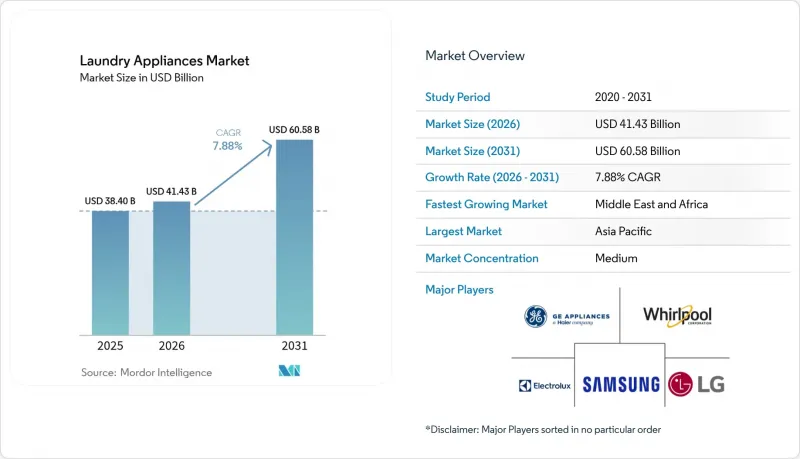
This report is Segmented by Product Type (Stand-Alone Washing Machines, Stand-Alone Drying Machines/Dryers, Combined Washer-Dryers), Loading Type (Front-Load, Top-Load), Capacity (Below 6 Kg, 6-8 Kg, Above 8 Kg), Usage (Residential, Commercial), Distribution Channel (B2B/Direct, B2C/Retail), and Geography (North America, and Other). The Market Forecasts are Provided in Terms of Value (USD).
Global Laundry Appliances Market Trends and Insights
Rising Urban Middle-Class Disposable Income
Disposable income growth in emerging economies drives first-time appliance purchases, especially in India, where washing-appliance revenue is set to jump significantly. As households transition from manual to automated washing, time savings enable additional wage-earning activities, reinforcing a virtuous spending cycle that accelerates laundry appliances market penetration. In China, domestic washing-machine sales reached 40.05 million units in 2023, a 3.4% rise year-over-year despite market maturity. African economies present the broadest white-space opportunity: imports of major home appliances totaled USD 3 billion against exports of USD 330 million, spotlighting scope for local assembly and after-sales networks. Urban density boosts collective demand for compact, high-capacity, and energy-efficient models that fit smaller living spaces common in megacities.
Proliferation of Energy-Efficient Inverter Motors
Advanced inverter motors cut electricity usage by up to 40% versus conventional alternatives, aligning with the EU ecodesign rule that bans non-heat-pump dryers from July 2025 to save 15 TWh of energy and slash 1.7 Mt CO2e by 2040. Appliances makers leverage this tailwind by positioning higher-margin SKUs with built-in AI energy modes, as seen in Samsung's Bespoke AI washer that achieves 20% additional savings. Adoption cascades from premium to mass segments, expanding inverter penetration to mid-tier top-load models across Asia-Pacific and Latin America. Emerging regulatory replicas in Australia and Canada hint at global standardization that cements energy efficiency as an indispensable buying criterion. Concurrently, reduced operating costs shorten payback periods, nurturing replacement demand even in price-sensitive markets.
Volatile Raw-Material Prices
Steel and plastic account for roughly half of manufacturing cost, so the 18.8% hike that pushed average washing-machine prices from USD 800 to USD 950 between 2024 and 2025 reduced gross margins until hedging strategies caught up. Producers respond by forward-buying, dual-sourcing, and redesigning chassis to use less metal without sacrificing durability. Hurricane disruptions to high-purity quartz supply chains highlight vulnerabilities that inflate semiconductor prices, raising BOM costs for smart models that integrate multiple chips. While vertical integration shields some risk, inventory buffers strain working capital and threaten profitability in weaker demand cycles. Continuous cost pressure also hastens adoption of recyclable plastics and alternative alloys that balance sustainability goals with economic imperatives.
Other drivers and restraints analyzed in the detailed report include:
- E-Commerce Penetration in White-Goods Retail
- Government Subsidies for High-Efficiency Appliances
- Grid-Electricity Shortages in Emerging Nations
For complete list of drivers and restraints, kindly check the Table Of Contents.
Segment Analysis
Combined washer-dryers accounted for a modest slice of 2025 volume yet are expanding at a 10.18% CAGR through 2031, reflecting consumer pursuit of space savings in compact urban dwellings that dominate new housing stock across Asia-Pacific and Europe. The laundry appliances market size for combination units benefits from premium price positioning and accessory revenue such as stacking kits and smart-detergent dispensers. Stand-alone washers retain 62.70% share thanks to established brand loyalty and price competitiveness, but their growth matures as saturation rises in developed economies. Advanced combo models like Samsung's Bespoke AI Laundry Vented Combo wash and dry a full load in 68 minutes, leveraging heat-pump technology to trim energy use by 75%. Brand rivalry between LG and Samsung intensifies around cycle speed and AI-driven fabric care, signaling sustained innovation pace that bolsters replacement demand. Stand-alone dryers lag where outdoor line-drying traditions prevail, though policy shifts favoring energy-efficient dryers gradually expand their addressable base.
Front-load washers captured 56.85% of 2025 shipments and exhibit a superior 8.98% CAGR, supported by regulatory promotion of water and energy savings. These units use 40% less water per cycle versus top-load models, aligning with municipal conservation targets in drought-prone regions. The laundry appliances market share for top-load models remains sizeable at 43.15% amid North American consumer preference for ergonomic loading and faster cycles. Appliance makers counterbalance by adopting AI Wash routines, self-clean basins, and vibration-damping tech that narrow performance gaps. Hybrid vertical-axis designs featuring impeller plates rather than agitator posts illustrate incremental evolution rather than outright displacement, preserving brand equity among traditionalist buyers. Front-load premiumization opens ancillary revenue for pedestal storage bases and smart dosing accessories that elevate ticket value.
Complete Report Scope:
- By Product Type
- Stand-alone Washing Machines
- Stand-alone Drying Machines/Dryers
- Combined Washer-Dryers
- By Loading Type
- Front-Load
- Top-Load
- By Capacity
- Below 6 Kg
- 6 - 8 Kg
- Above 8 Kg
- By Usage
- Residential
- Commercial (laundromats, hospitals, hotels, hostels, etc.)
- By Distribution Channel
- B2B / Direct from Manufacturers
- B2C / Retail Consumers
- By Geography
- North America
- Canada
- United States
- Mexico
- South America
- Brazil
- Peru
- Chile
- Argentina
- Rest of South America
- Europe
- United Kingdom
- Germany
- France
- Spain
- Italy
- BENELUX (Belgium, Netherlands, Luxembourg)
- NORDICS (Denmark, Finland, Iceland, Norway, Sweden)
- Rest of Europe
- Asia-Pacific
- India
- China
- Japan
- Australia
- South Korea
- South-East Asia (Singapore, Malaysia, Thailand, Indonesia, Vietnam, Philippines)
- Rest of Asia-Pacific
- Middle East and Africa
- United Arab Emirates
- Saudi Arabia
- South Africa
- Nigeria
- Rest of Middle East and Africa
- North America
Geography Analysis
Asia-Pacific retained 42.95% global share in 2025 as China produced 79.958 million washers, a 16.4% year-on-year surge that cements the region as both a manufacturing super-cluster and consumption juggernaut. India forecasts an 11% CAGR across the broader consumer-durables basket through FY29, supported by government import-duty relief on energy-efficient appliances. The laundry appliances market size in these two economies benefits from urbanization, rising middle-income cohorts, and female labor-force participation that values time-saving devices. Europe, accounting for a 24.30% share, skews toward premium models as the July 2025 ecodesign dryer mandate eradicates inefficient SKUs and catalyzes replacement demand. Consolidation, such as the Whirlpool-Arcelik merger forming Beko Europe, evidences strategic scaling to meet regulatory complexity and product-mix shifts. North America's replacement-driven market remains resilient, buoyed by smart-appliance adoption and robust home-improvement activity; Home Depot's record Q4 2024 appliance sales underscore these dynamics. The Middle East & Africa segment, though currently small, posts the fastest 6.32% CAGR, spurred by urban infrastructure investment and rising electrification. Haier's acquisition of Electrolux's South Africa water-heater business signals confidence in African expansion, mirroring its double-digit revenue gains across MEA for three consecutive years. South America sees moderate but volatile growth amid currency swings, yet megacity redevelopment keeps baseline demand intact.
- Whirlpool Corporation
- Haier Smart Home Co. Ltd. (incl. GE Appliances)
- LG Electronics Inc.
- Samsung Electronics Co. Ltd.
- AB Electrolux
- Panasonic Corporation
- BSH Hausgerate GmbH (Bosch & Siemens)
- Midea Group Co. Ltd.
- Alliance Laundry Systems LLC
- Arcelik A.?. (Beko)
- IFB Industries Ltd.
- Godrej Appliances
- Sharp Corporation
- Fisher & Paykel Appliances
- TCL Technology Group Corp.
- Hisense Home Appliances Group
- Vestel Elektronik
- Glen Dimplex Home Appliances
- SMEG S.p.A.
- Speed Queen (brand)
Additional Benefits:
- The market estimate (ME) sheet in Excel format
- 3 months of analyst support
TABLE OF CONTENTS
1 Introduction
- 1.1 Study Assumptions & Market Definition
- 1.2 Scope of the Study
2 Research Methodology
3 Executive Summary
4 Market Landscape
- 4.1 Market Overview
- 4.2 Market Drivers
- 4.2.1 Rising urban middle-class disposable income
- 4.2.2 Proliferation of energy-efficient inverter motors
- 4.2.3 E-commerce penetration in white-goods retail
- 4.2.4 Government subsidies for high-efficiency appliances
- 4.2.5 On-premise laundry demand from co-living spaces
- 4.2.6 AI-powered predictive-maintenance features
- 4.3 Market Restraints
- 4.3.1 Volatile raw-material (steel & plastics) prices
- 4.3.2 Grid-electricity shortages in emerging nations
- 4.3.3 Maturity & replacement cycle length in OECD
- 4.3.4 Consumer data-privacy concerns in smart devices
- 4.4 Value / Supply-Chain Analysis
- 4.5 Technological Outlook
- 4.6 Regulatory Landscape
- 4.7 Porter's Five Forces
- 4.7.1 Threat of New Entrants
- 4.7.2 Bargaining Power of Suppliers
- 4.7.3 Bargaining Power of Buyers
- 4.7.4 Threat of Substitute Products
- 4.7.5 Competitive Rivalry
5 Market Size & Growth Forecasts
- 5.1 By Product Type
- 5.1.1 Stand-alone Washing Machines
- 5.1.2 Stand-alone Drying Machines/Dryers
- 5.1.3 Combined Washer-Dryers
- 5.2 By Loading Type
- 5.2.1 Front-Load
- 5.2.2 Top-Load
- 5.3 By Capacity
- 5.3.1 Below 6 Kg
- 5.3.2 6 - 8 Kg
- 5.3.3 Above 8 Kg
- 5.4 By Usage
- 5.4.1 Residential
- 5.4.2 Commercial (laundromats, hospitals, hotels, hostels, etc.)
- 5.5 By Distribution Channel
- 5.5.1 B2B / Direct from Manufacturers
- 5.5.2 B2C / Retail Consumers
- 5.6 By Geography
- 5.6.1 North America
- 5.6.1.1 Canada
- 5.6.1.2 United States
- 5.6.1.3 Mexico
- 5.6.2 South America
- 5.6.2.1 Brazil
- 5.6.2.2 Peru
- 5.6.2.3 Chile
- 5.6.2.4 Argentina
- 5.6.2.5 Rest of South America
- 5.6.3 Europe
- 5.6.3.1 United Kingdom
- 5.6.3.2 Germany
- 5.6.3.3 France
- 5.6.3.4 Spain
- 5.6.3.5 Italy
- 5.6.3.6 BENELUX (Belgium, Netherlands, Luxembourg)
- 5.6.3.7 NORDICS (Denmark, Finland, Iceland, Norway, Sweden)
- 5.6.3.8 Rest of Europe
- 5.6.4 Asia-Pacific
- 5.6.4.1 India
- 5.6.4.2 China
- 5.6.4.3 Japan
- 5.6.4.4 Australia
- 5.6.4.5 South Korea
- 5.6.4.6 South-East Asia (Singapore, Malaysia, Thailand, Indonesia, Vietnam, Philippines)
- 5.6.4.7 Rest of Asia-Pacific
- 5.6.5 Middle East and Africa
- 5.6.5.1 United Arab Emirates
- 5.6.5.2 Saudi Arabia
- 5.6.5.3 South Africa
- 5.6.5.4 Nigeria
- 5.6.5.5 Rest of Middle East and Africa
- 5.6.1 North America
6 Competitive Landscape
- 6.1 Market Concentration
- 6.2 Strategic Moves
- 6.3 Market Share Analysis
- 6.4 Company Profiles (includes Global level Overview, Market level overview, Core Segments, Financials as available, Strategic Information, Market Rank/Share for key companies, Products & Services, and Recent Developments)
- 6.4.1 Whirlpool Corporation
- 6.4.2 Haier Smart Home Co. Ltd. (incl. GE Appliances)
- 6.4.3 LG Electronics Inc.
- 6.4.4 Samsung Electronics Co. Ltd.
- 6.4.5 AB Electrolux
- 6.4.6 Panasonic Corporation
- 6.4.7 BSH Hausgerate GmbH (Bosch & Siemens)
- 6.4.8 Midea Group Co. Ltd.
- 6.4.9 Alliance Laundry Systems LLC
- 6.4.10 Arcelik A.?. (Beko)
- 6.4.11 IFB Industries Ltd.
- 6.4.12 Godrej Appliances
- 6.4.13 Sharp Corporation
- 6.4.14 Fisher & Paykel Appliances
- 6.4.15 TCL Technology Group Corp.
- 6.4.16 Hisense Home Appliances Group
- 6.4.17 Vestel Elektronik
- 6.4.18 Glen Dimplex Home Appliances
- 6.4.19 SMEG S.p.A.
- 6.4.20 Speed Queen (brand)
7 Market Opportunities & Future Outlook
- 7.1 Subscription-based, IoT-enabled "Laundry-as-a-Service" for coin-less commercial laundromats
- 7.2 Heat-pump dryer technology commercialization to meet Net-Zero building codes in EU & California

