PUBLISHER: Mordor Intelligence | PRODUCT CODE: 2123092

PUBLISHER: Mordor Intelligence | PRODUCT CODE: 2123092
Residential Washing Machine - Market Share Analysis, Industry Trends & Statistics, Growth Forecasts (2026 - 2031)
According to Mordor Intelligence, residential washing machine market size in 2026 is estimated at USD 49.29 billion, growing from 2025 value of USD 46.99 billion with 2031 projections showing USD 62.55 billion, growing at 4.89% CAGR over 2026-2031.
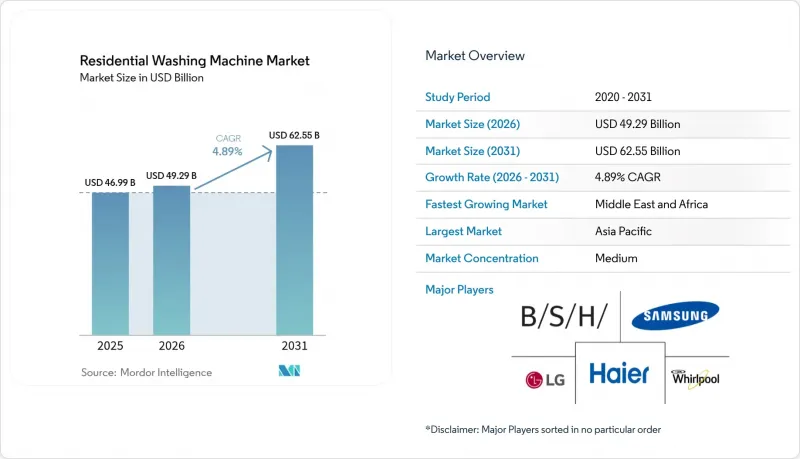
This report is Segmented Into by Type (Front Load, Top Load, and Twin Tub), by Technology (Fully-Automatic, Semi-Automatic), by Connectivity (Smart Connected, Conventional), by Distribution Channel (Multi-Brand Stores, Exclusive Brand Outlets, and More), and by Geography (North America, South America, and More). The Market Forecasts are Provided in Terms of Value (USD).
Global Residential Washing Machine Market Trends and Insights
Urbanization-Driven Demand Surge
Rapid city growth concentrates new households in high-rise apartments, where shared laundry rooms cannot scale. Chinese factories produced 79.9 million units in 2024, 16.4% higher year-over-year, while domestic sales reached 40.1 million units as first-time urban buyers entered the market . Apartment residents pay premiums for low-noise motors, slim depths, and stackability, accelerating premiumization across the residential washing machine market. Front-load designs thrive because they fit tight spaces and enable vertical stacking with heat-pump dryers. Local governments that restrict balcony drying further boost demand for high-spin machines that shorten indoor drying time. As a result, compact but feature-rich models capture rising wallet share among new city dwellers.
Rising Disposable Income & Convenience Focus
Middle-class expansion shifts preferences from basic spin-dryers to feature-rich models with AI cycles, Wi-Fi alerts, and fabric-care analytics. Larger drums that handle weekly loads reduce time spent on chores, meeting the lifestyle expectations of dual-income households. Manufacturers, therefore, introduce tiered line-ups to capture broader consumer surplus and drive margin growth inside the residential washing machine market. World Bank data confirm sustained disposable-income growth in emerging economies, lifting demand for premium appliances that were formerly considered luxuries . Brand prestige also matters more, with consumers equating smart dashboards and brushed-steel finishes with social status. Manufacturers capture surplus through tiered line-ups that migrate successful flagship features down to mid-price ranges while keeping margins intact.
Supply-Chain & Geopolitical Disruptions
A 2024 quartz-mine shutdown in North Carolina squeezed semiconductor output, delaying smart-board deliveries that premium washers rely on . Red Sea freight rerouting added two weeks to Asia-Europe transits and raised container rates, eroding appliance margins. Political tensions in the South China Sea amplify risk, as roughly one-third of machine components sail through contested waters. Manufacturers respond with multi-sourcing and buffer inventory, but the extra working capital burdens balance sheets. Persistent logistics volatility may also deter aggressive promotional campaigns if companies fear stock-outs during peak seasons.
Other drivers and restraints analyzed in the detailed report include:
- Energy-Efficient & Smart Appliance Preference
- Compact All-In-One Washer-Dryer Adoption
- High Energy-Consumption Sustainability Backlash
For complete list of drivers and restraints, kindly check the Table Of Contents.
Segment Analysis
Front-load washers held 51.23% share of the residential washing machine market in 2025 and advanced at a 5.72% CAGR. Their gentler wash action, water savings, and stackability appeal to dense-housing residents. Samsung's AI-enabled front loaders illustrate how premium software offsets higher prices.
Top-load designs remain popular in rural settings where lower upfront cost and quick-open lids matter, but their unit share gradually declines. Consequently, the residential washing machine market size tied to front-load units remains the largest contributor to global revenue through 2031.
Fully automatic machines captured 72.30% of the residential washing machine market in 2025 and grew at a 5.12% CAGR. LG's AI Wash adapts drum motion without user input. Remote alerts, auto-dose canisters, and voice control reinforce value perception.
Semi-automatic designs still appeal where the electricity supply is intermittent or budgets are tight. However, narrowing price gaps and growing consumer awareness of fabric protection keep funneling volume toward automatic platforms. Consequently, the residential washing machine market size linked to fully automatic units should widen its revenue gap over semi-automatic alternatives during the forecast horizon.
Complete Report Scope:
- By Product
- Front Load
- With Dryers
- Without Dryers
- Top Load
- With Dryers
- Without Dryers
- Twin Tub
- Front Load
- By Technology
- Fully Automatic
- Semi-Automatic
- By Capacity
- Small (Below 6 Kg)
- Medium (6 to 8 Kg)
- Large (Above 8 Kg)
- By Connectivity
- Smart Connected
- Conventional
- By Distribution Channel
- Multi-brand Stores
- Exclusive Brand Outlets
- Online
- Other Distribution Channels
- By Geography
- North America
- Canada
- United States
- Mexico
- South America
- Brazil
- Peru
- Chile
- Argentina
- Rest of South America
- Asia Pacific
- India
- China
- Japan
- Australia
- South Korea
- South East Asia (Singapore, Malaysia, Thailand, Indonesia, Vietnam, and Philippines)
- Rest of Asia Pacific
- Europe
- United Kingdom
- Germany
- France
- Spain
- Italy
- BENELUX (Belgium, Netherlands, and Luxembourg)
- NORDICS (Denmark, Finland, Iceland, Norway, and Sweden)
- Rest of Europe
- Middle East And Africa
- United Arab of Emirates
- Saudi Arabia
- South Africa
- Nigeria
- Rest of Middle East And Africa
- North America
Geography Analysis
Asia-Pacific owns 45.60% of the residential washing machine market and remains the global production hub. Chinese output reached 79.958 million units in 2024 as exports rebounded to Belt and Road Initiative partners. Manufacturing density offers cost leadership but exposes producers to shipping-route volatility.
The Middle East & Africa posts the highest 6.44% CAGR thanks to urbanization, infrastructure upgrades, and disposable-income growth, with regional GDP expected to rise 3.3% in 2025. Early movers that invest in localized after-sales networks lock in loyalty before competition intensifies.
North America and Europe remain mature but profitable, guided by tight efficiency rules that reward R&D-heavy incumbents. Consumers in these markets prioritize smart features, hygienic steam cycles, and eco-certifications, sustaining premium average selling prices.
- Whirlpool Corporation
- Haier Group Corp.
- LG Electronics Inc.
- Samsung Electronics Co. Ltd.
- BSH Home Appliances Group
- Panasonic Corp.
- Electrolux AB
- IFB Industries Ltd.
- Hitachi Ltd.
- Toshiba Corp.
- Midea Group
- GE Appliances
- Arcelik A.S.
- Hisense Co. Ltd.
- Sharp Corp.
- Godrej & Boyce
- Miele & Cie. KG
- Daewoo Electronics
- Smeg S.p.A.
- Kenmore (Transformco)
- Gree Electric Appliances Inc.
- Fisher & Paykel Appliances
- Candy Hoover Group
- Vestel White Goods
- Qingdao Hisense Electric Co. Ltd.
Additional Benefits:
- The market estimate (ME) sheet in Excel format
- 3 months of analyst support
TABLE OF CONTENTS
1 Introduction
- 1.1 Study Assumptions & Market Definition
- 1.2 Scope of the Study
2 Research Methodology
3 Executive Summary
4 Market Landscape
- 4.1 Market Overview
- 4.2 Market Drivers
- 4.2.1 Urbanization-Driven Demand Surge
- 4.2.2 Rising Disposable Income & Convenience Focus
- 4.2.3 Energy-Efficient & Smart Appliance Preference
- 4.2.4 Compact All-In-One Washer-Dryer Adoption
- 4.2.5 Government Energy-Rebate Replacement Programs
- 4.3 Market Restraints
- 4.3.1 Supply-Chain/Geopolitical Disruptions
- 4.3.2 High Energy-Consumption Sustainability Backlash
- 4.3.3 On-Demand Laundry Service Cannibalisation
- 4.4 Industry Value Chain Analysis
- 4.5 Porter's Five Forces Analysis
- 4.5.1 Threat of New Entrants
- 4.5.2 Bargaining Power of Suppliers
- 4.5.3 Bargaining Power of Buyers
- 4.5.4 Threat of Substitutes
- 4.5.5 Competitive Rivalry
- 4.6 Insights into the Latest Trends and Innovations in the Market
- 4.7 Insights on Recent Developments (New Product Launches, Strategic Initiatives, Investments, Partnerships, JVs, Expansion, M&As, etc.) in the Market
5 Market Size & Growth Forecasts (Value)
- 5.1 By Product
- 5.1.1 Front Load
- 5.1.1.1 With Dryers
- 5.1.1.2 Without Dryers
- 5.1.2 Top Load
- 5.1.2.1 With Dryers
- 5.1.2.2 Without Dryers
- 5.1.3 Twin Tub
- 5.1.1 Front Load
- 5.2 By Technology
- 5.2.1 Fully Automatic
- 5.2.2 Semi-Automatic
- 5.3 By Capacity
- 5.3.1 Small (Below 6 Kg)
- 5.3.2 Medium (6 to 8 Kg)
- 5.3.3 Large (Above 8 Kg)
- 5.4 By Connectivity
- 5.4.1 Smart Connected
- 5.4.2 Conventional
- 5.5 By Distribution Channel
- 5.5.1 Multi-brand Stores
- 5.5.2 Exclusive Brand Outlets
- 5.5.3 Online
- 5.5.4 Other Distribution Channels
- 5.6 By Geography
- 5.6.1 North America
- 5.6.1.1 Canada
- 5.6.1.2 United States
- 5.6.1.3 Mexico
- 5.6.2 South America
- 5.6.2.1 Brazil
- 5.6.2.2 Peru
- 5.6.2.3 Chile
- 5.6.2.4 Argentina
- 5.6.2.5 Rest of South America
- 5.6.3 Asia Pacific
- 5.6.3.1 India
- 5.6.3.2 China
- 5.6.3.3 Japan
- 5.6.3.4 Australia
- 5.6.3.5 South Korea
- 5.6.3.6 South East Asia (Singapore, Malaysia, Thailand, Indonesia, Vietnam, and Philippines)
- 5.6.3.7 Rest of Asia Pacific
- 5.6.4 Europe
- 5.6.4.1 United Kingdom
- 5.6.4.2 Germany
- 5.6.4.3 France
- 5.6.4.4 Spain
- 5.6.4.5 Italy
- 5.6.4.6 BENELUX (Belgium, Netherlands, and Luxembourg)
- 5.6.4.7 NORDICS (Denmark, Finland, Iceland, Norway, and Sweden)
- 5.6.4.8 Rest of Europe
- 5.6.5 Middle East And Africa
- 5.6.5.1 United Arab of Emirates
- 5.6.5.2 Saudi Arabia
- 5.6.5.3 South Africa
- 5.6.5.4 Nigeria
- 5.6.5.5 Rest of Middle East And Africa
- 5.6.1 North America
6 Competitive Landscape
- 6.1 Market Concentration
- 6.2 Strategic Moves
- 6.3 Market Share Analysis
- 6.4 Company Profiles (includes Global-Level Overview, Market-Level Overview, Core Segments, Financials, Strategic Information, Market Rank/Share, Products & Services, Recent Developments)
- 6.4.1 Whirlpool Corporation
- 6.4.2 Haier Group Corp.
- 6.4.3 LG Electronics Inc.
- 6.4.4 Samsung Electronics Co. Ltd.
- 6.4.5 BSH Home Appliances Group
- 6.4.6 Panasonic Corp.
- 6.4.7 Electrolux AB
- 6.4.8 IFB Industries Ltd.
- 6.4.9 Hitachi Ltd.
- 6.4.10 Toshiba Corp.
- 6.4.11 Midea Group
- 6.4.12 GE Appliances
- 6.4.13 Arcelik A.S.
- 6.4.14 Hisense Co. Ltd.
- 6.4.15 Sharp Corp.
- 6.4.16 Godrej & Boyce
- 6.4.17 Miele & Cie. KG
- 6.4.18 Daewoo Electronics
- 6.4.19 Smeg S.p.A.
- 6.4.20 Kenmore (Transformco)
- 6.4.21 Gree Electric Appliances Inc.
- 6.4.22 Fisher & Paykel Appliances
- 6.4.23 Candy Hoover Group
- 6.4.24 Vestel White Goods
- 6.4.25 Qingdao Hisense Electric Co. Ltd.
7 Market Opportunities & Future Outlook
- 7.1 AI-Powered Smart Washing Systems in the Residential Market

