PUBLISHER: Mordor Intelligence | PRODUCT CODE: 2113361

PUBLISHER: Mordor Intelligence | PRODUCT CODE: 2113361
Japan Laundry Appliances - Market Share Analysis, Industry Trends & Statistics, Growth Forecasts (2026 - 2031)
According to Mordor Intelligence, the Japan laundry appliances market size reached USD 3.54 billion in 2026 and is forecast to reach USD 3.92 billion by 2031, reflecting a CAGR of 2.07%.
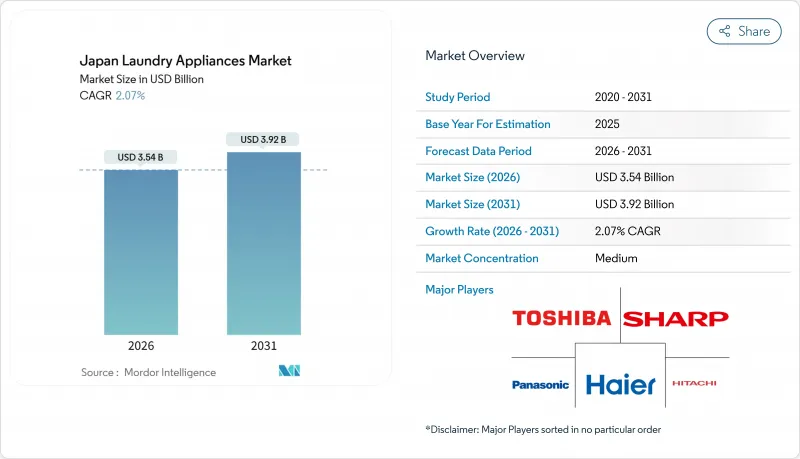
This report is Segmented by Product Type (Washing Machines, Clothes Dryers, Others), Technology (Fully Automatic, Semi-Automatic/Manual), Load Capacity (Below 6 Kg, 6-8 Kg, Above 8 Kg), Distribution Channel (Multi-Brand Stores, Exclusive Brand Outlets, Online, Other Distribution Channels), and Geography (Kanto, Kansai, Chubu, Rest of Japan). Market Forecasts are Provided in Terms of Value (USD).
Japan Laundry Appliances Market Trends and Insights
Rapid Adoption of Energy-Efficient Appliances Under Top Runner Standards
The Top Runner Program sets performance benchmarks that manufacturers must reach within defined timelines, which results in continuous redesign of motors, heat exchangers, and control systems to stay compliant. In 2024, METI refined energy-efficiency targets for washing machines and dryers, reinforcing an upgrade cycle that favors newer, more power-thrifty models. Heat-pump-based configurations, as seen in Hitachi's 2024 front-load portfolio, reduce electricity consumption by significant double-digit percentages compared with older heater-based units and eliminate water use during the drying phase. Retail programs and in-store merchandising actively highlight compliant models, which influences shopper choices within multi-brand showrooms where side-by-side comparisons are common. Local rebate schemes such as Tokyo's Zero Emission Point have added momentum by lowering out-of-pocket costs for households replacing pre-Top Runner era units, which brings forward planned purchases in dense urban clusters.
Growing Single-Person Households Driving Compact Washer-Dryer Demand
Single-person households now account for a large share of Japan's households, representing about one-third of all households and making them the largest household type in the country. This demographic shift reflects broader trends, including fewer families with children and a continuing decline in average household size, which supports demand for compact footprints, integrated drying, and feature sets tuned to small loads. Design preferences concentrate around narrow-width machines that fit standard apartment alcoves, with capacity and cycle options aligned to fewer garments and quick turnarounds after work or school. Product roadmaps from leading brands have focused on slimmer enclosures and intelligent wash-dry programs that shorten cycle times without sacrificing care for delicates. New models in 2025 and 2026 embed connected controls and tailored presets that match the daily routines of solo residents, strengthening the appeal of compact washer-dryer combos in metropolitan housing. The growing prevalence of individuals living alone, particularly in Tokyo and Osaka cores, increases demand for appliances that maximize space efficiency and convenience.
Saturated Household Penetration Limits Unit Growth
Ownership levels across income brackets leave little room for incremental unit additions, which emphasizes replacement timing and feature-led upgrades. Replacement intervals lengthen when consumers focus on durability and serviceability, which moderates annual unit volumes even during promotional periods. Rural areas with older populations extend usage further, which softens the regional contribution to national growth. Manufacturers adapt by improving energy performance and connectivity while keeping form factors familiar, which encourages upgrades without forcing changes to installation footprints. The Japan laundry appliances market, therefore, grows through specification improvements and targeted promotions rather than large swings in installed base.
Other drivers and restraints analyzed in the detailed report include:
- Government Eco-Point Subsidies Accelerating Replacement Sales
- Rising Demand for Smart, IoT-Connected Washers with Predictive Maintenance
- Aging Condominium Plumbing Limits Large-Capacity Installations
For complete list of drivers and restraints, kindly check the Table Of Contents.
Segment Analysis
Washing machines accounted for 70.83% of revenue in 2025, which reflects the depth of the installed base and recurring replacement behavior in the Japan laundry appliances market. Clothes dryers hold a smaller base but show the fastest growth at a 2.91% CAGR as heat-pump technology cuts electricity consumption and as drying becomes a priority in humid months. The washing machine category continues to add capacity options and cleaning features that improve fabric care while reducing water use. Heat-pump dryers increasingly appeal to households that need gentle cycles at lower temperatures, which helps maintain textile quality. Taken together, these shifts reinforce a transition toward integrated combos and more efficient standalone formats across households in dense urban regions.
Feature differentiation continues to focus on hygiene, energy performance, and usability that fits small spaces common in metro apartments. Brands are investing in antimicrobial cycles, auto-clean routines, and drum designs that reduce residue, which appeals to households with infants or elderly members. Vendor roadmaps show continued improvements in cleaning algorithms, fabric sensors, and convenience functions that reduce maintenance. As model updates roll out, certified efficiency remains prominent in retailer displays and online descriptions. These product-level changes sustain incremental pricing power at the premium end while meeting the everyday needs of the Japan laundry appliances market.
Fully automatic machines held 81.93% of sales in 2025 and are projected to expand at a 2.13% CAGR through 2031, making this the largest and fastest-growing technology tier in the Japan laundry appliances market. Growth in this segment is driven by convenience features, load sensing, and connected apps that simplify daily routines. Newer ranges add predictive maintenance alerts and guided troubleshooting, which reduce unexpected service calls. Rural segments continue to purchase simpler machines where electrical capacity or ease of repair remains a deciding factor. The technology mix, therefore, reflects both high-tech adoption in metros and enduring preference for straightforward controls in select rural prefectures.
Semi-automatic and manual formats remain in use where households value mechanical simplicity and budget pricing, which helps maintain a modest share for these models. Manufacturers sustain limited portfolios that target this need while prioritizing R&D around fully automatic ranges. Efficiency rules under the Top Runner guide motor choices and energy performance in new models, which pushes inverter designs into mainstream lines. Voice support and smart-home integration are rising in metropolitan sales, where buyers value remote control and monitoring in multi-device ecosystems. Over time, automation and connectivity anchor the premium and mid-tier, while basic functionality continues to serve select regional niches in the Japan laundry appliances industry.
Complete Report Scope:
- By Product Type
- Washing Machines
- Clothes Dryers
- Others(Garment Steamers, Electric Irons, Laundry Dehumidifiers)
- By Technology
- Fully Automatic
- Semi-Automatic /Manual
- By Load Capacity
- Below 6 kg
- 6-8 kg
- Above 8 kg
- By Distribution Channel
- Multi-brand Stores
- Exclusive Brand Outlets
- Online
- Other Distribution Channels
- By Region
- Kanto
- Kansai
- Chubu
- Rest of Japan
List of Companies Covered in this Report:
- Panasonic Corporation
- Hitachi Global Life Solutions, Inc.
- Toshiba Lifestyle Products & Services Corporation
- Sharp Corporation
- Mitsubishi Electric Corporation
- Haier Japan Holdings Co., Ltd. (AQUA)
- LG Electronics Japan Inc.
- Samsung Electronics Co., Ltd.
- Whirlpool Corporation
- Electrolux AB
- Bosch Home Appliances (BSH Hausgerate GmbH)
- Miele & Cie. KG
- Arcelik A.S. (Beko)
- Alliance Laundry Systems LLC
- Hisense Co., Ltd.
- Fisher & Paykel Appliances
- Vestel
- Sanyo (Panasonic brand)
- Daewoo Electronics
- Godrej & Boyce
Additional Benefits:
- The market estimate (ME) sheet in Excel format
- 3 months of analyst support
TABLE OF CONTENTS
1 Introduction
- 1.1 Study Assumptions & Market Definition
- 1.2 Scope of the Study
2 Research Methodology
3 Executive Summary
4 Market Landscape
- 4.1 Market Overview
- 4.2 Market Drivers
- 4.2.1 Rapid Adoption of Energy-Efficient Appliances Under Top Runner Standards
- 4.2.2 Growing Single-Person Households Driving Compact Washer-Dryer Demand
- 4.2.3 Government Eco-Point Subsidies Accelerating Replacement Sales
- 4.2.4 Subscription-Based Appliance Rentals Increasing Replacement Cycles
- 4.2.5 Antimicrobial Drum Coatings Appealing to Hygiene-Conscious Consumers
- 4.2.6 Rising Demand for Smart, IoT-Connected Washers With Predictive Maintenance
- 4.3 Market Restraints
- 4.3.1 Saturated Household Penetration Limits Unit Growth
- 4.3.2 Price Sensitivity Amid Stagnant Real Wages
- 4.3.3 Aging Condominium Plumbing Limits Large-Capacity Installations
- 4.3.4 Rising Demand for Smart, IoT-Connected Washers With Predictive Maintenance
- 4.4 Industry Value Chain Analysis
- 4.5 Regulatory Landscape
- 4.6 Porter's Five Forces
- 4.6.1 Threat of New Entrants
- 4.6.2 Bargaining Power of Suppliers
- 4.6.3 Bargaining Power of Buyers
- 4.6.4 Threat of Substitutes
- 4.6.5 Intensity of Competitive Rivalry
- 4.7 Insights into the Latest Trends and Innovations in the Market
- 4.8 Insights on Recent Developments (New Product Launches, Strategic Initiatives, Investments, Partnerships, JVs, Expansion, M&As, etc.) in the Market
5 Market Size & Growth Forecasts
- 5.1 By Product Type
- 5.1.1 Washing Machines
- 5.1.2 Clothes Dryers
- 5.1.3 Others(Garment Steamers, Electric Irons, Laundry Dehumidifiers)
- 5.2 By Technology
- 5.2.1 Fully Automatic
- 5.2.2 Semi-Automatic /Manual
- 5.3 By Load Capacity
- 5.3.1 Below 6 kg
- 5.3.2 6-8 kg
- 5.3.3 Above 8 kg
- 5.4 By Distribution Channel
- 5.4.1 Multi-brand Stores
- 5.4.2 Exclusive Brand Outlets
- 5.4.3 Online
- 5.4.4 Other Distribution Channels
- 5.5 By Region
- 5.5.1 Kanto
- 5.5.2 Kansai
- 5.5.3 Chubu
- 5.5.4 Rest of Japan
6 Competitive Landscape
- 6.1 Strategic Moves
- 6.2 Market Share Analysis
- 6.3 Company Profiles (includes Global level Overview, Market level overview, Core Segments, Financials as available, Strategic Information, Market Rank/Share for key companies, Products & Services, and Recent Developments)
- 6.3.1 Panasonic Corporation
- 6.3.2 Hitachi Global Life Solutions, Inc.
- 6.3.3 Toshiba Lifestyle Products & Services Corporation
- 6.3.4 Sharp Corporation
- 6.3.5 Mitsubishi Electric Corporation
- 6.3.6 Haier Japan Holdings Co., Ltd. (AQUA)
- 6.3.7 LG Electronics Japan Inc.
- 6.3.8 Samsung Electronics Co., Ltd.
- 6.3.9 Whirlpool Corporation
- 6.3.10 Electrolux AB
- 6.3.11 Bosch Home Appliances (BSH Hausgerate GmbH)
- 6.3.12 Miele & Cie. KG
- 6.3.13 Arcelik A.S. (Beko)
- 6.3.14 Alliance Laundry Systems LLC
- 6.3.15 Hisense Co., Ltd.
- 6.3.16 Fisher & Paykel Appliances
- 6.3.17 Vestel
- 6.3.18 Sanyo (Panasonic brand)
- 6.3.19 Daewoo Electronics
- 6.3.20 Godrej & Boyce
7 Market Opportunities & Future Outlook
- 7.1 AI-driven personalized fabric-care premium offerings
- 7.2 Micro-laundromat chains near urban railway stations

