PUBLISHER: Mordor Intelligence | PRODUCT CODE: 2113337

PUBLISHER: Mordor Intelligence | PRODUCT CODE: 2113337
United States Vehicle Rental - Market Share Analysis, Industry Trends & Statistics, Growth Forecasts (2026 - 2031)
According to Mordor Intelligence, the United States vehicle rental market size is expected to grow from USD 48.48 billion in 2025 to USD 51.13 billion in 2026 and is forecast to reach USD 66.72 billion by 2031 at a 5.47% CAGR over 2026-2031.
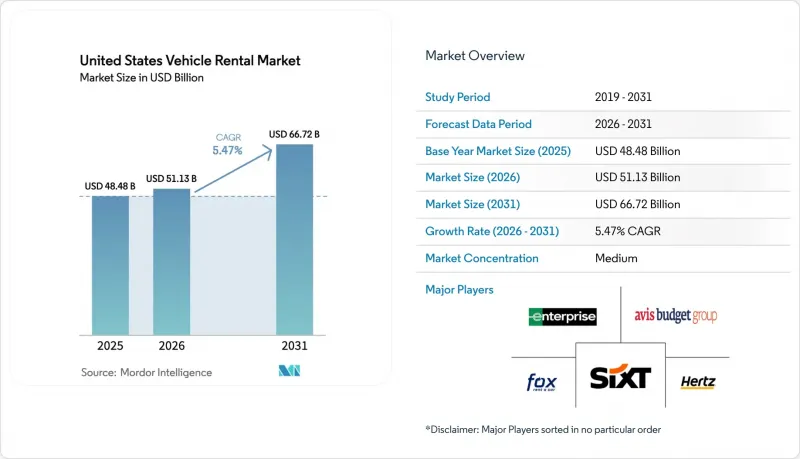
This report is Segmented by Application (Leisure and Tourism and Business and Corporate), Vehicle Type (Passenger Cars, Light Commercial Vehicles, and Medium and Heavy-Duty Commercial Vehicles), Booking Channel (Online and Offline), Rental Duration (Short-Term and Long-Term), Propulsion, Service Model, and Geography. The Market Forecasts are Provided in Terms of Value (USD).
United States Vehicle Rental Market Trends and Insights
Surge in Domestic Road-Trip/Leisure Demand
In 2025, U.S. travelers, opting for national parks and coastal drives over international vacations, drove a notable increase in domestic person-trips compared to pre-pandemic levels . While daily rental rates remained steady, a longer average rental duration significantly boosted revenue per transaction. With a substantial share of leisure rentals concentrated in key states like Florida, California, and Texas, operators strategically shifted their inventory towards sunbelt airports during peak quarters. The growing preference for SUVs and minivans, which typically generate higher revenue, enhanced fleet mix economics. However, this shift introduced seasonal volatility, particularly during the less busy quarters when utilization rates dropped. To navigate these challenges, companies have turned to dynamic pricing algorithms and real-time telematics for cross-regional transfers.
Rapid Growth of Online & Mobile Booking Channels
In 2025, digital bookings constituted a significant majority of transactions in the U.S. car rental market, showing a notable increase from the previous year. This growth can be attributed to mobile apps, like those of Enterprise Holdings, which have significantly reduced booking times and driven a considerable rise in ancillary revenue . Meanwhile, Hertz's strategic move to integrate rental options within the Uber app has successfully converted a notable portion of Uber's users for multi-day rentals, highlighting the increasingly blurred lines between ride-hailing and car rentals due to platform convergence. While digital channels have substantially lowered customer acquisition costs, incidents such as a ransomware attack that temporarily disrupted operations for a mid-tier operator in 2024 emphasize the critical need for robust ISO 27001-grade cybersecurity defenses.
Persistent New-Vehicle Supply Constraints & High CAPEX
In 2025, U.S. light-vehicle production experienced a notable decline compared to pre-pandemic levels. As a result, OEMs prioritized retail channels, achieving significantly higher transaction prices compared to the discounts offered in fleet sales. Hertz reported a considerable increase in average acquisition costs, with the fleet's average age extending, leading to a noticeable rise in monthly maintenance expenses per vehicle. Meanwhile, Avis Budget's bond issuance in May 2025, set at a high-interest rate, highlights the intensified capital demands for fleet renewals amid rising interest rates.
Other drivers and restraints analyzed in the detailed report include:
- OEM-Backed Electrification of Rental Fleets
- Peer-to-Peer Supply Expansion & Price Discovery
- Modal Substitution by Ride-Hailing & Subscription MaaS
For complete list of drivers and restraints, kindly check the Table Of Contents.
Segment Analysis
Leisure and tourism captured 56.71% of the United States car rental market in 2025 as remote work let families extend vacations, pushing summer utilization above four-fifths in Florida and California. Business and corporate clients, though smaller, will outpace leisure at a 5.49% CAGR because firms are substituting ownership with flexible rentals that trim fixed fleet costs by one-fourth. Such a strategy not only streamlines expenses but also smooths out seasonal fluctuations: leisure rentals peak during the summer months, while corporate demand bolsters occupancy during the beginning and end of the year. Premium SUVs and convertibles command higher rental rates, pushing the average daily revenue upward compared to the previous year.
Avis Budget witnessed a significant surge in corporate subscriptions, especially from tech giants in Austin and San Francisco. These firms are consolidating their hybrid workforce, leading to fewer but extended client engagements. Another resilient segment, insurance replacements, saw steady growth. This growth comes as vehicle repair timelines are extended, prompting operators to allocate lower-cost fleets, ensuring margins on fixed-rate contracts. The landscape of EV adoption reveals a stark divide: leisure renters exhibit a much greater inclination to trial EVs for shorter trips. In contrast, corporate clients prefer traditional ICE vehicles, prioritizing the need for swift refueling.
Passenger cars held 63.37% of the United States car rental market size in 2025 and will expand at the leading 5.57% CAGR because sedans and compact SUVs balance fuel economy, acquisition cost, and airport space fees. Light commercial vehicles are growing at a minimal rate annually as e-commerce firms rent vans and pickups for flexible last-mile capacity without large capital outlays. Enterprise added 18,000 Ford F-150s in 2024 to meet contractor demand, realizing slightly higher revenue per vehicle but accepting faster depreciation.
Regional preferences diverge: compact sedans dominate in California and the Northeast, where fuel costs and parking constraints are acute, while pickups and full-size SUVs lead in Texas and Florida, where trip distances and family travel justify size premiums. Commercial electrification lags; only 3% of rented vans were EVs in 2024, but Ford E-Transit pilots in dense urban routes signal incremental change.
Complete Report Scope:
- By Application
- Leisure and Tourism
- Business and Corporate
- By Vehicle Type
- Passenger Cars
- Light Commercial Vehicles
- Medium and Heavy-duty Commercial Vehicles
- By Booking Channel
- Online
- Offline
- By Rental Duration
- Short-Term
- Long-Term
- By Propulsion
- ICE Vehicles
- Battery-Electric Vehicles
- Hybrid-Electric Vehicles
- By Service Model
- Traditional Corporate Fleets
- Peer-to-Peer Platforms
List of Companies Covered in this Report:
- Enterprise Holdings Inc.
- Hertz Global Holdings Inc.
- Avis Budget Group Inc.
- Sixt SE
- Fox Rent A Car
- Ace Rent A Car
- Advantage Rent A Car
- U-Save Car & Truck Rental
- Turo Inc.
- Getaround Inc.
- Kyte
- HyreCar Inc.
Additional Benefits:
- The market estimate (ME) sheet in Excel format
- 3 months of analyst support
TABLE OF CONTENTS
1 Introduction
- 1.1 Study Assumptions & Market Definition
- 1.2 Scope of the Study
2 Research Methodology
3 Executive Summary
4 Market Landscape
- 4.1 Market Overview
- 4.2 Market Drivers
- 4.2.1 Surge in Domestic Road-Trip/Leisure Demand
- 4.2.2 Rapid Growth of Online & Mobile Booking Channels
- 4.2.3 Flexible Fleet-Leasing Demand from Hybrid-Work Corporates
- 4.2.4 OEM-Backed Electrification of Rental Fleets
- 4.2.5 Peer-to-Peer Supply Expansion & Price Discovery
- 4.2.6 Telematics-Driven OPEX Optimisation
- 4.3 Market Restraints
- 4.3.1 Persistent New-Vehicle Supply Constraints & High CAPEX
- 4.3.2 Modal Substitution by Ride-Hailing & Subscription MaaS
- 4.3.3 Residual-Value Risk from Low-Priced Chinese EV Imports
- 4.3.4 Escalating Airport Concession & Local Taxation Costs
- 4.4 Value / Supply-Chain Analysis
- 4.5 Regulatory Landscape
- 4.6 Technological Outlook
- 4.7 Porter's Five Forces
- 4.7.1 Bargaining Power of Suppliers
- 4.7.2 Bargaining Power of Buyers
- 4.7.3 Threat of New Entrants
- 4.7.4 Threat of Substitutes
- 4.7.5 Competitive Rivalry
5 Market Size & Growth Forecasts (Value (USD))
- 5.1 By Application
- 5.1.1 Leisure and Tourism
- 5.1.2 Business and Corporate
- 5.2 By Vehicle Type
- 5.2.1 Passenger Cars
- 5.2.2 Light Commercial Vehicles
- 5.2.3 Medium and Heavy-duty Commercial Vehicles
- 5.3 By Booking Channel
- 5.3.1 Online
- 5.3.2 Offline
- 5.4 By Rental Duration
- 5.4.1 Short-Term
- 5.4.2 Long-Term
- 5.5 By Propulsion
- 5.5.1 ICE Vehicles
- 5.5.2 Battery-Electric Vehicles
- 5.5.3 Hybrid-Electric Vehicles
- 5.6 By Service Model
- 5.6.1 Traditional Corporate Fleets
- 5.6.2 Peer-to-Peer Platforms
6 Competitive Landscape
- 6.1 Market Concentration
- 6.2 Strategic Moves
- 6.3 Market Share Analysis
- 6.4 Company Profiles (includes Global Level Overview, Market Level Overview, Core Segments, Financials as Available, Strategic Information, Market Rank/Share for Key Companies, Products and Services, SWOT Analysis, and Recent Developments)
- 6.4.1 Enterprise Holdings Inc.
- 6.4.2 Hertz Global Holdings Inc.
- 6.4.3 Avis Budget Group Inc.
- 6.4.4 Sixt SE
- 6.4.5 Fox Rent A Car
- 6.4.6 Ace Rent A Car
- 6.4.7 Advantage Rent A Car
- 6.4.8 U-Save Car & Truck Rental
- 6.4.9 Turo Inc.
- 6.4.10 Getaround Inc.
- 6.4.11 Kyte
- 6.4.12 HyreCar Inc.
7 Market Opportunities & Future Outlook
- 7.1 White-space & Unmet-need Assessment

